

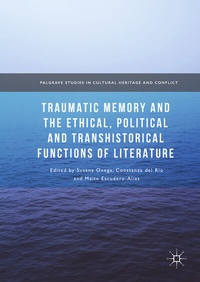
Traumatic Memory and the Ethical, Political and Transhistorical Functions of Literature
Description

This volume addresses the construction and artistic representation of traumatic memories in the contemporary Western world from a variety of inter- and trans-disciplinarity critical approaches and perspectives, ranging from the cultural, political, historical, and ideological to the ethical and aesthetic, and distinguishing between individual, collective, and cultural traumas. The chapters introduce complementary concepts from diverse thinkers including Cathy Caruth, Jacques Derrida, Judith Butler, Homi Bhabha, Abraham and Torok, and Joyce Carol Oates; they also draw from fields of study such as Memory Studies, Theory of Affects, Narrative and Genre Theory, and Cultural Studies.
Traumatic Memory and the Political, Economic, and Transhistorical Functions of Literature addresses trauma as a culturally embedded phenomenon and deconstructs the idea of trauma as universal, transhistorical, and abstract.
Reviews / Votes
"The volume makes a very welcome contribution to the growing field of postcolonial trauma theory with a number of excellent individual contributions, well-supported by a focus on detailed close reading." (Alexander Hope, Miscelánea, Vol. 60, 2019)More details
Other editions
Additional editions
Persons
Susana Onega is Professor of English Literature at the University of Zaragoza. She has written on the work of contemporary writers, narrative theory, and ethics and trauma; and is the author of five monographs, including Form and Meaning in the Novels of John Fowles (1989, Winner of the Enrique García Díez Research Award), Metafiction and Myth in the Novels of Peter Ackroyd (1999), and Jeanette Winterson (2006, Shortlisted for the European Society for the Study of English Book Award, 2008).
Constanza del Río is Senior Lecturer in British and Irish Literature at the University of Zaragoza. Her research centers on contemporary Irish fiction, narrative and critical theory, and popular narrative genres. She is co-editor of Memory, Imagination and Desire in Contemporary Anglo-American Literature and Film (2004).
Maite Escudero-Alías is Senior Lecturer at the University of Zaragoza, where she teaches English Literature. Her main research interests centre on contemporary literary criticism, feminism, queer and affect theory in literature, and culture. She is the author of Long Live the King: A Genealogy of Performative Genders (2009) and has published in the Journal of Gender Studies, The Journal of Popular Culture, Journal of Lesbian Studies, The Journal of Transatlantic Studies, and Journal of International Women's Studies, among others.
Content
Introduction.- History Become Memory: The Dante Sexcentenary and World War I in the German Press.- On Poetic Violence: W. B. Yeats's "Leda and the Swan" and César Vallejo's "Vusco volvvver de golpe el golpe.".- Holocaust Trauma between the National and the Transnational: Reflections on History's "Broken Mirror.".- Wandering Memory, Wandering Jews: Generic Hybridity and the Construction of Jewish Memory in Linda Grant's works.- .- Self-representation and the Impossibility of (Re) membering in Jamaica Kincaid's The Autobiography of My Mother.- Trauma, Screen Memories, Safe Spaces, and Productive Melancholia in Toni Morrison's Home.- Conclusion.
