

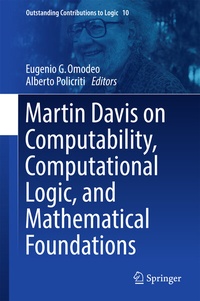
Martin Davis on Computability, Computational Logic, and Mathematical Foundations
Description

This book presents a set of historical recollections on the work of Martin Davis and his role in advancing our understanding of the connections between logic, computing, and unsolvability. The individual contributions touch on most of the core aspects of Davis' work and set it in a contemporary context. They analyse, discuss and develop many of the ideas and concepts that Davis put forward, including such issues as contemporary satisfiability solvers, essential unification, quantum computing and generalisations of Hilbert's tenth problem.
The book starts out with a scientific autobiography by Davis, and ends with his responses to comments included in the contributions. In addition, it includes two previously unpublished original historical papers in which Davis and Putnam investigate the decidable and the undecidable side of Logic, as well as a full bibliography of Davis' work. As a whole, this book shows how Davis' scientific work lies at the intersection of computability,theoretical computer science, foundations of mathematics, and philosophy, and draws its unifying vision from his deep involvement in Logic.
Reviews / Votes
"It is welcome indeed to have the book under review on my desk and in my possession, particularly given that it's something of a Festschrift, sporting all sorts of goodies. . To real logicians or even to folks like me . this is a wonderful book to have." (Michael Berg, MAA Reviews, January 2018)More details
Other editions
Additional editions
Content
Chapter 1. My Life as a Logician (Martin Davis).- Chapter 2. Martin Davis and Hilbert's Tenth Problem (Yuri Matiyasevich).- Chapter 3. Extensions of Hilbert's Tenth Problem: Definability and Decidability in Number Theory (Alexandra Shlapentokh).- Chapter 4. A Story of Hilbert's Tenth Problem (Laura Elena Morales Guerrero).- Chapter 5. Hyperarithmetical Sets (Yiannis N. Moschovakis).- Chapter 6. Honest Computability and Complexity (Udi Boker and Nachum Dershowitz).- Chapter 7. Why Post Did [Not] Have Turing's Thesis (Wilfried Sieg).- Chapter 8. On Quantum Computation, Anyons, and Categories (Andreas Blass).
