

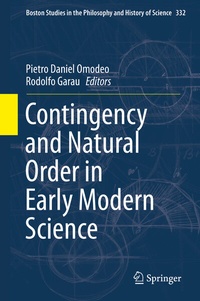
Contingency and Natural Order in Early Modern Science
Description

Contingency is intrinsic to scientific practice. Whether observing the behaviour of a photon, diagnosing a patient, or calculating the orbit of a distant planet, scientists face the unavoidable challenge of dealing with data that differ from their models and expectations. However, epistemological categories are not fixed in time. Indeed, there is something fundamentally different in the way an Aristotelian natural philosopher defined a wonder or a "monstrous" birth as "contingent", a modern scientist defines the unexpected result of an experiment, and a quantum physicist the behavior of a photon. Although to each inquirer these instances appeared self-evidently contingent, each also employs the concept differently.
More details
Other editions
Additional editions
Persons
Pietro Daniel Omodeo
is a cultural historian of science and a professor of philosophy of science at the Ca' Foscari University of Venice (Italy). He is the principal investigator of the ERC Consolidator research endeavour "Institutions and Metaphysics of Cosmology in the Epistemic Networks of Seventeenth-Century Europe" (Horizon 2020, GA 725883). His publications comprise
Copernicus in the Cultural Debates of the Renaissance: Reception, Legacy, Transformation
(2014) and
Science in Court Society: Giovanni Battista Benedetti's
Diversarum speculationum mathematicarum et physicarum liber (Turin, 1585) (2018, co-authored with Jürgen Renn). His present projects include the edition of the volume
Bernardino Telesio and the Natural Sciences in the Renaissance
(in press) and the monograph
For Political Epistemology: The Problem of Ideology in Science Studies
(in press).
Rodolfo Garau
is a historian of philosophy and of science. He is currently postdoc researcher at the ERC Consolidator research endeavour "Institutions and Metaphysics of Cosmology in the Epistemic Networks of Seventeenth-Century Europe" (Horizon 2020, GA 725883), based at the University Ca' Foscari in Venice. After his PhD (2015), he held postdoctoral positions at the Max Planck Institute for the History of Science and at the Université du Quebéc à Trois-Rivières, and, as adjunct lecturer, at Bard College Berlin and at the University of Turin. His current research foci are: 1. the cross-use of concepts between physics, biology, and metaphysics in the early modern period, on which he is preparing a volume exploring the history of the concept of conatus ("endeavor") between late-Scholastic and modern science and philosophy; 2. the physics, astronomy, and logic of Pierre Gassendi, of whom he is also translating (with Justin E. H. Smith) the
Syntagma philosophicum
for Oxford University Press; and 3. the critical investigation of the emergence of, and correlation between, modern race theories and criminology.
