

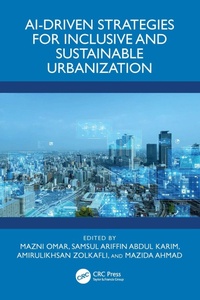
AI-Driven Strategies for Inclusive and Sustainable Urbanization
Published on 21. October 2025
272 pages
978-1-040-42912-9 (ISBN)
Description

This book explores the transformative potential of artificial intelligence (AI) in reshaping urban development practices. Its objective is to provide a comprehensive overview of the latest advancements in AI-driven strategies for urban development and governance, with a focus on promoting inclusivity, sustainability, and resilience in cities worldwide. This book studies how AI technologies can be utilized to tackle the complex challenges encountered in urban areas, spanning ethical, social, and environmental implications across urban governance and beyond.
The in-depth analysis in this book uncovers the potential of AI in addressing longstanding challenges and seizing new opportunities in urban contexts, offering insights into wide-ranging applications. For the use of AI in urban planning, the authors showcase applications that help reduce environmental impact while enhancing accessibility for underserved communities by analyzing real-time data on land use, transportation, and population needs. Another topic in this book examines AI-powered urban mobility systems, utilizing software that integrates real-time data to create adaptive transportation networks. These systems offer efficient, eco-friendly travel solutions tailored to diverse populations, including individuals with disabilities, by dynamically adjusting routes and services. Additionally, this book delves into digital inclusion and accessible technologies in smart cities, highlighting software that prioritizes accessibility and digital inclusion, ensuring that all residents, regardless of ability, can fully participate in urban life. The interdisciplinary approach allows readers to understand how different fields, such as technology, urban planning, and social policy, intersect and shape AI-driven urban development. By weaving together insights from these diverse areas, this book demonstrates how AI can address real-world challenges, from improving infrastructure to fostering sustainability and inclusivity in cities. This perspective helps readers grasp the broader impact of AI, showing how it can enhance various aspects of urban life, including social equity and environmental resilience.
Through interdisciplinary research, case studies, and expert insights, this book aims to educate students in higher learning and inspire policymakers, urban planners, and practitioners to leverage AI technologies in addressing urban challenges and build better cities for all residents.
The in-depth analysis in this book uncovers the potential of AI in addressing longstanding challenges and seizing new opportunities in urban contexts, offering insights into wide-ranging applications. For the use of AI in urban planning, the authors showcase applications that help reduce environmental impact while enhancing accessibility for underserved communities by analyzing real-time data on land use, transportation, and population needs. Another topic in this book examines AI-powered urban mobility systems, utilizing software that integrates real-time data to create adaptive transportation networks. These systems offer efficient, eco-friendly travel solutions tailored to diverse populations, including individuals with disabilities, by dynamically adjusting routes and services. Additionally, this book delves into digital inclusion and accessible technologies in smart cities, highlighting software that prioritizes accessibility and digital inclusion, ensuring that all residents, regardless of ability, can fully participate in urban life. The interdisciplinary approach allows readers to understand how different fields, such as technology, urban planning, and social policy, intersect and shape AI-driven urban development. By weaving together insights from these diverse areas, this book demonstrates how AI can address real-world challenges, from improving infrastructure to fostering sustainability and inclusivity in cities. This perspective helps readers grasp the broader impact of AI, showing how it can enhance various aspects of urban life, including social equity and environmental resilience.
Through interdisciplinary research, case studies, and expert insights, this book aims to educate students in higher learning and inspire policymakers, urban planners, and practitioners to leverage AI technologies in addressing urban challenges and build better cities for all residents.
More details
Language
English
Place of publication
London
United Kingdom
Publishing group
Taylor & Francis Ltd
Target group
College/higher education
Professional and scholarly
Illustrations
12 Tables, black and white; 32 Line drawings, black and white; 32 Illustrations, black and white
File size
5,86 MB
ISBN-13
978-1-040-42912-9 (9781040429129)
Copyright in bibliographic data and cover images is held by Nielsen Book Services Limited or by the publishers or by their respective licensors: all rights reserved.
Schweitzer Classification
Other editions
Additional editions
Mazni Omar | Samsul Ariffin Abdul Karim | Amirulikhsan Zolkafli
AI-Driven Strategies for Inclusive and Sustainable Urbanization
Book
10/2025
1st Edition
CRC Press
€80.20
Shipment within 15-20 days
Mazni Omar | Samsul Ariffin Abdul Karim | Amirulikhsan Zolkafli
AI-Driven Strategies for Inclusive and Sustainable Urbanization
Book
10/2025
1st Edition
CRC Press
€274.20
Shipment within 15-20 days
Persons
Mazni Omar is an Associate Professor at the School of Computing (SOC) and a Research Fellow at the Institute for Advanced and Smart Digital Opportunities (IASDO) at Universiti Utara Malaysia (UUM). She holds professional certifications in software testing, specifically CTFL and CTFL-AT. With a focus on software engineering, her research interests encompass agile project management, software process, software quality, and data mining using AI techniques. She has contributed significantly to her field, with numerous articles published in esteemed journals, proceedings, and book chapters. She has also secured research grants from diverse sources, including universities, national and international agencies, and industry partners. Collaborating extensively with Asian universities, including those in Indonesia and Pakistan, she actively participates in Erasmus+ CBHE and Erasmus+ KA107 Mobility Projects involving Asian and European universities. Dr. Mazni's research extends beyond computing to encompass social sciences applications related to the human aspects of software engineering. She serves on the editorial board of the Scopus-indexed Journal of Information and Communication Technology (JICT).
Samsul Ariffin Abdul Karim is an Associate Professor with the School of Quantitative Sciences, UUM College of Arts and Sciences, Universiti Utara Malaysia (UUM), Malaysia. He earned a PhD in mathematics at Universiti Sains Malaysia (USM). He is a Professional Technologist registered with the Malaysia Board of Technologists (MBOT), no. Perakuan PT21030227. His research interests include numerical analysis, machine learning, approximation theory, optimization, science, and engineering education as well as wavelets. He has published more than 180 papers in journals and conference proceedings, including five edited conference volumes and 80 book chapters. He received the Effective Education Delivery Award and Publication Award (Journal and Conference Paper) on UTP Quality Day 2010, 2011, and 2012. He is a Certified WOLFRAM Technology Associate, Mathematica Student Level. He has published 13 books with Springer Publishing, including eight books in the Studies in Systems, Decision and Control (SSDC) series, three books with Taylor & Francis/CRC Press, one book with IntechOpen, and one book with UTP Press. He received the Book Publication Award on UTP Quality Day 2020 for the book Water Quality Index (WQI) Prediction Using Multiple Linear Fuzzy Regression: Case Study in Perak River, Malaysia, published by SpringerBriefs in Water Science and Technology in 2020.
Amirulikhsan Zolkafli is a Senior Lecturer at Universiti Utara Malaysia (UUM), where he serves as a faculty member in the School of Computing, contributing significantly to the fields of geographic information systems and information technology. He earned a PhD in geographic information systems at the University of Queensland, Australia. With a robust academic background and a passion for research, he has published numerous papers in reputable journals, focusing on participatory GIS approaches and practical solutions in various areas. In addition to his research contributions, he is dedicated to teaching and mentoring students, fostering a dynamic and engaging learning environment. He is also a member of an Erasmus+ research team that has successfully designed a master's program on geoinformatics for disaster risk reduction. His commitment to education and scholarly excellence is reflected in his active participation in various academic conferences and workshops. He continually seeks to bridge the gap between theoretical knowledge and real-world application. His work not only advances academic understanding but also has a tangible impact on industry practices. Beyond his academic and research endeavors, he is actively involved in community service, striving to make a positive difference both within and outside the university.
Mazida Ahmad is an Associate Professor in the School of Computing, Universiti Utara Malaysia. With a degree from International Islamic University Malaysia, a master's of real-time software engineering from Universiti Teknologi Malaysia, and a PhD from Universiti Sains Malaysia, Mazida has been serving Universiti Utara Malaysia for approximately 15 years. She teaches courses on advanced systems analysis and design, information system development, information technology project management, knowledge management, and management information systems. Her research areas include knowledge management, software engineering, and IT in education. She is currently involved in numerous international collaborations, such as International Research Collaboration with Universitas Komputer, Telkom University, and Universitas Kuningan in Indonesia, the International Credit Mobility (ICM) program with University West Attica, Greece, and Capacity Building in the field of Higher Education (CBHE) project with European and Asian universities.
Samsul Ariffin Abdul Karim is an Associate Professor with the School of Quantitative Sciences, UUM College of Arts and Sciences, Universiti Utara Malaysia (UUM), Malaysia. He earned a PhD in mathematics at Universiti Sains Malaysia (USM). He is a Professional Technologist registered with the Malaysia Board of Technologists (MBOT), no. Perakuan PT21030227. His research interests include numerical analysis, machine learning, approximation theory, optimization, science, and engineering education as well as wavelets. He has published more than 180 papers in journals and conference proceedings, including five edited conference volumes and 80 book chapters. He received the Effective Education Delivery Award and Publication Award (Journal and Conference Paper) on UTP Quality Day 2010, 2011, and 2012. He is a Certified WOLFRAM Technology Associate, Mathematica Student Level. He has published 13 books with Springer Publishing, including eight books in the Studies in Systems, Decision and Control (SSDC) series, three books with Taylor & Francis/CRC Press, one book with IntechOpen, and one book with UTP Press. He received the Book Publication Award on UTP Quality Day 2020 for the book Water Quality Index (WQI) Prediction Using Multiple Linear Fuzzy Regression: Case Study in Perak River, Malaysia, published by SpringerBriefs in Water Science and Technology in 2020.
Amirulikhsan Zolkafli is a Senior Lecturer at Universiti Utara Malaysia (UUM), where he serves as a faculty member in the School of Computing, contributing significantly to the fields of geographic information systems and information technology. He earned a PhD in geographic information systems at the University of Queensland, Australia. With a robust academic background and a passion for research, he has published numerous papers in reputable journals, focusing on participatory GIS approaches and practical solutions in various areas. In addition to his research contributions, he is dedicated to teaching and mentoring students, fostering a dynamic and engaging learning environment. He is also a member of an Erasmus+ research team that has successfully designed a master's program on geoinformatics for disaster risk reduction. His commitment to education and scholarly excellence is reflected in his active participation in various academic conferences and workshops. He continually seeks to bridge the gap between theoretical knowledge and real-world application. His work not only advances academic understanding but also has a tangible impact on industry practices. Beyond his academic and research endeavors, he is actively involved in community service, striving to make a positive difference both within and outside the university.
Mazida Ahmad is an Associate Professor in the School of Computing, Universiti Utara Malaysia. With a degree from International Islamic University Malaysia, a master's of real-time software engineering from Universiti Teknologi Malaysia, and a PhD from Universiti Sains Malaysia, Mazida has been serving Universiti Utara Malaysia for approximately 15 years. She teaches courses on advanced systems analysis and design, information system development, information technology project management, knowledge management, and management information systems. Her research areas include knowledge management, software engineering, and IT in education. She is currently involved in numerous international collaborations, such as International Research Collaboration with Universitas Komputer, Telkom University, and Universitas Kuningan in Indonesia, the International Credit Mobility (ICM) program with University West Attica, Greece, and Capacity Building in the field of Higher Education (CBHE) project with European and Asian universities.
Content
1. AI-Driven Strategies: An Overview Towards Inclusive and Sustainable Urbanization. 2. Ethical Implications of AI in Urban Governance. 3. Community Engagement in AI-Driven Urban Development. 4. AI for Environmental Sustainability in Urban Areas. 5. Digital Inclusion and Accessible Technologies in Smart Cities. 6. Civic Technology and Open Data: Transforming Urban Governance for Participatory Democracy. 7. Adaptive Cities: AI-Based Climate Resilience Strategies from Sensor Networks. 8. AI Strategies for Effective Text Summarization in Urban Contexts: Insights and Developments. 9. Adopting AI in Local Government Green Infrastructure Procurement. 10. AI-Based Water Quality Detection and Monitoring in Urban Environments. 11. Building Inclusive Smart Cities: The Role of Mathematical Models and AI Applications. 12. Inclusive and Sustainable Urbanization Towards Sustainable Development Goals.
