

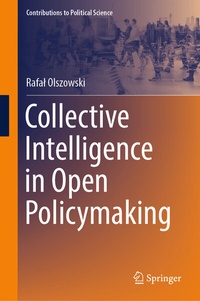
Collective Intelligence in Open Policymaking
Description

This book examines the nexus of collective intelligence (CI), a feature of online projects in which various types of communities solve problems intelligently, and open policymaking, as a trend of large groups of people shaping public policies.
While doing so, it presents the current state of theoretical knowledge for these concepts, many practical examples of successful and unsuccessful projects, as well as additional research and laboratory experiments. The book develops an analytical framework based on qualitative research, which is applied to the analysis of different projects in selected case studies, such as Decide Madrid; Better Reykjavik; Loomio; Deliberatorium; Civic Budget of the City of Kraków.
The book is structured into four chapters, addressing essential questions in the field: (1) Opening Policymaking; (2) Beyond the Individual: Understanding the Evolution of Collective Intelligence; (3) A Review of the Projects Using Collective Intelligence in Policymaking; (4) Online Public Debate. How Can We Make it More Intelligent?
The book will appeal to students, scholars, and researchers of political science, public policy, and public administration, as well as policymakers interested in a better understanding of collective intelligence and open policymaking.
More details
Other editions
Additional editions
Person
Rafal Olszowski is a social scientist specializing in research on e-participation, the public sphere, social media in politics, AI ethics, e-government, and the history of political doctrines. He is affiliated with AGH University of Kraków and the MIT Center for Collective Intelligence. He is the author of a monograph on permanence and change in the political thought of Edmund Burke (2021). He is also a seasoned business consultant in the field of new technologies, and a manager of educational projects. Apart from professional work, he is actively involved in the non-governmental sector with the Aurea Libertas Institute Foundation.
Content
Chapter 1. Opening Policymaking.- Chapter 2. Beyond the Individual: Understanding the Evolution of Collective Intelligence.- Chapter 3. A Review of the Projects Using Collective Intelligence in Policymaking.- Chapter 4. Online Public Debate. How Can We Make it More Intelligent?.
