

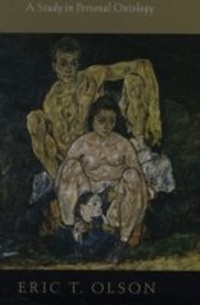
What Are We?
A Study in Personal Ontology
1st Edition
Published on 27. September 2007
261 pages
978-0-19-803920-4 (ISBN)
Description

From the time of Locke, discussions of personal identity have often ignored the question of our basic metaphysical nature: whether we human people are biological organisms, spatial or temporal parts of organisms, bundles of perceptions, or what have you. The result of this neglect has been centuries of wild proposals and clashing intuitions.
What Are We? is the first general study of this important question. It beings by explaining what the question means and how it differs from others, such as questions of personal identity and the mind-body problem. It then examines in some depth the main possible accounts of our metaphysical nature, detailing both their theoretical virtues and the often grave difficulties they face.
The book does not endorse any particular account of what we are, but argues that the matter turns on more general issues in the ontology of material things. If composition is universal--if any material things whatever make up something bigger--then we are temporal parts of organisms. If things never compose anything bigger, so that there are only mereological simples, then we too are simples--perhaps the immaterial substances of Descartes--or else we do not exist at all (a view Olson takes very seriously). The intermediate view that some things compose bigger things and others do not leads almost inevitably to the conclusion that we are organisms. So we can discover what we are by working out when composition occurs.
More details
Other editions
Additional editions
Book
10/2007
Oxford University Press Inc
€104.60
Shipment within 15-20 days
Person
Eric T. Olson is Professor of Philosophy at the University of Sheffield.
Content
- Intro
- Contents
- 1 The Question
- 1.1 What Are We?
- 1.2 Some Answers
- 1.3 'We'
- 1.4 Rephrasing the Question
- 1.5 Must There Be an Answer?
- 1.6 How the Question Differs from Others
- 1.7 Why It Matters
- 2 Animals
- 2.1 Animalism
- 2.2 What Is an Animal?
- 2.3 The Thinking-Animal Problem
- 2.4 Are There Animals?
- 2.5 Can Animals Think?
- 2.6 Too Many Thinkers
- 2.7 Creative Linguistics
- 2.8 Animalism and Our Identity over Time
- 2.9 Further Objections
- 3 Constitution
- 3.1 Material Things Constituted by Animals
- 3.2 The Clay-Modeling Puzzle
- 3.3 The Replacement Puzzle and the Amputation Puzzle
- 3.4 Thinking Animals Again
- 3.5 When Does Constitution Occur?
- 3.6 What Determines Our Boundaries?
- 4 Brains
- 4.1 The Brain View
- 4.2 The Thinking-Brain Problem
- 4.3 The Brain View and Our Identity over Time
- 4.4 Thinking-Subject Minimalism
- 4.5 Direct Involvement
- 4.6 Homunculism
- 5 Temporal Parts
- 5.1 Four-Dimensional Hunks of Matter
- 5.2 Temporary Intrinsics
- 5.3 Lumps and Statues
- 5.4 The Problem of Modal Incompatibility
- 5.5 Puzzles of Personal Identity
- 5.6 Thinking Animals and Other Worries
- 5.7 Thinking Stages
- 5.8 The Stage View
- 6 Bundles
- 6.1 Bundle Theories
- 6.2 Traditional Arguments for the Bundle View
- 6.3 Personal Identity and the Bundle View
- 6.4 Can Thoughts Think?
- 6.5 Thinking Animals Once More
- 6.6 Bundles of Universals
- 6.7 The Program View
- 7 Souls
- 7.1 Immaterialism
- 7.2 Traditional Arguments for Immaterialism
- 7.3 The Paradox of Increase
- 7.4 The Cost of Materialism
- 7.5 Objections to Immaterialism
- 7.6 Compound Dualism
- 7.7 Hylomorphism
- 7.8 Simple Materialism
- 8 Nihilism
- 8.1 We Do Not Exist
- 8.2 Is Nihilism Mad?
- 8.3 Is Nihilism Self-Refuting?
- 8.4 Unity and Simplicity
- 8.5 Paraphrase: The Mentalistic Strategy
- 8.6 Paraphrase: The Atomistic Strategy
- 8.7 What It Would Mean If We Did Not Exist
- 9 What Now?
- 9.1 Some Results
- 9.2 Some Opinions
- 9.3 Animalism and the Thinking-Parts Problem
- 9.4 Animalism and the Clay-Modeling Puzzle
- 9.5 Theories of Composition
- 9.6 Composition and What We Are
- 9.7 Brutal Composition
- References
- Index
- A
- B
- C
- D
- E
- F
- G
- H
- I
- J
- K
- L
- M
- N
- O
- P
- Q
- R
- S
- T
- U
- V
- W
- Y
- Z
