

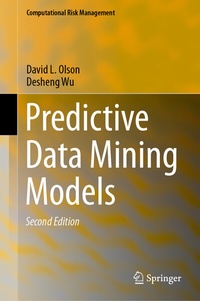
Predictive Data Mining Models
2nd Edition
Published on 7. August 2019
XI, 125 pages
978-981-13-9664-9 (ISBN)
Description

This book provides an overview of predictive methods demonstrated by open source software modeling with Rattle (R') and WEKA. Knowledge management involves application of human knowledge (epistemology) with the technological advances of our current society (computer systems) and big data, both in terms of collecting data and in analyzing it. We see three types of analytic tools. Descriptive analytics focus on reports of what has happened. Predictive analytics extend statistical and/or artificial intelligence to provide forecasting capability. It also includes classification modeling. Prescriptive analytics applies quantitative models to optimize systems, or at least to identify improved systems. Data mining includes descriptive and predictive modeling. Operations research includes all three. This book focuses on prescriptive analytics.
The book seeks to provide simple explanations and demonstration of some descriptive tools. This second editionprovides more examples of big data impact, updates the content on visualization, clarifies some points, and expands coverage of association rules and cluster analysis. Chapter 1 gives an overview in the context of knowledge management. Chapter 2 discusses some basic data types. Chapter 3 covers fundamentals time series modeling tools, and Chapter 4 provides demonstration of multiple regression modeling. Chapter 5 demonstrates regression tree modeling. Chapter 6 presents autoregressive/integrated/moving average models, as well as GARCH models. Chapter 7 covers the set of data mining tools used in classification, to include special variants support vector machines, random forests, and boosting.
Models are demonstrated using business related data. The style of the book is intended to be descriptive, seeking to explain how methods work, with some citations, but without deep scholarly reference. The data sets and software are all selected for widespread availability and access by any reader with computer links.
The book seeks to provide simple explanations and demonstration of some descriptive tools. This second editionprovides more examples of big data impact, updates the content on visualization, clarifies some points, and expands coverage of association rules and cluster analysis. Chapter 1 gives an overview in the context of knowledge management. Chapter 2 discusses some basic data types. Chapter 3 covers fundamentals time series modeling tools, and Chapter 4 provides demonstration of multiple regression modeling. Chapter 5 demonstrates regression tree modeling. Chapter 6 presents autoregressive/integrated/moving average models, as well as GARCH models. Chapter 7 covers the set of data mining tools used in classification, to include special variants support vector machines, random forests, and boosting.
Models are demonstrated using business related data. The style of the book is intended to be descriptive, seeking to explain how methods work, with some citations, but without deep scholarly reference. The data sets and software are all selected for widespread availability and access by any reader with computer links.
More details
Series
Edition
Second Edition 2020
Language
English
Place of publication
Singapore
Singapore
Publishing group
Springer Singapore
Target group
Professional and scholarly
Product notice
Reflowable
Illustrations
XI, 125 p. 77 illus., 69 illus. in color.
File size
7,36 MB
ISBN-13
978-981-13-9664-9 (9789811396649)
DOI
10.1007/978-981-13-9664-9
Schweitzer Classification
Other editions
Additional editions
David L. Olson | Desheng Wu
Predictive Data Mining Models
Book
08/2019
2nd Edition
Springer
€117.69
Shipment within 15-20 days
Previous edition
David L. Olson | Desheng Wu
Predictive Data Mining Models
E-Book
09/2016
Springer
€96.29
Available for download
Persons
David L. Olson is the James & H.K. Stuart Professor and Chancellor's Professor at the University of Nebraska, USA. He has published research in over 200 refereed journal articles and has authored over 40 books, including Decision Aids for Selection Problems, Introduction to Information Systems Project Management, Managerial Issues of Enterprise Resource Planning Systems, Supply Chain Risk Management, and Supply Chain Information Technology. He has served as associate editor of Service Business, Decision Support Systems, and Decision Sciences and co-editor in chief of International Journal of Services Sciences. He is a member of the Decision Sciences Institute, the Institute for Operations Research and Management Sciences, and the Multiple Criteria Decision Making Society. He was a Lowry Mays endowed Professor at Texas A&M University from 1999 to 2001. He has named the Raymond E. Miles Distinguished Scholar award for 2002 and was a James C. and Rhonda Seacrest Fellow from 2005 to 2006. He was named Best Enterprise Information Systems Educator by IFIP in 2006. He is a Fellow of the Decision Sciences Institute.
Desheng Wu is a Special-term Professor at University of Chinese Academy of Sciences, Beijing, China, and a Professor at Stockholm University, Sweden. He has published over 150 ISI-indexed papers in refereed journals, such as Production and Operations Management, Decision Sciences, Risk Analysis, and IEEE Transactions on Systems, Man, and Cybernetics, as well as 7 books with publishers like Springer. He is an elected member of Academia Europaea (The Academy of Europe), the European Academy of Sciences and Arts, and the International Eurasian Academy of Sciences. He has served as an associate editor and a guest editor for several journals, such as Risk Analysis, IEEE Transactions on Systems, Man, and Cybernetics, the Annals of Operations Research, Computers and Operations Research, the International Journal of Production Economics, and Omega. He is the editor of Springer's book series on computational risk management.
Desheng Wu is a Special-term Professor at University of Chinese Academy of Sciences, Beijing, China, and a Professor at Stockholm University, Sweden. He has published over 150 ISI-indexed papers in refereed journals, such as Production and Operations Management, Decision Sciences, Risk Analysis, and IEEE Transactions on Systems, Man, and Cybernetics, as well as 7 books with publishers like Springer. He is an elected member of Academia Europaea (The Academy of Europe), the European Academy of Sciences and Arts, and the International Eurasian Academy of Sciences. He has served as an associate editor and a guest editor for several journals, such as Risk Analysis, IEEE Transactions on Systems, Man, and Cybernetics, the Annals of Operations Research, Computers and Operations Research, the International Journal of Production Economics, and Omega. He is the editor of Springer's book series on computational risk management.
Content
Chapter 1 Knowledge Management.- Chapter 2 Data Sets.- Chapter 3 Basic Forecasting ToolsChapter 3 Basic Forecasting Tools.- Chapter 4 Multiple Regression.- Chapter 5 Regression Tree Models.- Chapter 6 Autoregressive Models.- Chapter 7 GARCH Models.- Chapter 8 Comparison of Models.
