

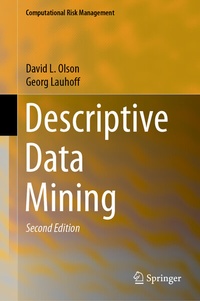
Descriptive Data Mining
2nd Edition
Published on 6. May 2019
XI, 130 pages
978-981-13-7181-3 (ISBN)
Description

This book provides an overview of data mining methods demonstrated by software. Knowledge management involves application of human knowledge (epistemology) with the technological advances of our current society (computer systems) and big data, both in terms of collecting data and in analyzing it. We see three types of analytic tools. Descriptive analytics focus on reports of what has happened. Predictive analytics extend statistical and/or artificial intelligence to provide forecasting capability. It also includes classification modeling. Diagnostic analytics can apply analysis to sensor input to direct control systems automatically. Prescriptive analytics applies quantitative models to optimize systems, or at least to identify improved systems. Data mining includes descriptive and predictive modeling. Operations research includes all three. This book focuses on descriptive analytics.
The book seeks to provide simple explanations and demonstration of some descriptive tools. This second edition provides more examples of big data impact, updates the content on visualization, clarifies some points, and expands coverage of association rules and cluster analysis. Chapter 1 gives an overview in the context of knowledge management. Chapter 2 discusses some basic software support to data visualization. Chapter 3 covers fundamentals of market basket analysis, and Chapter 4 provides demonstration of RFM modeling, a basic marketing data mining tool. Chapter 5 demonstrates association rule mining. Chapter 6 is a more in-depth coverage of cluster analysis. Chapter 7 discusses link analysis.
Models are demonstrated using business related data. The style of the book is intended to be descriptive, seeking to explain how methods work, with some citations, but without deep scholarly reference. The data sets and software are all selected for widespread availability and access by any reader with computer links.
The book seeks to provide simple explanations and demonstration of some descriptive tools. This second edition provides more examples of big data impact, updates the content on visualization, clarifies some points, and expands coverage of association rules and cluster analysis. Chapter 1 gives an overview in the context of knowledge management. Chapter 2 discusses some basic software support to data visualization. Chapter 3 covers fundamentals of market basket analysis, and Chapter 4 provides demonstration of RFM modeling, a basic marketing data mining tool. Chapter 5 demonstrates association rule mining. Chapter 6 is a more in-depth coverage of cluster analysis. Chapter 7 discusses link analysis.
Models are demonstrated using business related data. The style of the book is intended to be descriptive, seeking to explain how methods work, with some citations, but without deep scholarly reference. The data sets and software are all selected for widespread availability and access by any reader with computer links.
Reviews / Votes
"The book is direct and easy to read, explaining how methods work without in-depth scholarly references. . this is a suitable book for data mining newcomers who are not interested in a theoretical understanding of the algorithms. . the book could be used as a course resource." (Evangelia Kavakli, Computing Reviews, November 2, 2020)
More details
Series
Edition
Second Edition 2019
Language
English
Place of publication
Singapore
Singapore
Publishing group
Springer Singapore
Target group
Professional and scholarly
Product notice
Reflowable
Illustrations
XI, 130 p. 89 illus., 78 illus. in color.
File size
6,27 MB
ISBN-13
978-981-13-7181-3 (9789811371813)
DOI
10.1007/978-981-13-7181-3
Schweitzer Classification
Other editions
Additional editions
David L. Olson | Georg Lauhoff
Descriptive Data Mining
Book
05/2019
2nd Edition
Springer
€160.49
Shipment within 15-20 days
Previous edition
Persons
David L. Olson
is the James & H.K. Stuart Chancellor's Distinguished Chair and Full Professor at the University of Nebraska. He has published research in over 150 refereed journal articles, primarily on the topic of multiple objective decision-making, information technology, supply chain risk management, and data mining. He teaches in the management information systems, management science, and operations management areas. He has authored over 20 books. He is a member of the Decision Sciences Institute, the Institute for Operations Research and Management Sciences, and the Multiple Criteria Decision Making Society. He was a Lowry Mays endowed Professor at Texas A&M University from 1999 to 2001. He was named the Raymond E. Miles Distinguished Scholar award for 2002, and was a James C. and Rhonda Seacrest Fellow from 2005 to 2006. He was named Best Enterprise Information Systems Educator by IFIP in 2006. He is a Fellow of the DecisionSciences Institute.
Georg Lauhoff is a Technologist at Western Digital Corporation and carries out R&D in materials science and its application in data storage devices and uses the techniques described in this book for his work. He co-authored 38 refereed journal articles and over 30 conference presentations, primarily on the topic of materials science, data storage materials and magnetic thin films. He was awarded scholarships and research grants in the U.K. and Japan. He was the Clerk Maxwell Scholar from 1995- 98 and is a Fellow of the Cambridge Philosophical Society. He studied physics at Aachen (Diplom) and Cambridge University (Master and Ph.D.) specializing in the field of materials science and magnetic thin films and sensors. After graduating he moved to Japan and held a faculty position in Materials Science and Engineering at the Toyota Technological Institute and, then carried out research in the sequencing of DNA using magnetic sensors at Cambridge University before moving in 2005 to the recording industry in the Bay area.
Georg Lauhoff is a Technologist at Western Digital Corporation and carries out R&D in materials science and its application in data storage devices and uses the techniques described in this book for his work. He co-authored 38 refereed journal articles and over 30 conference presentations, primarily on the topic of materials science, data storage materials and magnetic thin films. He was awarded scholarships and research grants in the U.K. and Japan. He was the Clerk Maxwell Scholar from 1995- 98 and is a Fellow of the Cambridge Philosophical Society. He studied physics at Aachen (Diplom) and Cambridge University (Master and Ph.D.) specializing in the field of materials science and magnetic thin films and sensors. After graduating he moved to Japan and held a faculty position in Materials Science and Engineering at the Toyota Technological Institute and, then carried out research in the sequencing of DNA using magnetic sensors at Cambridge University before moving in 2005 to the recording industry in the Bay area.
