

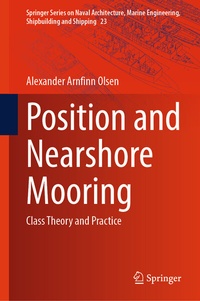
Position and Nearshore Mooring
Description

This book provides a summary of the Class Rules and Guides for mooring systems so that they are easier to navigate and therefore implement.
Mooring systems have been evolving in design, analysis, operating management, and other areas to meet the challenges of safety and efficiency. To ensure these challenges are met, Class Rules and Guides are developed and updated to keep pace with the maritime industry. This has resulted in a complex library of Class Rules and Guides. Many requirements are repeated throughout these Class Rules and Guides making use and maintenance of Class Rules/Guides increasingly cumbersome and bureaucratic.
In addition to the consolidation of the current requirements, this book also includes guidance in the following areas based on the latest industry knowledge and experiences:
- Vortex-Induced Motion (VIM) effect.
- Bending-tension fatigue of mooring chains.
- Fiber rope mooring criteria.
- Mooring systems in squalls.
- Dynamically installed anchors.
- Anchor holding capacity.
- Mooring analysis methodology.
- Thruster-assisted mooring.
More details
Other editions
Additional editions
Person
Alexander is a Training Solutions Architect for a leading UK maritime engineering and defence company. Formerly a senior consultant for the Italian Shipping Registry, RINA SpA, Alexander has developed a breadth of experience across marine training development, design, and delivery. This book is intended as a reference for marine professionals and students with an interest in position and nearside mooring theory and practice.
Content
Chapter 1. Classification of Mooring Systems.- Chapter 2. Mooring System Design.- Chapter 3. Thruster Assisted Mooring.- Chapter 4. Pre-laid station keeping systems for mobile offshore units.- Chapter 5. Mooring System Components.- Chapter 6. Mooring System Analysis.- Chapter 7. Available Thrust Analysis.- Chapter 8. Vortex Induced Movement (VIM).- Chapter 9. Mooring Chain Fatigue.- Chapter 10. Nearside Position Mooring.- Chapter 11. Nearside Mooring Design Considerations.- Chapter 12. Sample Jetty Mooring Analysis.- Chapter 13. Mooring Integrity Analysis.- Chapter 14. Baseline Condition of Existing Mooring Systems.- Chapter 15. Mooring Integrity Assessment.- Chapter 16. Example of Mooring System Life Extension.- Glossary.- References.
