

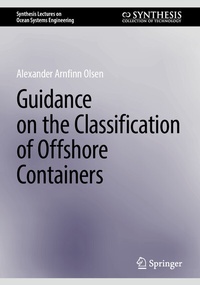
Guidance on the Classification of Offshore Containers
Description

This guide provides guidance for manufacturing facilities to build offshore containers. It also serves to assist Class Engineers and Surveyors in certifying offshore containers around the globe. It provides Marine Surveyors and Offshore Industry Professionals with responsibility over offshore containers with a brief and concise summary of the main classification rules and regulations relating to the design, construction, inspection and testing, surveyance, and use of offshore containers.
More details
Other editions
Additional editions
Person
Alexander Arnfinn Olsen is a Training Solution Architect for a leading maritime defence company with a focus on marine training and professional development domain. Previously, was a Senior Consultant for the Italian Shipping Registry, RINA SpA, from which he derives his extensive knowledge of marine classification rules and regulations.
Content
General provisions and scope.- Certification procedure.- Quality Assessment.- Offshore Container Design.- Materials and Welding.- Design.- Prototype Testing.- Production and Manufacture of Offshore Containers.- Offshore Container Marking and Data Plates.- Lifting Sets; In-service Inspection.- Repair and Modification Procedures.- Class Recognized Standards.- Certification Requirements for Offshore Tank Containers/Portable Tanks and MEGC.- Container Corner Castings.
