

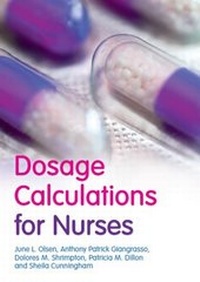
Dosage Calculations for Nurses uPDF eBook
Description

This comprehensive and easy-to-use guide for dosage calculations and drug administration is an excellent reference guide for nursing and healthcare professionals. Critical thinking case studies, practice tests, and exercises prepare students for real calculations so they can confidently calculate safe and accurate dosage levels
With a workbook style, comprehensive coverage and over 1,000 problems and answers, 'Dosage Calculations for Nurses' allows the student to work at their own pace in the areas where they feel need the most support.
"This book is appropriate for new student nurses" Dawn Reasbeck, Sheffield Hallam University
"Excellent book with lots of examples and practice tests. Clear and easy to understand." Alison Williams, School of Health & Social Care, Sport & Exercise Sciences, Glyndwr University
"I found this book extremely practical, student friendly with a good range of self assessmentsfor the student" Sharon Sykes,Senior Lecturer, Department of Nursing Studies, University of Central Lancashire"An excellent textbook for pre-reg nurses and non-medical prescribers" Ruth Broadhead, Senior Lecturer, School of Nursing & Caring Sciences, University of Central Lancashire
All prices
More details
Other editions
Additional editions
Content
- Cover
- Contents
- About the authors
- Preface
- Acknowledgements
- Unit 1: Basic calculation skills and introduction to medication administration
- Chapter 1: Review of arithmetic skills for medical dosage calculations
- Diagnostic test of arithmetic
- Fundamental skills for calculations
- Explaining decimals and fractions
- Changing decimal numbers and whole numbers to fractions
- Changing fractions to decimal numbers
- Rounding decimal numbers
- Rounding numbers (up or down)
- Multiplying and dividing decimal numbers
- Multiplying and dividing fractions
- Complex fractions
- Percentages
- Summary
- References
- Case study 1.1
- Reflection
- Practice sets
- Chapter 2: Safe and accurate drug administration
- Diagnostic questions
- The drug administration process
- Who administers drugs?
- Six rights of medication administration
- The right drug
- The right dose
- The right route
- The right time
- The right patient
- The right documentation
- Drug prescriptions
- Prescriptions and administration records
- Prescription forms
- Prescription variations
- Components of a prescription
- Medication administration records
- Computerised recordkeeping
- Drug labels
- Drug package inserts
- Summary
- References
- Practice sets
- Chapter 3: Changing units of measurements
- Diagnostic questions
- Introduction to units of measurement and conversions
- The mathematical foundation
- Changing a single unit of measurement to another single unit of measurement
- Simple problems with single units of measurement
- Complex problems with single units of measurement
- Changing one rate to another rate
- Simple problems with rates
- Complex problems with rates
- Summary
- Practice sets
- Chapter 4: The metric measurement system
- Diagnostic questions
- The metric system
- Liquid volume measurements
- Weight measures
- Length measures
- Shortcut for converting units in the metric system
- Measurements in the imperial measurement system
- Summary
- References
- Reflection
- Practice sets
- Cumulative review exercises
- Unit 2: Oral and parenteral medications
- Chapter 5: Calculating oral medication doses
- Diagnostic questions
- Simple problems
- Medication in solid form
- Medication in liquid form
- Medications measured in millimoles
- Complex problems
- Calculating dosage by body weight
- Calculating dosage by body surface area
- BSA formulae
- Nomograms
- Summary
- Reference
- Case study 5.1
- Practice reading labels
- Practice sets
- Chapter 6: Syringes
- Diagnostic questions
- Parts of a syringe
- Needles
- Types of syringes
- Measuring insulin doses
- Measuring a single dose of insulin in an insulin syringe
- Measuring two types of insulin in one syringe
- Measuring premixed insulin
- Insulin pens
- Safety syringes
- Summary
- References
- Case study 6.1
- Reflection
- Practice sets
- Chapter 7: Solutions and drug strengths or concentrations
- Diagnostic questions
- Determining the strength of a medication
- Pure drugs in liquid form
- Pure drugs in dry form
- Determining the amount of pure drug in a given amount of solution
- Determining the amount of solution that contains a given amount of pure drug
- Molar solutions and molarity
- Use of moles and millimoles
- Drugs measured in units
- Summary
- References
- Case study 7.1
- Practice sets
- Chapter 8: Parenteral medications
- Diagnostic questions
- Parenteral medications
- Parenteral medications supplied as liquids
- Parenteral medications supplied in powdered form
- Heparin
- Summary
- References
- Case study 8.1
- Practice sets
- Cumulative review exercises
- Unit 3: Infusions and paediatric dosages
- Chapter 9: Calculating flow rates and durations of enteral and intravenous infusions
- Diagnostic questions
- Introduction to intravenous and enteral solutions
- Enteral feedings
- Intravenous infusions
- Intravenous solutions
- Equipment for intravenous infusions
- Infusion pumps
- Calculating the flow rate of infusions
- Calculating the duration of flow for intravenous and enteral solutions
- Summary
- References
- Case study 9.1
- Practice sets
- Chapter 10: Calculating flow rates for intravenous medications
- Diagnostic questions
- Intravenous administration of medications
- Secondary intravenous infusion lines
- Calculating flow rates based on body weight
- Titrating medications
- Calculating flow rates based on body surface area
- Summary
- Reference
- Case study 10.1
- Practice sets
- Chapter 11: Calculating paediatric dosages
- Diagnostic questions
- Safe paediatric drug dosages
- Administration of oral and parenteral medications
- Oral medications
- Parenteral medications
- Calculating drug dosages by body weight
- Calculating drug dosages by body surface area
- Administration of intravenous medications using a volume control chamber
- Calculating daily fluid maintenance
- Summary
- References
- Case study 11.1
- Practice sets
- Cumulative review exercises
- Comprehensive self-tests
- Appendices
- Appendix A: Answer section
- Appendix B: Common abbreviations used in medical documentation
- Appendix C: Tables of weight conversions
- Appendix D: Ratio and algebraic calculations
- Index
