

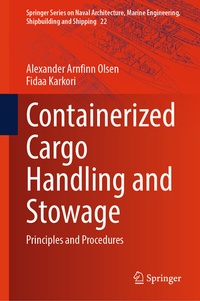
Containerized Cargo Handling and Stowage
Description

Container industry is gathering pace as vessels are becoming increasingly larger, with the volume of containers carried regularly exceeding 23,000 per vessel. This means the scope for accidents and incidents is also increasing exponentially.
This title aims to provide those professionals involved in the packing and handling of cargoes inside containers with the necessary knowledge to do so safely. This will help ensure container collapses are avoided due to inertial forces both at sea and during land transportation.
More details
Other editions
Additional editions
Persons
Alexander Arnfinn Olsen is currently employed as a Senior Consultant for RINA Consulting Defence Ltd, a subsidiary of RINA SpA - the Italian national ship registry. Prior to this, he worked as a training and instructional designer for the Royal Navy. He has also been a marine assurance surveyor for the oil and gas industry in Scotland, and an inshore fisheries observer for the Scottish Government. He has published several titles in seafaring, ship operations, and maritime engineering.
Fidaa Karkori is an educationalist with a specialism in editing textbooks and technical titles.
Content
PART I DEVELOPMENT OF CONTAINERISATION .- The development of containerization.- Positioning and securing of containers.- Container stowage plans.- Container and cargo insurance.- Responsibility for container packing.- PART II CAUSES OF DAMAGE AND LOSS DURING TRANSIT .- Causes of damage and loss during transit.- Mechanical stress.- Mechanical stress in maritime transport.- Mechanical stress in land transport.- Mechanical stress during cargo handling.- Non-mechanical stress.- PART III CONTAINER DESIGN AND CONSTRUCTION.- Container terminology.- Container design.- CSC and structural testing regimes.- Cargo securing equipment.- Container dimensions and weights.- Container identification systems 18 Container size and type codes.- Container operational markings.- Marking of containers carrying dangerous cargo.- PART IV CONTAINER LOAD PACKING.- Impact of packaging and packing aids on load security.- Unitisation and palletisation.- Marking of goods.- Packing and stowing methods.- PARTV CONTAINER LOAD SECURING.- General load securing methods.- Principles of load securing.- Lashing materials and equipment.- Load securing, filling materials and airbags.- Friction and friction enhancing mats.
