

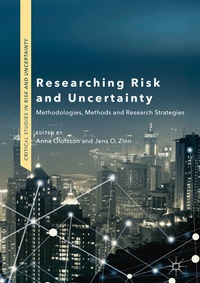
Researching Risk and Uncertainty
Description

Understanding and managing risk and uncertainty is a central task in contemporary societies characterised by rapid social, technological and environmental change.
This book presents research approaches used by scholars who all share a passion to gain new insights in how individuals, organisations and societies approach uncertain futures and their potential dangers.
The contributions illustrate the usefulness of particular methods and methodologies for researching risk in order to advance the understanding and management of social, technological and environmental challenges.
With research strategies and approaches from sociology, psychology, history, linguistics, anthropology, and gender studies,
Researching Risk and Uncertaint
y provides guidance and inspiration to students and scholars across a range of disciplines interested in risk, disaster and social crisis.
More details
Other editions
Additional editions
Persons
Anna Olofsson is Professor of Sociology at Mid Sweden University and the director of the Risk and Crisis Research Centre, Sweden.
Jens O. Zinn is T.R Asworth Associate Professor in Sociology at the University of Melbourne, Australia, Marie Sklodowska-Curie Fellow at the ESRC Centre of Corpus Approaches to Social Science, Lancaster University, UK (2016-2018) and Research Awardee of the Alexander von Humboldt Foundation (2015).
Content
1 Introduction, Jens Zinn & Anna Olofsson.- Part I: Visual and Ethnographic Methods. - 2 Seeing Risk and Risking Seeing: Studying Audiences in Participatory Visual Research; Claudia Mitchell.- 3. Key Points of Interactive Research: An Ethnographic Approach to Risk; Roanne van Voorst and Dorothea Hilhorst.- 4. Virtual Ethnography: Managing Pharmacological Risk and Uncertainty in Online Drug Forums; Moritz Berning and Anita Hardon.- Part 2: Narrative, Biographical and Mixed Analyses. - 5 The Domestic Cycle Approach as Methodological Tool in Risk Research; Libertad Chavez-Rodriguez.- 6. Investigating Risk: Methodological Insights from Interpretive Social Science and Sustainable Energy Transitions Research; Karen Henwood. - 7. The Problem-Centred Approach for Researching Biographical Uncertainty and Risk; Herwig Reiter.- 8. Using Repeat Interviewing and Diaries to Research the Impact of Life-Threatening Events: The Example of Stroke Survivors' Narratives; Andy Alaszewski. - 9. Interviews as a Means of Exploring Risk Lifeworlds: Excavating the Roots of Everyday Meanings, Experiences and Practices; Patrick Brown, Gerben Moerman, and Christian Bröer. - Part 3: Surveys and Statistical Methods. - 10. International Comparative Surveys in Risk Perception Research: Data Sets, Construction of Questionnaires, and Analytical Dimensions; Aiste Balzekiene. - 11. Quantitative Analysis of Risk Positions: An Exploratory Approach; Susanna Öhman & Anna Olofsson.- Part 4: Discourse and Semantic Analyses.- 12. Tracing Discourses and Uncovering the 'Performativity' of Risk: Exploring the Role of Discourse Analysis in Studies of Risk and Inequality; Katarina Giritli Nygren.- 13. Investigating Risk, Uncertainty and Normativity Within the Framework of Digital Discourse Analysis: Renewable Energies in Climate Change Discourse, Marcus Müller & Jörn Stegmeier.- 14. Utilizing Corpus Linguistic Tools for Analysing Social Change in Risk; Jens O Zinn.- 15. Concluding Thoughts and Perspectives for Interdisciplinary Risk Research; Jens Zinn & Anna Olofsson.
