

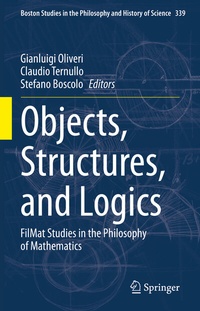
Objects, Structures, and Logics
Description

This edited collection casts light on central issues within contemporary philosophy of mathematics such as the realism/anti-realism dispute; the relationship between logic and metaphysics; and the question of whether mathematics is a science of objects or structures.
The discussions offered in the papers involve an in-depth investigation of, among other things, the notions of mathematical truth, proof, and grounding; and, often, a special emphasis is placed on considerations relating to mathematical practice.
A distinguishing feature of the book is the multicultural nature of the community that has produced it. Philosophers, logicians, and mathematicians have all contributed high-quality articles which will prove valuable to researchers and students alike.
More details
Other editions
Additional editions
Persons
Gianluigi Oliveri obtained a Laurea (BA) in philosophy from the University of Bari (Italy). After that, he received a DPhil in philosophy from the University of Oxford (GB), and a PhD in cognitive science from the University of Messina (Italy).
His research interests range from the philosophy of mathematics, artificial intelligence, and the philosophy of science, to metaphysics and the history of philosophy.
He has held teaching and research posts at the universities of Reading, Leeds, Keele, Oxford and Palermo, and has been
Visiting Scholar
at the
Sydney Centre for the Foundations of Science
of the University of Sydney, Australia. He is, currently, Associate Professor of Logic and the Philosophy of Science at the university of Palermo (Italy), Corresponding Member of the Accademia Nazionale di Scienze, Lettere ed Arti di Palermo (National Academy of Sciences, Letters and Arts of Palermo), and Chairman of the Centro Interdipartimentale per leTecnologie della Conoscenza (Interdepartmental Centre for the Technologies of Knowledge) of the university of Palermo.
Claudio Ternullo
(PhD Liverpool, 2012), is currently Beatriu de Pinós (Marie-Sklodowska Curie Actions COFUND) Post-Doctoral Fellow at the University of Barcelona. Previously, he has held positions as post-doc at the Kurt Gödel Research Center for Mathematical Logic at the University of Vienna and at the University of Tartu. His research interests lie in logic and the philosophy of mathematics, in particular in the philosophy of set theory. His work focuses on the set-theoretic multiverse, new axioms (and their justification) and mathematical platonism (in particular, Gödel's Platonism). He has also done work on issues in ancient and medieval philosophy.
Stefano Boscolo
(PhD Palermo, 2016), is an IT Solution Architect at Volkswagen Group. His current areas of expertise are advanced analytics, cloud computing, and machine learning. After receiving his PhD in Logic and Philosophy of Science, he worked at Ca' Foscari University of Venice on truth pluralism. Throughout his academic career, he worked on the philosophy of mathematics, in particular on the debate between platonism and anti-platonism. His current research interests range from natural-language processing to deep neural networks.
