

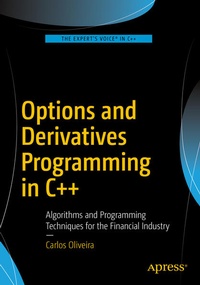
Options and Derivatives Programming in C++
Algorithms and Programming Techniques for the Financial Industry
Published on 30. September 2016
XXIII, 260 pages
978-1-4842-1814-3 (ISBN)
Description

Learn how C++ is used in the development of solutions for options and derivatives trading in the financial industry. As an important part of the financial industry, options and derivatives trading has become increasingly sophisticated. Advanced trading techniques using financial derivatives have been used at banks, hedge funds, and pension funds. Because of stringent performance characteristics, most of these trading systems are developed using C++ as the main implementation language.Options and Derivatives Programming in C++ covers features that are frequently used to write financial software for options and derivatives, including the STL, templates, functional programming, and support for numerical libraries. New features introduced in the C++11 and C++14 standard are also covered: lambda functions, automatic type detection, custom literals, and improved initialization strategies for C++ objects.Readers will enjoy the how-to examples covering all the major tools and concepts used to build working solutions for quantitative finance. It includes advanced C++ concepts as well as the basic building libraries used by modern C++ developers, such as the STL and Boost, while also leveraging knowledge of object-oriented and template-based programming. Options and Derivatives Programming in C++ provides a great value for readers who are trying to use their current programming knowledge in order to become proficient in the style of programming used in large banks, hedge funds, and other investment institutions. The topics covered in the book are introduced in a logical and structured way and even novice programmers will be able to absorb the most important topics and competencies.What You Will Learn
Grasp the fundamental problems in options and derivatives trading Converse intelligently about credit default swaps, Forex derivatives, and more Implement valuation models and trading strategies Build pricing algorithms around the Black-Sholes Model, and also using the Binomial and Differential Equations methods Run quantitative finance algorithms using linear algebra techniques Recognize and apply the most common design patterns used in options trading Save time by using the latest C++ features such as the STL and the Boost libraries Who This Book Is For
Professional developers who have some experience with the C++ language and would like to leverage that knowledge into financial software development. This book is written with the goal of reaching readers who need a concise, algorithms-based book, providing basic information through well-targeted examples and ready to use solutions. Readers will be able to directly apply the concepts and sample code to some of the most common problems faced in the analysis of options and derivative contracts.
More details
Series
Edition
1st ed.
Language
English
Place of publication
Berkeley
United States
Publishing group
APRESS
Target group
Professional and scholarly
Product notice
Reflowable
Illustrations
XXIII, 260 p. 26 illus., 18 illus. in color.
File size
7,02 MB
ISBN-13
978-1-4842-1814-3 (9781484218143)
DOI
10.1007/978-1-4842-1814-3
Schweitzer Classification
Other editions
Additional editions
Carlos Oliveira
Options and Derivatives Programming in C++
Algorithms and Programming Techniques for the Financial Industry
Book
09/2016
APress
€40.65
Article exhausted; check for reprint
Person
Carlos Oliveira
works in the area of quantitative finance, with more than ten years of experience in creating scientific and financial models in C++. During his career, Carlos has developed several large-scale applications for financial companies such as Bloomberg L.P. and F-Squared Investments.
Carlos Oliveira obtained a PhD in Operations Research and Systems Engineering from the University of Florida, an MSc in Computer Science from UFC (Brazil), and a BSc in Computer Science from UECE (Brazil). He has also performed academic research in the field of combinatorial optimization, with applications in diverse areas such as finance, telecommunications, computational biology, and logistics. Carlos has written more than 30 academic papers on optimization, and authored three books, including Practical C++ Financial Programming (Apress, 2015).
Carlos Oliveira obtained a PhD in Operations Research and Systems Engineering from the University of Florida, an MSc in Computer Science from UFC (Brazil), and a BSc in Computer Science from UECE (Brazil). He has also performed academic research in the field of combinatorial optimization, with applications in diverse areas such as finance, telecommunications, computational biology, and logistics. Carlos has written more than 30 academic papers on optimization, and authored three books, including Practical C++ Financial Programming (Apress, 2015).
Content
Chapter 1: Options Concepts.- Chapter 2: Financial Derivatives.- Chapter 3: Basic Algorithms.- Chapter 4: Object-Oriented Techniques.- Chapter 5: Design Patterns for Options Processing.- Chapter 6: Template-Based Techniques.- Chapter 7: STL for Derivatives Programming.- Chapter 8: Functional Programming Techniques.- Chapter 9: Linear Algebra Algorithms.- Chapter 10: Algorithms for Numerical Analysis.- Chapter 11: Models Based on Differential Equations.- Chapter 12: Basic Models for Option Pricing.- Chapter 13: Monte-Carlo Methods.- Chapter 14: Using C++ Libraries for Finance.-Chapter 15: Credit Derivatives.
