

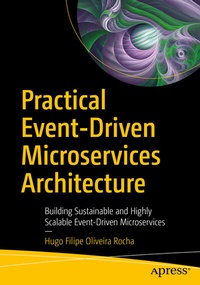
Practical Event-Driven Microservices Architecture
Description

In the simplest terms, event-driven architectures are like onions; they are manageable as a single layer (like a monolith) but when you get into them, they begin to cascade apart and you quickly realize that there are many complex layers (distributed microservices architecture). And that's when the tears begin.
This prescriptive guide takes you through the steps of moving a platform with millions of users from a monolith to a microservices event-driven architecture. You will learn about the challenges and complexities that arise in high-throughput environments that often contain upwards of hundreds of microservices. This book is designed to be your single best resource for learning how to apply event-driven architectures in real-world scenarios and offers hundreds of patterns to overcome the common and not so common challenges.
While event-driven architectures have been the standard for decoupled, pluggable, evolutionary architectures for years, they have onlyrecently been adopted by enterprises for the purpose of distributed microservices and there is little information about adopting them. Using them at scale can save valuable resources, but requires different considerations, including the added complexity of supporting several moving parts and getting the event schema right from the start in order to avoid large restructuring later on.
Author Hugo Rocha understands that these kinds of challenges, as well as many others, need to be considered from the beginning, and helps teach you the mindset needed to create a deliberate strategy upfront. This book offers learning approaches and patterns to get you up to speed in order to sustainably build and manage event-driven architectures.
What You Will Learn
- Understand the real-world challenges of event-driven architectures and the patterns to deal with those challenges and the trade-offs of each solution
- Leverage the advantages of event-driven architectures to build scalable solutions and address legacy applications
- Plan successful future implementations to avoid common pitfalls and apply proven patterns to deal with challenges in a real-world platform with millions of users
- Decide whether event-driven solutions are the right choice for the requirements at hand
- Discuss and understand advanced concepts about event-driven architectures
Who Is This Book For
Software engineers and software architects. Anyone currently working with microservice architectures, primarily event-driven microservices, will greatly benefit from this book. Readers working with monoliths will benefit, as the book explores migration from a monolithic application to an event-driven microservice architecture.
More details
Other editions
Additional editions
Person
Content
