

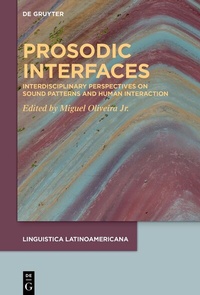
Prosodic Interfaces
Interdisciplinary Perspectives on Sound Patterns and Human Interaction
1st Edition
Published on 4. August 2025
VIII, 282 pages
978-3-11-106030-9 (ISBN)
Description

This book explores the interaction between prosody and other research topics, in Brazilian Portuguese and beyond. Written by experts in the field, the contributions present a variety of studies that range from prosodic variation across languages to multimodal analysis of speech acts and common linguistic structures. It will be of interest for linguists, speech therapists, music researchers and psycholinguists alike.
More details
Series
Language
English
Place of publication
Berlin/Boston
Germany
Target group
Professional and scholarly
US School Grade: College Graduate Student
Illustrations
81 s/w Tabellen, 20 s/w Abbildungen, 2 farbige Tabellen, 42 farbige Abbildungen
20 b/w and 42 col. ill., 81 b/w and 2 col. tbl.
File size
17,05 MB
ISBN-13
978-3-11-106030-9 (9783111060309)
Schweitzer Classification
Other editions
Additional editions

Miguel Oliveira, Jr.
Prosodic Interfaces
Interdisciplinary Perspectives on Sound Patterns and Human Interaction
Book
08/2025
1st Edition
De Gruyter
€119.95
Shipment within 5-7 days

Miguel Oliveira, Jr.
Prosodic Interfaces
Interdisciplinary Perspectives on Sound Patterns and Human Interaction
E-Book
08/2025
1st Edition
De Gruyter
€119.95
Available for download
Person
Miguel Oliveira Jr ., Universidade Federal da Alagoas, Maceió, Brazil.
Content
- Intro
- Preface
- Contents
- Prosody and L2 Learning Interface: The Case of Spanish L2 and Brazilian Portuguese L1 Intonation
- 1 Introduction
- 2 The Intonation of wh-questions
- 2.1 Spanish and BP L1
- 2.2 Learning wh-questions
- 3 Previous Results
- 4 Goals of the Present Study
- 5 Methodology
- 5.1 Speakers
- 5.2 Speech Material
- 5.3 Analysis Procedure
- 5.4 Statistical Analysis
- 6 Results and Discussion
- 7 Conclusions
- References
- The Role of Prosody in the Processing of Ambiguities in Brazilian Portuguese: A Visual World Paradigm Study
- 1 Introduction
- 2 Background
- 3 Method
- 4 Results
- 4.1 Preferences for NP1 and NP2 Areas Analyzed Together
- 4.1.1 'np1' Segment (NP1 and NP2 Areas)
- 4.1.2 'np2' Segment (NP1 and NP2 Areas)
- 4.1.3 'very' Segment (NP1 and NP2)
- 4.1.4 'adj' Segment (NP1 and NP2)
- 4.1.5 'end' Segment (NP1 and NP2)
- 4.2 Preferences for NP1 Area
- 4.2.1 'very' ('Bastante') Segment
- 4.2.2 'adj' Segment
- 4.2.3 'end' segment
- 4.3 Preferences for NP2 Area
- 4.3.1 'very' ('Bastante') Segment
- 4.3.2 'adj' Segment
- 4.3.3 'end' Segment
- 4.4 Analysis of the 'Area' Factor, by Condition and by Segment
- 5 Discussion and Conclusion
- References
- Defining and Identifying Discourse Markers in Spontaneous Speech: A corpus-based and experimental proposal
- 1 Introduction
- 2 The Problem. Discourse Markers in the Literature
- 3 Our Theoretical Framework
- 4 Different Functions for DMs
- 4.1 Methodological Premise
- 4.2 Functional Distinctions and Formal Correlates for DMs
- 4.2.1 Previous Studies
- 4.2.2 Five Different Interactional DMs
- 4.2.2.1 Incipit
- 4.2.2.2 Conative and Allocutive
- 4.2.2.3 Expressive
- 4.2.2.4 Highlighter
- 5 The Perceptual Experiment
- 5.1 The Data Selection
- 5.2 Dataset of the Experiment
- 5.3 Participants
- 5.4 Paradigm
- 5.5 Statistical Analysis
- 5.6 Results
- 6 Conclusions & Perspectives
- References
- A Contribution to a Better Understanding of Silent Pause
- 1 What the Literature Says
- 2 The Role of Pause in the Perception of Prosodic Boundaries
- 3 Investigation of Pause Perception
- 3.1 Data for Pause Perception Task
- 3.2 Annotators, Task Instructions and Agreement
- 3.3 Analysis of the Minimal Duration for Perceived Pause
- 3.4 Factors Potentially Responsible for Pause Perception
- 3.4.1 The Analysis Results
- 3.5 General Discussion
- References
- Perceptual and Physiological Correlates of Voice Quality Settings
- 1 Introduction
- 2 Literature Review - State of the Art Dialogue
- 2.1 Theoretical Basis of the Phonetic Description of Voice Quality Model and the VPAS Instrument
- 2.2 Overview of Research on Voice Quality
- 3 Methods
- 3.1 Ethics Committee
- 3.2 Research Corpus Composition
- 3.3 Data Collection Procedures
- 3.4 Data Analysis Procedures
- 4 Results and Discussion
- 4.1 Auditory Vocal Profiles
- 4.2 Visual Mapping of VQSs Influences: Ultrasound Tongue Images of Key Segments for Phonetic Evaluation of Voice Qualities
- 5 Conclusions
- References
- Multimodal Analysis of Speech Attractiveness Expression
- 1 Introduction
- 2 On Charisma and Vocal Prosody
- 3 On Charisma and Visual Prosody
- 4 Material and Method
- 4.1 Corpus
- 4.2 The Research Subject
- 4.3 Methodological Procedures
- 4.4 Perceptual-Semantic Analysis
- 4.5 Acoustic Analysis
- 4.6 Perceptual Voice Quality Analysis
- 4.7 Facial Expression Analysis
- 4.8 Statistical Analysis
- 5 Results
- 5.1 Perceptual-Semantic Test Results
- 5.2 Perceptual Voice Quality Analysis Results
- 5.3 Facial Expression Analysis Results
- 5.4 Acoustic Analysis Results
- 5.5 Statistical Results on the Automatic Acoustic and Automated Facial Analysis
- 6 Discussion
- 7 Final Comments
- Appendix 1 Perceptual-Semantic Test
- Appendix 2 VPA (Laver and Mackenzie Beck, 2007)
- References
- Posture and Gestures Can Affect the Prosodic Speaker Impact in a Remote Presentation
- 1 Introduction
- 1.1 Speech Communication in Video Calls: Uncharted Territory
- 1.2 Nonverbal Communication Signals in Video Calls
- 1.2.1 Knowledge Gap 1: Use of Gestures
- 1.2.2 Knowledge Gap 2: The Prosody-Gesture Link
- 1.2.3 Knowledge Gap 3: Posture and Its Influence on Gestures and Prosodies
- 1.3 Motivation, Aim and Questions
- 2 Method
- 2.1 Speakers and Language
- 2.2 Speech Material
- 2.3 Elicitation Procedure and Independent Variable Body
- 2.4 Gesture Analysis and Dependent Variable Gesture Count
- 2.5 Prosodic Analysis
- 2.5.1 Parameters and Dependent Variables Related to Rhythm
- 2.5.2 Parameters and Dependent Variables Related to Intonation and Voice
- 2.6 Inferential Statistics
- 3 Results
- 3.1 Gestures
- 3.2 Rhythm
- 3.3 Intonation and Voice
- 4 Discussion
- References
- An Acoustic Analysis of Creaky Voice Patterns in Singing
- 1 Introduction
- 2 The Definitions of Creaky Voice and Vocal Fry
- 3 One Single Definition of Creakiness
- 4 The Distinction Between Creaky Voice and Vocal Fry
- 5 Five Different Types of Creaky Voice
- 6 Examples of Vocal Fry and Creaky Voice
- 7 Analysis of Creaky Voice and Vocal Fry in Singing
- 8 Conclusion
- References
- Evaluating OpenAI's Whisper ASR for Punctuation Prediction and Topic Modeling of life histories of the Museum of the Person
- 1 Introduction
- 2 Related Work
- 2.1 Punctuation Prediction: Approaches, Datasets, Features, Evaluation Metrics and Results
- 2.2 Transcript-based Video Topic Modeling
- 3 OpenAI's Whisper
- 3.1 Whisper Features
- 3.2 Illustrating the Use of Whisper for Punctuation Prediction in Portuguese
- 4 Experimental Setup
- 4.1 Evaluation Dataset
- 4.2 Data Preparation
- 4.2.1 Data Preparation for Punctuation Analysis
- 4.2.2 Data Preparation for Transcript-based Video Topic Modeling
- 5 Results and Discussion
- 5.1 Results for Punctuation Prediction
- 5.2 Results for Transcript-based Video Topic Modeling
- 6 Conclusions and Future Work
- References
- Index
