

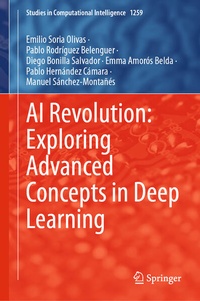
AI Revolution: Exploring Advanced Concepts in Deep Learning
Description

This comprehensive textbook offers a unique approach to learning machine learning and deep learning by seamlessly integrating theoretical foundations with hands-on laboratory exercises. The book bridges the gap between theory and practice, providing students and practitioners with both the conceptual understanding and practical implementation skills necessary in today's AI landscape.
Each chapter follows a carefully structured format that combines theoretical explanations with immediate practical applications. This innovative approach allows readers to reinforce their understanding through direct implementation, creating a more engaging and effective learning experience.
More details
Other editions
Additional editions
Persons
Emilio Soria-Olivas received his B.Sc. degree (with honors) in Physics from the Universitat de València, Spain, in 1992, and his Ph.D. degree (cum laude) in Electronic Engineering in 1997. He is currently a Full Professor in the Electronic Engineering Department at the Universitat de València. His research focuses on the medical applications of advanced data analysis.
Pablo Rodríguez Belenguer is a researcher in the field of medical imaging at the GIBI2³0 group of the La Fe Health Research Institute. He received his PhD in Biomedicine in 2024, specializing in AI models applied to healthcare. His research interests include computer vision, deep learning, and reinforcement learning, with publications in top-tier journals and international conferences. He has collaborated on various interdisciplinary research initiatives (with research institutes, academia, and pharmaceutical companies) and is particularly focused on the clinical translation of AI systems and their integration into real-world healthcare environments.
Diego Bonilla Salvador is a Deep Learning and Computer Vision researcher at Mango. Specialized and studied diffusion models and State of the Art Deep Learning architectures. He also has taught at several universities and master degrees as an instructor, like in University of Valencia. Jazz musician in his little free time.
Emma Amorós Belda is a Machine Learning Engineer at Openbank and a Ph.D. candidate in Artificial Intelligence at the University of Valencia. With a background in Physics and Data Science, her work spans predictive modelling, anomaly detection, and specializes in developing AI models and cloud-based solutions. She collaborates with the Intelligent Data Analysis Laboratory (IDAL) and teaches in the University of Valencia's Master in Data Science program.
Pablo Hernández-Cámara is a postdoctoral researcher at the Image Processing Laboratory of the Universitat de València. He received his PhD in Electronic Engineering in 2025, specializing in perceptual alignment between human vision and deep neural networks. His research interests include computer vision, deep learning, and bio-inspired models of perception, with publications in leading journals and conferences. He has participated in multiple national and international research projects and regularly contributes to academic teaching and scientific outreach.
Manuel Sánchez-Montañés received his B.Sc. degree (with honors) in Physics from the Universidad Complutense de Madrid, Spain, 1997, and Ph.D. degree (cum laude) in Computer Science from the Universidad Autónoma de Madrid, Spain, 2003. He is currently part of the permanent faculty of the Computer Science Department, Universidad Autónoma de Madrid. His research activity is focused in Artificial Intelligence and Advanced Data Analysis, carrying out theoretical developments and applications.
Content
Deep learning basics.- Convolutional Neural Networks.- Recurrent Neural Networks.- Attention Mechanisms, Transformers and LLMs.
