

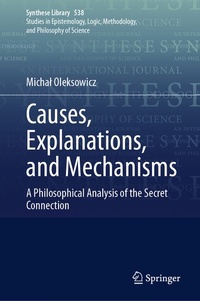
Causes, Explanations, and Mechanisms
Description

This book provides a philosophical analysis of the link between the concept of causation, explanation and mechanisms. It addresses the rapidly expanding field of the new mechanical philosophy from a historical and theoretical point of view, and presents the philosophical ideas that have impacted the mechanistic project and the limits of this project as seen from various explanatory contexts. Furthermore, the book focuses in a succinct manner on the metaphysical and methodological aspects of the new mechanical philosophy and proposes suggestions for future work on the issue of causes and mechanisms. The chapters, accessible to both philosophers and scientists, serve as a helpful tool to the current debate surrounding mechanism, explanation and causation. The variety and range of coverage in this book makes it a perfect choice for students of history and philosophy of science, students of the sciences, and scholars interested in the philosophy of science.
More details
Other editions
Additional editions
Person
Michal Oleksowicz is a researcher at the Faculty of Philosophy and Social Sciences (Institute of Philosophy, Department of Logic) at Nicolaus Copernicus University in Torun. From 2022-2025 he has been a board member of the Polish Association for Logic and Philosophy of Science. From 2022-2024, he was the principal investigator of the research project New Mechanicism and theology (2021/41/N/HS1/01338), funded by the National Science Centre in Poland. Currently, he is the principal investigator (2024-2027) of the project Philosophical-logical foundations of mechanistic causation (2024/52/C/HS1/00179), funded by the National Science Centre in Poland. The editor of the volume Hypotheses in Science, part of the book series Synthese Library (SYLI, volume 536). His main research interests are: philosophical logic, philosophical aspects of causation and causal explanations, especially mechanistic explanation and its application to various explanatory contexts.
Content
Dedication.- List of Abbreviations.- Part I: Causes and Mechanisms: A Historical and Theoretical Background.- Chapter 1. Introduction.- Chapter 2. Mechanical Philosophies and Mechanical Worldviews.- Chapter 3. Hume, Mach, and Russell on Causation.- Chapter 4. Various Perspectives on Causation and Causal Explanation and Their Impact on the New Mechanical Philosophy.- Part II: Mechanisms: An Ontological and Epistemological Perspective.- Chapter 5. What Are the New Mechanists Pluralistic About?.- Chapter 6. Ontic or Epistemic Conception of Explanation: A Misleading Distinction?.- Part III: Mechanisms: Various Explanatory Contexts.- Chapter 7. The New Mechanists on the Explanatory Role of Scientific Models: The Case of the Hodgkin-Huxley Model.- Chapter 8. An Ontic-Epistemic Approach to Explanatory Problems in Biology.- Chapter 9. Feasibility of the Mechanistic Explanation in the Case of Near-Death Experiences: Nothing but a Reductionism?.- Chapter 10. Defective Idealizations and Deeply Idealized Mechanisms.- Chapter 11. Conclusions.- Index.
