

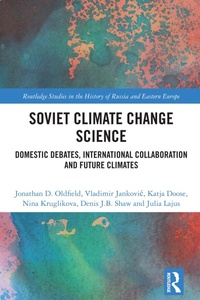
Soviet Climate Change Science
Domestic Debates, International Collaboration and Future Climates
Published on 10. November 2025
184 pages
978-1-040-50109-2 (ISBN)
Description

Soviet Climate Change Science explores the character and range of Soviet contributions to the emerging understanding of large-scale anthropogenic climate change during the post-1945 period. More specifically, it examines the role of Soviet scientists in helping to shape the debate, both domestically and on the international stage, and with a particular focus on the period 1960s to the 1980s.
The book details the institutional underpinnings of Soviet activity in this area, the main scientific debates evident within key centres of climate-related science and the activities of Soviet scientists with respect to a range of international collaborations such as the 1972 US-USSR Agreement on Cooperation in the Field of Environmental Protection, the early work of the Intergovernmental Panel on Climate Change (IPCC) and the Greenhouse Glasnost initiative, which included the world's first teleconference on climate change. It concludes with a reflection on the extent to which Soviet scientific legacies continued to shape Russian approaches to climate change post-1991.
This book will be of interest to those working on the historical and sociocultural aspects of climate change, providing the first detailed assessment of Soviet involvement in this critical area of scientific activity.
The book details the institutional underpinnings of Soviet activity in this area, the main scientific debates evident within key centres of climate-related science and the activities of Soviet scientists with respect to a range of international collaborations such as the 1972 US-USSR Agreement on Cooperation in the Field of Environmental Protection, the early work of the Intergovernmental Panel on Climate Change (IPCC) and the Greenhouse Glasnost initiative, which included the world's first teleconference on climate change. It concludes with a reflection on the extent to which Soviet scientific legacies continued to shape Russian approaches to climate change post-1991.
This book will be of interest to those working on the historical and sociocultural aspects of climate change, providing the first detailed assessment of Soviet involvement in this critical area of scientific activity.
More details
Series
Language
English
Place of publication
London
United Kingdom
Publishing group
Taylor & Francis Ltd
Target group
Professional and scholarly
College/higher education
Illustrations
10 Tables, black and white
File size
5,20 MB
ISBN-13
978-1-040-50109-2 (9781040501092)
Copyright in bibliographic data and cover images is held by Nielsen Book Services Limited or by the publishers or by their respective licensors: all rights reserved.
Schweitzer Classification
Other editions
Additional editions
Jonathan D. Oldfield | Vladimir Jankovic | Katja Doose
Soviet Climate Change Science
Domestic Debates, International Collaboration and Future Climates
Book
11/2025
1st Edition
Routledge
€206.00
Shipment within 10-20 days
Persons
Jonathan D. Oldfield is Professor in Russian Environmental Studies at the University of Birmingham, UK. His current research explores Soviet and Russian understandings of climate science, geoengineering and society-nature interactions.
Vladimir Jankovic is Reader in History of Science and Atmospheric Humanities at the University of Manchester. His main area of research focuses on the cultures of weather and climate since the 1700s. He is Chair of the History Group of the Royal Meteorological Society. He has previously published Reading the Skies (2001) and Confronting the Climate (2011) and is currently writing on the bilateral approach to climate research during the Cold War.
Katja Doose is Assistant Professor at the University Lyon 2. She works on the environmental history of the nineteenth and twentieth centuries and the history of the earth sciences.
Nina Kruglikova was a postdoctoral researcher on the 'Soviet Climate Science and Its Intellectual Legacies' project at the University of Birmingham and an honorary research associate in the School of Geography and the Environment at the University of Oxford. She holds a DPhil in Geography and the Environment from Trinity College, Oxford, and her research expertise covers sustainable development, climate change studies and climate science diplomacy. She is currrently Research Associate in the History and Philosophy of Science at the University of Manchester.
Denis J.B. Shaw was an honorary senior research fellow at the University of Birmingham, UK, where he had formerly been Reader in Russian Geography. His most recent book, published posthumously, was titled Reconnoitring Russia: Mapping Exploring and Describing Early Modern Russia, 1613-1825 (2024).
Julia Lajus is a Core Fellow at the Helsinki Collegium for Advanced Studies (HCAS), University of Helsinki, Finland. In 2023, she was a visiting associate professor at Columbia University in the City of New York, where she taught the history of the Arctic and the history of climate science. She publishes on the history of marine and polar environments and sciences.
Vladimir Jankovic is Reader in History of Science and Atmospheric Humanities at the University of Manchester. His main area of research focuses on the cultures of weather and climate since the 1700s. He is Chair of the History Group of the Royal Meteorological Society. He has previously published Reading the Skies (2001) and Confronting the Climate (2011) and is currently writing on the bilateral approach to climate research during the Cold War.
Katja Doose is Assistant Professor at the University Lyon 2. She works on the environmental history of the nineteenth and twentieth centuries and the history of the earth sciences.
Nina Kruglikova was a postdoctoral researcher on the 'Soviet Climate Science and Its Intellectual Legacies' project at the University of Birmingham and an honorary research associate in the School of Geography and the Environment at the University of Oxford. She holds a DPhil in Geography and the Environment from Trinity College, Oxford, and her research expertise covers sustainable development, climate change studies and climate science diplomacy. She is currrently Research Associate in the History and Philosophy of Science at the University of Manchester.
Denis J.B. Shaw was an honorary senior research fellow at the University of Birmingham, UK, where he had formerly been Reader in Russian Geography. His most recent book, published posthumously, was titled Reconnoitring Russia: Mapping Exploring and Describing Early Modern Russia, 1613-1825 (2024).
Julia Lajus is a Core Fellow at the Helsinki Collegium for Advanced Studies (HCAS), University of Helsinki, Finland. In 2023, she was a visiting associate professor at Columbia University in the City of New York, where she taught the history of the Arctic and the history of climate science. She publishes on the history of marine and polar environments and sciences.
Content
Chapter 1 Soviet science and the challenge of climate change
Chapter 2 Institutional underpinnings of climate science in the Soviet Union
Chapter 3 Soviet scientific debates concerning climate change
Chapter 4 Cold War climate science: collaboration and competition, 1945-1991
Chapter 5 Greenhouse glasnost
Chapter 6 Soviet climate science, its legacies and climate politics
Chapter 7 Conclusion
Chapter 2 Institutional underpinnings of climate science in the Soviet Union
Chapter 3 Soviet scientific debates concerning climate change
Chapter 4 Cold War climate science: collaboration and competition, 1945-1991
Chapter 5 Greenhouse glasnost
Chapter 6 Soviet climate science, its legacies and climate politics
Chapter 7 Conclusion
