

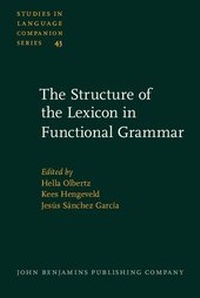
The Structure of the Lexicon in Functional Grammar
1st Edition
Published on 15. June 1998
XII, 312 pages
978-90-272-8189-0 (ISBN)
Description

The papers collected in this volume concern five different aspects of the role of the lexicon in the theory of Functional Grammar such as developed by Simon C. Dik and his co-workers. The volume starts off with an eminently practical section on the Functional-Lexematic Model, a lexicological and lexicographical system which has largely been inspired by Dik's principle of stepwise lexical decomposition. In addition to a theoretical introduction to the model, applications to English, German and Spanish are presented. The second part of the volume deals with the derivation of action-nouns, pseudo-reflexive verbs and causative constructions, thus offering new perspectives on predicate formation within Functional Grammar. This is followed by a section that centres around an important problem related to valency which up to now has had almost no attention within Functional Grammar: the question of how to account for the collocational properties of predicates. The fourth part of the book discusses (non-prototypical) transitive verbs and their relation to the typology of states of affairs, which leads to proposals of possible adaptations of Dik's typology. The final section focusses on the relationship between the lexicon and the underlying structure of the clause. Three proposals of varying degrees of radicalism are presented to reconsider this relation.
More details
Other editions
Additional editions
Hella Olbertz | Kees Hengeveld | Jesus Sanchez Garcia
The Structure of the Lexicon in Functional Grammar
Book
06/1998
John Benjamins Publishing Co
€121.90
Shipment within 10-15 days
Persons
Content
- Intro
- CONTENTS
- Introduction
- Part 1. The Functional-Lexematic Model
- Methodological criteria for the elaboration of a functional lexicon-based grammar of the semantic domain of cognitive verbs
- A functional-lexematic description of the verbal core lexicon of the German language
- The compilation of a Spanish verbal lexicon based on functional-lexematic principles
- Cognitive abilities from a functional-lexematic perspective
- Meaning definitions and grammatical properties of predicates: Russian verbs of possession
- Part 2. Predicate Formation
- Support verb constructions as predicate formation
- Predicate formation for French pseudo-reflexive constructions? With special reference to the verbs referring to an affective process
- Causatives in Dutch and Swedish
- Part 3. Collocations
- Enriching the Functional Grammar lexicon
- Treatment of senses and collocations in dictionaries: an issue for lexicology and lexicography
- Part 4. Transitive Verbs and the Typology of States of Affairs
- A prototype approach to transitivity: its implications for the FG typology of SoAs
- On some semantic, pragmatic and formal issues in the study of causative constructions
- Part 5. The Lexicon and the Underlying Structure of the Clause
- The lexicon in FG and SFG: on the relation between syntax and semantics
- Pronouns, adpositions, "adverbs" and the lexicon
- The Dynamic Lexicon from a functional perspective
- List of contributors
- Index of names
- Subject index
