

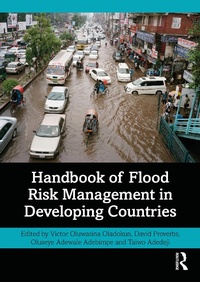
Handbook of Flood Risk Management in Developing Countries
1st Edition
Published on 31. March 2023
414 pages
978-1-000-84770-3 (ISBN)
Description

This new handbook brings together various views and experiences of the impacts of flooding and its management in Africa, Asia and Latin America by drawing from traditional and modern approaches adopted by communities, homeowners, academics, project managers, institutions and policy makers. Key stakeholders provide insights and perspectives on flood hazards, flood impacts, flood control and adaptation strategies across these regions. The inclusion of policy makers, emergency responders, leaders of key organizations and managers of flood defence projects makes this volume a unique addition to the flood management literature.
The chapters are organized to reveal various impacts and challenges associated with the management of flooding, including response and recovery. The chapter contributions bring together the different impacts of flooding and propose various mitigation approaches. They describe procedures for managing flooding and reducing the impacts from the perspectives of policy makers, environmental planners and restorers of flood-affected communities. Also, the book considers some of the related aspects including land use, waste management, drainage systems, security challenges, urban planning and development and their contributions to flooding.
The book's primary target is experienced researchers and practitioners in flood risk management. It would also serve as a key text for postgraduate students studying related programmes. Inhabitants of flood prone communities in such developing countries will also find the text an important resource for guidance and understanding. This multi-disciplinary book represents a valuable contribution for a wide range of professionals (e.g. in engineering, built environment, health, retail, etc) who are interested in flood control and management and/or faced with flood-related challenges in the course of their work.
The chapters are organized to reveal various impacts and challenges associated with the management of flooding, including response and recovery. The chapter contributions bring together the different impacts of flooding and propose various mitigation approaches. They describe procedures for managing flooding and reducing the impacts from the perspectives of policy makers, environmental planners and restorers of flood-affected communities. Also, the book considers some of the related aspects including land use, waste management, drainage systems, security challenges, urban planning and development and their contributions to flooding.
The book's primary target is experienced researchers and practitioners in flood risk management. It would also serve as a key text for postgraduate students studying related programmes. Inhabitants of flood prone communities in such developing countries will also find the text an important resource for guidance and understanding. This multi-disciplinary book represents a valuable contribution for a wide range of professionals (e.g. in engineering, built environment, health, retail, etc) who are interested in flood control and management and/or faced with flood-related challenges in the course of their work.
More details
Edition
1. Auflage
Language
English
Place of publication
London
United Kingdom
Publishing group
Taylor & Francis Ltd
Target group
College/higher education
Professional and scholarly
Illustrations
43 Tables, black and white; 6 Line drawings, color; 48 Line drawings, black and white; 24 Halftones, color; 34 Halftones, black and white; 30 Illustrations, color; 82 Illustrations, black and white
ISBN-13
978-1-000-84770-3 (9781000847703)
Copyright in bibliographic data and cover images is held by Nielsen Book Services Limited or by the publishers or by their respective licensors: all rights reserved.
Schweitzer Classification
Other editions
Additional editions
Victor Oladokun | David Proverbs | Oluseye Adebimpe
Handbook of Flood Risk Management in Developing Countries
Book
approx. 06/2026
1st Edition
Routledge
€72.50
Not yet published
Victor Oladokun | David Proverbs | Oluseye Adebimpe
Handbook of Flood Risk Management in Developing Countries
Book
03/2023
1st Edition
Routledge
€265.30
Shipment within 15-20 days
Persons
Victor Oluwasina Oladokun, Ph.D., a professor of industrial and production engineering at the University of Ibadan, Nigeria, is a senior Fulbright scholar and a Commonwealth academic fellow. Professor Oladokun, a certified SAP trainer/consultant, is the Deputy Dean, University of Ibadan School of Business. He is a member of the Academic Board of SAP University Alliances Africa (ESEFA) and a member of the Commonwealth Scholarship Commission Alumni Advisory Panel. Engr. Oladokun, a member of the Nigerian Society of Engineers, worked in the heavy equipment service sector before joining academics. He has extensive experience in teaching, research, mentoring, leadership and curricula development and has been involved in several multidisciplinary and international collaborative initiatives. As the Chair of the Department of Industrial and Production Engineering, he led the successful development and deployment of a new professional master's program in engineering management to create a vital university-industry link. Professor Oladokun has served as a visiting research fellow at universities in the United Kingdom, United States and Nigeria. His research interests include disaster risk management and resilience modelling. His ongoing research includes the application of digital twin and IoT systems for disaster risk management and supply chain resilience improvement. Prof Oladokun teaches undergraduate and postgraduate courses in applied optimization, operation management, project management, scheduling, reliability engineering, soft computing, entrepreneurship, supply chain management and enterprise systems.
Professor David Proverbs is Dean of the Faculty of Science and Engineering at the University of Wolverhampton. He has over 25 ?years of experience in higher education and has held strategic leadership roles in three modern universities, where he has championed student learning as a research-driven, curriculum-active and enterprising academic. David has developed significant regional, national and international research and enterprise collaborations, drawing on a range of funding sources to pioneer innovative solutions towards improving resilience to flooding. He has pioneered the development of flood recovery approaches to the benefit of many governments, agencies, charities, companies and institutions worldwide. His research has had significant national and international impact in the development of UK climate change policy; as a trustee advising on global research grant awards; and through supporting the development of national flood risk strategies, for example, in Brazil, China, Nigeria, Peru and the United Kingdom. He is a member and lead innovation adviser to the Environment Agency's Regional Flood and Coastal Committee. He has published extensively on a range of flood risk management topics, including adaptation, resilience and recovery. David is an experienced editor and is Chief Editor of the International Journal of Building Pathology and Adaptation (Emerald), Guest Editor of two recent special issues of the Water journal on flood risk and Editor of a number of books related to flooding and climate change. He is Co-Chair to the bi-annual International Conference on Flood and Urban Water Management (FRIAR).
Oluseye Adewale Adebimpe is a young academic and doctoral student at the Department of Industrial and Production Engineering, University of Ibadan, Nigeria. He is a certified SAP trainer, SAP ERP consultant, Fulbright scholar and Erasmus scholar. Oluseye is registered with the apex engineering body in Nigeria (Council for the Regulation of Engineering in Nigeria) and is a member of the Nigerian Society of Engineers. Oluseye had vast experience in the manufacturing sector which spans production and management of engineering systems before joining academics. He is a teacher, researcher and mentor with publications in reputable journals. He has served as a research student in the United Kingdom and United States. His research interests include flood risk management and renewable energy storage. His ongoing research includes developing models for flood resilience measurement, measuring flood vulnerability and developing a model for evaluating integrated solar photovoltaic and pumped-hydro storage systems. Oluseye teaches undergraduate and professional courses in energy systems modelling, terotechnology, industrial quality control, manufacturing systems and supply chain management.
Dr. Taiwo Adedeji is a lecturer at the Department of Design, Manufacturing and Engineering Management at the University of Strathclyde, Glasgow. He has over eight years of teaching experience in higher education, with a passion for student learning and ability to impart complex information to audiences of all levels. He has developed particular expertise in flood risk management and is committed to helping communities respond and adapt to climate change. He has published his research findings in a range of outputs, including Q1 journals, book chapters and research reports. Taiwo is currently a reviewer for the International Journal of Building Pathology and Adaptation (Emerald).
Professor David Proverbs is Dean of the Faculty of Science and Engineering at the University of Wolverhampton. He has over 25 ?years of experience in higher education and has held strategic leadership roles in three modern universities, where he has championed student learning as a research-driven, curriculum-active and enterprising academic. David has developed significant regional, national and international research and enterprise collaborations, drawing on a range of funding sources to pioneer innovative solutions towards improving resilience to flooding. He has pioneered the development of flood recovery approaches to the benefit of many governments, agencies, charities, companies and institutions worldwide. His research has had significant national and international impact in the development of UK climate change policy; as a trustee advising on global research grant awards; and through supporting the development of national flood risk strategies, for example, in Brazil, China, Nigeria, Peru and the United Kingdom. He is a member and lead innovation adviser to the Environment Agency's Regional Flood and Coastal Committee. He has published extensively on a range of flood risk management topics, including adaptation, resilience and recovery. David is an experienced editor and is Chief Editor of the International Journal of Building Pathology and Adaptation (Emerald), Guest Editor of two recent special issues of the Water journal on flood risk and Editor of a number of books related to flooding and climate change. He is Co-Chair to the bi-annual International Conference on Flood and Urban Water Management (FRIAR).
Oluseye Adewale Adebimpe is a young academic and doctoral student at the Department of Industrial and Production Engineering, University of Ibadan, Nigeria. He is a certified SAP trainer, SAP ERP consultant, Fulbright scholar and Erasmus scholar. Oluseye is registered with the apex engineering body in Nigeria (Council for the Regulation of Engineering in Nigeria) and is a member of the Nigerian Society of Engineers. Oluseye had vast experience in the manufacturing sector which spans production and management of engineering systems before joining academics. He is a teacher, researcher and mentor with publications in reputable journals. He has served as a research student in the United Kingdom and United States. His research interests include flood risk management and renewable energy storage. His ongoing research includes developing models for flood resilience measurement, measuring flood vulnerability and developing a model for evaluating integrated solar photovoltaic and pumped-hydro storage systems. Oluseye teaches undergraduate and professional courses in energy systems modelling, terotechnology, industrial quality control, manufacturing systems and supply chain management.
Dr. Taiwo Adedeji is a lecturer at the Department of Design, Manufacturing and Engineering Management at the University of Strathclyde, Glasgow. He has over eight years of teaching experience in higher education, with a passion for student learning and ability to impart complex information to audiences of all levels. He has developed particular expertise in flood risk management and is committed to helping communities respond and adapt to climate change. He has published his research findings in a range of outputs, including Q1 journals, book chapters and research reports. Taiwo is currently a reviewer for the International Journal of Building Pathology and Adaptation (Emerald).
Content
1. Handbook of flood risk management in developing countries Section 1: Impacts, challenges and particularities 2. Impacts of floods on infrastructures in developing countries: focus on Bangladesh 3. Impacts of flooding on agriculture and food security in developing countries: evidence from Southeastern Nigeria 4. Adoption pathway for flood-resilient construction and adaptation in Ghana 5. Resettlement as a flood-preventive measure in Sri Lanka: investigation into the socio-economic impacts 6. A survey-based approach to estimating the downtime of buildings damaged by flood in developing countries Section 2: Preparedness, prevention, responses and recovery 7. Application of spatial planning and other tools to support preparedness for flooding in developing countries; example from Nigeria 8. Understanding engineering approaches to urban flood management in Indonesia 9. Restoration and recovery of flood-affected communities 10. Preparedness and management of (flood) disaster amid a pandemic in a developing country: lessons from Cyclone Amphan in southwestern Bangladesh 11. A review of the flooding events in southern Brazil: challenges and opportunities Section 3: Risk assessments, flood mitigation and project management 12. Flood vulnerability in developing countries, international collaboration, and network visualization: a bibliometric analysis 13. Flood risk assessment in developing countries: dealing with data quality and availability 14. Flood risk management projects: financing and project implementation, the case of Ibadan Urban Flood Management Project 15. Current knowledge, uncertainties, and aspirations of flood risk management policy for developing countries Section 4: Infrastructure systems, urban systems and their management 16. Integrated water resources management and flood risk management: opportunities and challenges in developing countries 17. Developing resilient cities in developing countries 18. Flood risk and urban infrastructure sustainability in a developing country: a case study of Central Java Province, Indonesia 19. A review of flood management in South Asia: approaches, challenges, and opportunities Section 5: Community perspectives, resilience and adaptation 20. The role of education in flood risk management: building a resilient generation in developing countries 21. Emerging resilience to urban flooding in low-income communities: a socio-cultural perspective from Ghana 22. Towards a socially just flood risk management in developing countries: lessons from serving the last mile in Malawi 23. Exploring the perspective of school children on flood risk management in developing countries: lessons from Ghana 24. Conclusions and final remarks
