

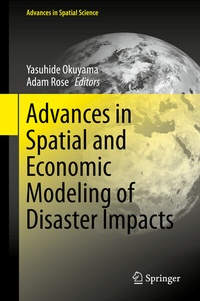
Advances in Spatial and Economic Modeling of Disaster Impacts
Description

This book presents essential advances in analytical frameworks and tools for modeling the spatial and economic impacts of disasters. In the wake of natural disasters, such as Hurricane Katrina, the Haiti Earthquake, and the East Japan Earthquake and Tsunami, as well as major terrorist attacks, the book analyzes disaster impacts from various perspectives, including resilience, space-time extensions, and decision-making strategies, in order to better understand how and to what extent these events impact economies and societies around the world.
The contributing authors are internationally recognized experts from various disciplines, such as economics, geography, planning, regional science, civil engineering, and risk management. Thanks to the insights they provide, the book will benefit not only researchers in these and related fields, but also graduate students, disaster management professionals, and other decision-makers.
More details
Other editions
Additional editions
Persons
Yasuhide Okuyama is a Professor in the University of Kitakyushu, Japan. He earned his doctoral degree in regional planning from the University of Illinois at Urbana-Champaign in 1999. He also holds master's degrees from the University of Wisconsin-Madison (urban and regional planning, 1994) and from the University of Tsukuba, Japan (environmental science, 1986). His research interests center on economic impacts of disasters, regional science, input-output analysis, and urban and regional planning. He has published a number of articles in various academic journals and book chapters, and edited a book titled " Modeling Spatial and Economic Impacts of Disasters " in 2004 with Professor Stephanie Chang of the University of British Columbia. In addition, he has been contributing to research projects and consultation for organizations such as the World Bank, European Commission, Economic Research Institute for ASEAN and East Asia (ERIA), and Japan Bank for International Cooperation.
Adam Rose is a Research Professor in the University of Southern California Sol Price School of Public Policy, and a Research Fellow of USC's Center for Risk and Economic Analysis of Terrorism Events (CREATE). Professor Rose's primary research interest is the economics of natural disasters and terrorism. He has spearheaded the development of CREATE's comprehensive economic consequence analysis framework to include aspects of mitigation, resilience, behavioral responses, and remediation. He has done pioneering theoretical and empirical research on resilience to disasters at the level of the individual business/household, market/industry and regional/national economy. Professor Rose is the author of several books and 250 professional papers, including most recently
Economic Consequence Analysis of Disasters
:
The E-CAT Software Tool
(Springer),
and
Defining and Measuring Economic Resilience from a Societal, Environmental and Security Perspective
(Springer). He is a Fellow of the Regional Science Association International and President of the International Society for Integrated Disaster Risk Management.
