

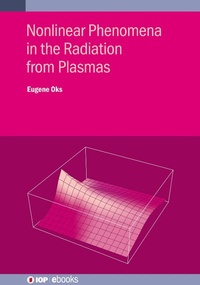
Nonlinear Phenomena in the Radiation from Plasmas
Description

Nonlinearity is omnipresent in nature and in laboratory experiments. The overturning of a wave coming towards a beach is an example of the nonlinearity in nature that many people see. An ubiquitous example of man-made nonlinearity is electric circuits: as the current heats the wire, its resistance changes, meaning that the linear Ohm's law is no longer valid. The radiation from plasmas is no exception. The nonlinear phenomena in the radiation from plasmas are fundamentally important because of the rich physics behind these phenomena. They are also practically important because the most informative way to study laboratory and astrophysical plasmas is by analysing their radiation.
These nonlinear phenomena constitute the subject of this comprehensive book. First, the book covers various nonlinear phenomena occurring in plasmas containing quasimonochromic electric fields. The quasimonochromic electric fields in plasmas can be intrinsic (such as Langmuir waves) or extrinsic (such as laser radiation penetrating into the plasma). Second, the book covers nonlinear phenomena manifesting in the Stark broadening of spectral lines by dynamic plasma electrons or ions. Many theoretical results presented in the book are counterintuitive, and are illustrated by numerous two-dimensional and three-dimensional plots. The book also describes various applications of the theoretical results for areas of diagnostics for laboratory and astrophysical plasmas, including laser-plasma interactions and plasma devices for magnetically controlled thermonuclear fusion.
More details
Other editions
Additional editions
Person
Professor Eugene Oks received his PhD degree from the Moscow Institute of Physics and Technology, and later the highest degree of Doctor of Sciences from the Institute of General Physics of the Academy of Sciences of the USSR by the decision of the Scientific Council led by the Nobel Prize winner, academician A M Prokhorov. His research has included atomic and molecular physics, plasma physics, laser physics, nonlinear dynamics, and astrophysics. He has also discovered new research areas such as intra-Stark spectroscopy and quantum chaos and has consequently published over 600 papers and twelve books on relevant subjects. Professor Oks works at Auburn University and is continuing his research into theoretical atomic and molecular physics, plasma physics, and astrophysics.
Content
1 Introduction
2 Nonlinear effects in the radiation of satellites of hydrogenic spectral lines from plasmas and their applications
3 Nonlinear effects in the radiation of hydrogenic spectral lines under the broadband electric field of Langmuir turbulence
4 Nonlinear effects in the radiation of satellites of non-hydrogenic spectral lines from plasmas and their applications
5 Intra-Stark spectroscopy of plasmas: the nonlinear optical phenomenon and its applications
6 Nonlinear effects in the spectrum of the quasistatically Stark-broadened spectral lines of plasma under a high-frequency laser field
7 Nonlinear effects in the radiation of dynamically-Stark-broadened hydrogenic spectral lines by plasma electrons
8 Nonlinear effects in the dynamical Stark broadening of radiation by plasma ions
Appendix A: The effects of various electric fields on the 5D, 5F, and 5G energy levels of helium
Appendix B: Examples of the use of spectral line radiation to perform diagnostics of oscillatory electric fields in laser-produced plasmas
Appendix C: The validity of using the analytical method based on separating rapid and slow subsystems for a more accurate analysis of the Stark broadening of hydrogenlike spectral lines by plasma electrons
Appendix D: A brief outline of the impact approximation in the conventional theory of the Stark broadening of spectral lines in plasmas
