

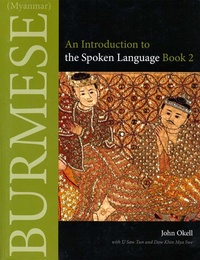
Burmese (Myanmar)
Description

Burmese has two styles of speaking and writing: the colloquial style, which is used for talking to friends and for writing letters, and the literary style, which is used in more formal contexts, such as academic articles, newspaper reports, and narrative passages in fiction. This volume, the final book in a four-part Burmese language course, introduces learners to the literary style. It assumes a prior knowledge of Burmese script and a grounding in the colloquial style. Okell starts with simple sentences, and, over a series of short lessons, gradually increases the range of vocabulary and the level of complexity. The texts Okell uses for study are excerpts from Burmese children's schoolbooks highlighting themes of home- and school-life and Burmese nationalism and independence. Each passage is accompanied by a full translation and is followed by a set of exercises designed to familiarize the reader with the new vocabulary and sentence structures. Accompanying audio files allow students to hear the texts read aloud. Language professors and their students, or those learning Burmese on their own, will appreciate the accessible approach and the manageable size of the lessons of the very practical textbooks in this series.
More details
Other editions
Additional editions
Person
John Okell, now retired, was for many years Lecturer in Burmese at the School of Oriental and African Studies (SOAS), University of London. He is the author of First Steps in Burmese and A Reference Grammar of Colloquial Burmese and coauthor of Burmese/Myanmar. He continues to teach short courses in Thailand, in Burma, in Spain, in the USA, and at SOAS.
Content
- Intro
- CONTENTS
- A NOTE FROM THE AUTHOR
- LEVEL 2, TOPIC 1
- LEVEL 2, TOPIC 2
- LEVEL 2, TOPIC 3
- LEVEL 2, TOPIC 4
- LEVEL 2, TOPIC 5
- LEVEL 2, TOPIC 6
- LEVEL 2, TOPIC 7
- LEVEL 2, TOPIC 8
- LEVEL 2, TOPIC 9
- LEVEL 2, TOPIC 10A
- LEVEL 2, TOPIC 10B
- LEVEL 2, TOPIC 11
- LEVEL 2, TOPIC 12
- LEVEL 3, TOPIC 1
- LEVEL 3, TOPIC 2
- LEVEL 3, TOPIC 3
- LEVEL 3, TOPIC 4
- LEVEL 3, TOPIC 5
- LEVEL 3, TOPIC 6
- LEVEL 3, TOPIC 7
- LEVEL 3, TOPIC 8
- LEVEL 3, TOPIC 9
- LEVEL 3, TOPIC 10A
- LEVEL 3, TOPIC 10B
- LEVEL 3, TOPIC 11
- LEVEL 3, TOPIC 12
- LEVEL 4, TOPIC 1
- LEVEL 4, TOPIC 2
- LEVEL 4, TOPIC 3
- LEVEL 4, TOPIC 4
- LEVEL 4, TOPIC 5
- LEVEL 4, TOPIC 6
- LEVEL 4, TOPIC 7
- LEVEL 4, TOPIC 8
- LEVEL 4, TOPIC 9
- LEVEL 4, TOPIC 10A
- LEVEL 4, TOPIC 10B
- LEVEL 4, TOPIC 11
- LEVEL 4, TOPIC 12
- LEVEL 5, TOPIC 1
- LEVEL 5, TOPIC 2
- LEVEL 5, TOPIC 3
- LEVEL 5, TOPIC 4
- LEVEL 5, TOPIC 5
- LEVEL 5, TOPIC 6
- LEVEL 5, TOPIC 7
- LEVEL 5, TOPIC 8
- LEVEL 5, TOPIC 9
- LEVEL 5, TOPIC 10A
- LEVEL 5, TOPIC 108
- LEVEL 5, TOPIC 11
- LEVEL 5, TOPIC 12
- APPENDIX 1
- APPENDIX 2
- APPENDIX 3
- APPENDIX 4
- APPENDIX 5.1
- APPENDIX 5.2
- APPENDIX 6
- APPENDIX 7
