

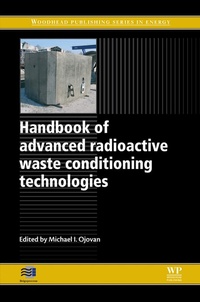
Handbook of Advanced Radioactive Waste Conditioning Technologies
Published on 24. January 2011
512 pages
978-0-85709-095-9 (ISBN)
Description

Radioactive wastes are generated from a wide range of sources, including the power industry, and medical and scientific research institutions, presenting a range of challenges in dealing with a diverse set of radionuclides of varying concentrations. Conditioning technologies are essential for the encapsulation and immobilisation of these radioactive wastes, forming the initial engineered barrier required for their transportation, storage and disposal. The need to ensure the long term performance of radioactive waste forms is a key driver of the development of advanced conditioning technologies.The Handbook of advanced radioactive waste conditioning technologies provides a comprehensive and systematic reference on the various options available and under development for the treatment and immobilisation of radioactive wastes. The book opens with an introductory chapter on radioactive waste characterisation and selection of conditioning technologies. Part one reviews the main radioactive waste treatment processes and conditioning technologies, including volume reduction techniques such as compaction, incineration and plasma treatment, as well as encapsulation methods such as cementation, calcination and vitrification. This coverage is extended in part two, with in-depth reviews of the development of advanced materials for radioactive waste conditioning, including geopolymers, glass and ceramic matrices for nuclear waste immobilisation, and waste packages and containers for disposal. Finally, part three reviews the long-term performance assessment and knowledge management techniques applicable to both spent nuclear fuels and solid radioactive waste forms.With its distinguished international team of contributors, the Handbook of advanced radioactive waste conditioning technologies is a standard reference for all radioactive waste management professionals, radiochemists, academics and researchers involved in the development of the nuclear fuel cycle.
- Provides a comprehensive and systematic reference on the various options available and under development for the treatment and immobilisation of radioactive wastes
- Explores radioactive waste characterisation and selection of conditioning technologies including the development of advanced materials for radioactive waste conditioning
- Assesses the main radioactive waste treatment processes and conditioning technologies, including volume reduction techniques such as compaction
More details
Other editions
Additional editions
Michael I. Ojovan
Handbook of Advanced Radioactive Waste Conditioning Technologies
Book
01/2011
Woodhead Publishing Ltd
€289.69
Shipment within 10-15 days
Content
Contributor contact details
Woodhead Publishing Series in Energy
Chapter 1: Radioactive waste characterization and selection of processing technologies
Abstract:
1.1 Introduction
1.2 Radioactive waste classification
1.3 Radioactive waste characterization
1.4 Radioactive waste processing
1.5 Selection of conditioning technologies
1.6 Sources of further information and advice
1.7 Acknowledgements
Part I: Radioactive waste treatment processes and conditioning technologies
Chapter 2: Compaction processes and technology for treatment and conditioning of radioactive waste
Abstract:
2.1 Applicable waste streams in compaction processes and technology
2.2 Compaction processes and technology
2.3 End waste forms and quality control of compaction processes
2.4 Pre-treatment in compaction processes
2.5 Secondary wastes of compaction processes and technology
2.6 Advantages and limitations of compaction processes and technoligy
2.7 Future trends
2.8 Sources of further information and advice
Chapter 3: Incineration and plasma processes and technology for treatment and conditioning of radioactive waste
Abstract:
3.1 Introduction
3.2 Applicable waste streams in incineration processes and technology
3.3 Incineration process and technology
3.4 Plasma process and technology
3.5 End waste form and quality control in incineration (plasma) processes
3.6 Advantages and limitations of incineration (plasma) processes
3.7 Future ternds
3.8 Sources of further information and advice
Chapter 4: Application of inorganic cements to the conditioning and immobilisation of radioactive wastes
Abstract:
4.1 Overview
4.2 Manufacture of Portland cement
4.3 Application of Portland cement
4.4 Hydration of Portland cement
4.5 Porosity and permeability
4.6 Supplementary cementitious materials
4.7 Mineral aggregates
4.8 Service environments and cement performance in its service environment
4.9 Standards and testing
4.10 Organic materials added to Portland cement
4.11 Service environments and lessons from historic concrete
4.12 Non-Portland cement
4.13 Immobilisation mechanisms
4.14 Deterioration processes affecting Portland cement: processes and features
4.15 Deterioration processes: carbonation
4.16 Miscellaneous interactions of cement in its service environment
4.17 Summary and conclusions
Chapter 5: Calcination and vitrification processes for conditioning of radioactive wastes
Abstract:
5.1 Introduction
5.2 Calcination and vitrification processes
5.3 End waste forms and quality control in calcination and vitrification processes
5.4 Future trends
Chapter 6: Historical development of glass and ceramic waste forms for high level radioactive wastes
Abstract:
6.1 Introduction
6.2 Borosilicate glass development in the United States
6.3 Borosilicate glass development in France
6.4 Borosilicate glass development in the United Kingdom
6.5 Aluminosilicate glass development in Canada
6.6 Phosphate glass development in the United States, Russia, Germany and Belgium
6.7 Ceramic waste form development in various countries
Chapter 7: Decommissioning of nuclear facilities and environmental remediation: generation and management of radioactive and other wastes
Abstract:
7.1 Introduction
7.2 What is decommissioning?
7.3 Generation of decommissioning waste
7.4 Waste from dismantling of nuclear facilities
7.5 Waste from decontamination for decommissioning purposes
7.6 Problematic decommissioning waste
7.7 Environmental remediation as a decommissioning component
7.8 Future trends
Part II: Advanced materials and technologies for the immobilisation of radioactive wastes
Chapter 8: Development of geopolymers for nuclear waste immobilisation
Abstract:
8.1 Nuclear wastes around the world
8.2 Cementitious low-level waste (LLW)/intermediate-level waste (ILW) waste forms
8.3 Future work
8.4 Conclusions
8.5 Sources of further information and advice
8.6 Acknowledgements
Chapter 9: Development of glass matrices for high level radioactive wastes
Abstract:
9.1 Introduction
9.
