

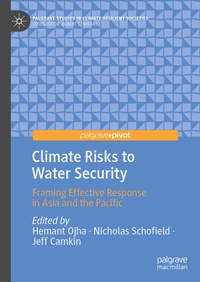
Climate Risks to Water Security
Description

Going beyond the national scales and focussing on several socio-ecological zones, this book captures stories written by engaged scholars on recent attempts to develop cross-sectoral and cross-scaler solutions to assess and mitigate risks to water security across Asia and the Pacific. Identifying lessons from successes and failures, it highlights management and strategic lessons that water and climate leaders of Asia and the Pacific need to consider. This book showcases reflective and analytical thought pieces written by key actors in the climate and water spaces. Several critical socio-ecological zones are covered - from Pakistan in the west to pacific islands in the east. The chapters clearly identify strategies for improvement based on the analysis of emerging responses to climate risks to water security and gaps in current practices. The book will include an editorial introduction and a final synthesis chapter to ensure clear articulation of common themes and to highlight the overall messages of the book.
More details
Other editions
Additional editions
Persons
Nick Schofield recently retired as the Chief Executive of the Australian Water Partnership, with over 35 years' experience in the water and natural resource management sector. He has led 14 major research programs across Australia at the intersections of water, agriculture, forestry, mining, urbanisation, biodiversity and climate change. Nick has developed national policies and pioneered methods in research prioritisation, evaluation and futures analysis. Nick was formerly Director of the Global Water Institute at the University of New South Wales, CEO of the International RiverFoundation, and CEO of the Western Australian Ministerial Water Resources Council. He has also held senior positions in government, industry, consulting, academia and the not-for-profit sectors.
Content
- Intro
- Preface and Acknowledgements
- Contents
- Contributors
- Abbreviations
- List of Figures
- List of Tables
- 1 Introduction
- 1 Why This Book?
- 2 The Growing Climate Risk to Water Security
- 3 Socio-Ecological Zones and Basins as Sites of Climate-Water Risks
- 4 Chapters Overview
- References
- 2 Water Security and Spring Conservation in the Himalaya
- 1 Introduction
- 2 Declining Himalayan Springs
- 2.1 Anecdotal Evidence in Absence of Long-Term Monitoring
- 2.2 Deterioration of Spring Water Quality
- 3 Climate and Socio-Economic Drivers of Changes in Himalayan Springs
- 3.1 Climatic Drivers of Changes in Himalayan
- 3.1.1 Springs Temperature Rise in the Himalaya
- 3.1.2 Role of Snowmelt
- 3.1.3 Extreme Events (Landslides & Flash Floods)
- 3.1.4 Land-Use & Land-Cover Change (LU&LCC)
- 4 Socio-Economic Drivers of Changes in Himalayan Springs
- 4.1 Infrastructure-Dams & Tunnelling, Road Cutting, Mining or Quarrying
- 4.2 Urbanization and Tourism
- 4.3 Gender and Caste
- 5 State and Community Responses for Spring Conservation and Revival in Himalaya
- 5.1 Traditional Knowledge Systems for Spring Conservation
- 5.2 Early Research and the Spring-Sanctuary Model
- 5.3 Hydrogeology-Based Spring Rejuvenation Programmes
- 5.4 Policy (State & National Recognition)
- 6 Gaps and Future Directions
- References
- 3 Water Stresses and Responses in Myanmar's Central Dry Zone
- 1 Central Dry Zone
- 2 Impacts of Climate Change and Development on Water
- 3 Water Management in the CDZ
- 4 Rehabilitation of Pyawt Ywar Pump Irrigation Project
- 5 Restoring Artesian Aquifers in the Pale Sub-Basin
- 5.1 Groundwater Irrigation Development
- 5.2 Groundwater Management-Issues and Constraints
- 5.3 Groundwater Management and Rehabilitation of the Tube Wells
- 6 Discussion
- 7 Key Lessons
- References
- 4 Managing the Invisible Under Changing Climate: A Participatory Approach for Sustaining Groundwater Use
- 1 Introduction
- 2 Groundwater and Climate Change
- 3 The Marvi Project
- 3.1 Overview
- 3.2 Action on the Ground: What Did the Marvi Project Do?
- 4 Marvi Results and Outcomes
- 4.1 Bhujal Jankaars as the Change Makers
- 4.2 Mywell App
- 4.3 Estimating Check Dam Recharge Through Bhujal Jaankaar Measurements
- 4.4 Understanding the Diversity of Attitudes to Groundwater
- 4.5 Groundwater and Gender
- 4.6 Developing the Village Groundwater Co-Operatives (VGCs)
- 4.7 Why Farmers Became Interested in VGCs?
- 5 Wider Lessons and Insights from Marvi
- 5.1 Sustaining Groundwater Use Under Changing climate-The Magic of Cooperation
- 5.2 Groundwater Sustainability and Future Climate
- 6 Concluding Remarks
- References
- 5 Tackling Climate Risks to Urban Water Security in Coastal Cities in Asia
- 1 Introduction
- 2 Drivers of Urban Water Insecurity
- 2.1 Climate Crisis and Climate Risks Affecting Water Security in Asia's Coastal Cities
- 2.2 Global Urbanisation
- 2.3 Water Scarcity and Drought
- 2.4 Safely Managed Sanitation
- 2.5 Floods
- 2.6 Environmental Degradation
- 2.7 Urban Heat
- 3 Climate Risks Affecting Water Security in Asia's Coastal Cities
- 4 Emerging Trends in Urban Water Management
- 4.1 Water Supply Security
- 4.2 Flood Hazards Management
- 4.3 Improving Urban Biodiversity
- 4.4 Planetary Health
- 5 Integrating Urban Water Management Initiatives
- 5.1 Evolution of Urban Water Management
- 5.2 Integrated Urban Water Management
- 5.3 Water Sensitive Cities, Sponge Cities and Low Impact Development
- 5.4 The Role of Nature-Based Solutions and Hybrid Infrastructure
- 5.5 The Water-Energy Nexus
- 6 Concluding Remarks
- References
- 6 Achieving Water Security and Addressing Climate Risks in the Mekong Delta
- 1 Introduction
- 2 Climate Change and Sea Level Rise
- 3 Upstream Mekong River Basin Development Plan
- 4 Hydrological Change in the Mekong Delta
- 4.1 Current and Future Change of Hydrological Flow During Flood Season
- 4.2 Change of Flood and Inundation Status into the Future
- 4.3 Change of Hydrological Flow During the Dry Season
- 4.3.1 The Impact of Early Water Storage Operation
- 4.3.2 Impact of Late Water Storage Operation
- 4.4 Salinity Intrusion Change
- 4.5 Impacts of Groundwater Abstraction and Climate Change on Groundwater Resources in Mekong Delta, Vietnam
- 5 Socioeconomic State in the Mekong Delta
- 6 Strategies Addressing Water Security and Climate Risks
- 6.1 Key Policies and Planning Strategies
- 6.2 Analysis of Planning Strategies and Policies
- 7 Summary
- References
- 7 Water Security in the Coastal Region of Bangladesh
- 1 Introduction
- 2 The General Context of the Socio-Ecological Zone of Coastal Bangladesh
- 3 Impact of Climatic Risks to Water Security
- 4 Current water security status in coastal areas
- 4.1 Water Availability
- 4.1.1 Saline Water Intrusion
- 4.1.2 Reduction of Upstream Flow (River Morphology)
- 4.1.3 Rainfall Trend
- 4.2 Water Accessibility to Services
- 4.3 Water Safety and Quality
- 4.4 Water Management
- 5 Current and Emerging Responses to Climate Risks
- 6 Conclusion
- References
- 8 Policy Insights into Water Management and Climate Risks in Australia's Murray-Darling Basin
- 1 Introduction
- 2 The MDB Context: Hydro-Climatic Conditions and Climate Risks
- 3 Policy Responses to Climate Risks in the MDB
- 3.1 Science and Policy Responses
- 3.2 Sharing Climate Risks
- 4 Insights
- 4.1 Soft and Symbolic Policies Rely on Existing Policy Instruments
- 4.2 Water Markets Are Important Adaptation Policy Measures
- 4.3 More Flexible Water Resources Planning Methods Are Needed
- 4.4 Technical, Political, Theoretical and Institutional Constraints to Adaptation
- 4.5 Australia's Climate Wars
- 5 Conclusions
- References
- 9 Institutional Strengthening for Managing Climate Risks and Water Security in the Yangtze River Basin
- 1 A River Under Threat
- 2 Institutional Strengthening and Socio-Economic Reforms
- 2.1 Policy Responses
- 2.2 Natural Resources Accounting
- 2.3 The Yangtze River Protection Law
- 3 Innovative Financing
- 3.1 Ecological Compensation
- 3.2 National Green Development Fund
- 4 Summary
- References
- 10 Climate Change, Water Scarcity and Agriculture: Lessons from the Countries of the Lower Mekong
- 1 Introduction
- 2 The Context-Agriculture and Water Resources Development in the Lower Mekong Basin
- 2.1 Variable Progress of Water Resources Development
- 2.2 Agriculture Is Economically Important and a Significant Water User in All Four Countries
- 3 Water Scarcity and Climate Change in the Mekong
- 4 Responding to Water Scarcity Worsened by a Changing Climate
- 4.1 The Water Scarcity Management Trajectory
- 4.2 Where the Lower Mekong Countries Are Situated on the Trajectory
- 5 Lessons for Managing Water Scarcity and Climate Change
- References
- 11 Climate Resilient Water Safety Plans in the Pacific
- 1 Climate Threats to Pacific Island Countries
- 2 Responding to Climate Threats: Climate Resilient Water Safety Planning
- 2.1 Applying WSP to Address Climate Threats-Three Examples
- 2.1.1 Tonga
- 2.1.2 Kiribati
- 2.1.3 Nauru
- 3 Conclusions
- References
- 12 Synthesis of Key Messages and Lessons Learnt
- 1 Introduction
- 2 Key Messages from Preceding Chapters
- 3 The Emergence of Two Conceptual Gaps
- 4 How Is Climate Risk Manifesting with Regard to Water Security?
- 5 Patterns of Response to Address Risks
- 6 Emerging Themes and Lessons
- 7 Conclusions
- Index
