

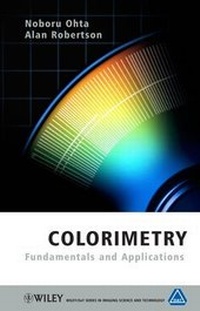
Colorimetry
Fundamentals and Applications
Published on 3. February 2006
350 pages
978-0-470-09473-0 (ISBN)
Description

Colorimetry, the science of quantitvely describing color, isessential for color reproduction technology. This is because itcreates standards by which to measure color, using mathematicaltechniques and software to ensure fidelity across media, allowaccurate color mixing, and to develop color optimization.
This book is a comprehensive and thorough introduction tocolorimetry, taking the reader from basic concepts through to avariety of industrial applications. Set out in clear,easy-to-follow terminology, Ohta and Robertson explain fundamentalprinciples such as color specification, the CIE (InternationalCommission on Illumination) system, and color vision and appearancemodels. They also cover the following topics:
* the optimization of color reproduction;
* uniform color spaces and color difference formulae, includingthe CIEDE 2000 formula;
* applications of metamerism, chromatic adaptation, colorappearance and color rendering;
* mathematical formulae for calculating color mixing, maximisingluminous efficacy, and designing illuminants with specificproperties.
Colorimetry: Fundamentals and Applications is an idealreference for practising color engineers, color scientists andimaging professionals working on color systems. It is also apractical guide for senior undergraduate and graduate students whowant to acquire knowledge in the field.
Reviews / Votes
"This volume will be a useful addition to academic libraries andwill be indispensible for basic and clinical researchers in thisgrowing field." (E-Streams, June 2008) "...a systematic and unambiguous exposition of how color isdefined, measured, and seen by humans under different viewingconditions...highly recommended." (CHOICE, June2006)More details
Other editions
Additional editions
Noboru Ohta | Alan Robertson
Colorimetry - Fundamentals and Applications
Software
05/2006
Wiley
€145.87
No shipping information available
Book
11/2005
Wiley
€156.50
Article not available at the moment
Persons
Noboru Ohta earned his B.Sci., and Dr.Eng.from theUniversity of Tokyo. In 1968, he joined Fuji Photo Film and From1973, he spend three y ears under Gunter Wyszecki at the NationalResearch Council of Canada.
He has taught colorimetry and color reproduction at a variety ofuniversities. he joined Rochester Institute of Technology in 1998,and is associated there with the Munsell Color Science Laboratoryin the Center for Imaging Science.
He has published more than 100 technical paper sin Japanese andEnglish, and several books on colorimetry and color reproduction inJapanese, Chinese, and Korean. He has been active in a variety ofacademic societies, and also in standards organizations such as theJapanese Industrial Standards (JIS), the American NationalStandards Institute (ANSI), and the International Commission onIllumination (CIE).
Alan Robertson earned his B.Sc and Ph.D. from theUniversity of London, where he studied under David Wright. He thenjoined Gunter Wyszecki at the National Research Council of Canadaand Spent 35 years there before retiring in 2000. He has publishedover 50 papers in journals and conference proceedings and has givenmore than 60 invited talks in 10 countries. He is former Presidentof the international Color Association (AIC) and Vice President ofthe International Commission on Illumination (CIE). In 2005, hereceived the Godlove Award of the Inter-Society Color Council(ISCC) for long-term contributions in the field of color.
Content
- Intro
- Colorimetry
- Wiley-IS&T Series in Imaging Science and Technology
- Contents
- About the Authors
- Series Preface
- Preface
- Introduction
- 1 Light, Vision and Photometry
- 1.1 Light
- 1.2 Mechanism of the Human Eye
- 1.3 Adaptation and Responsivity of the Human Eye
- 1.4 Spectral Responsivity and the Standard Photometric Observer
- 1.5 Definition of Photometric Quantities
- 1.6 Photometric Units
- 1.7 Calculation and Measurement of Photometric Quantities
- 1.8 Relations Between Photometric Quantities
- Note 1.1 Luminous Exitance, Illuminance, and Luminance of a Perfect Diffusing Plane Light Source
- Note 1.2 Luminance and Brightness
- 2 Color Vision and Color Specification Systems
- 2.1 Mechanism of Color Vision
- 2.2 Chemistry of Color Vision
- 2.3 Color Specification and Terminology
- 2.4 Munsell Color System
- 2.5 Color System Using Additive Color Mixing
- Note 2.1 Colorfulness, Chroma and Saturation
- 3 CIE Standard Colorimetric System
- 3.1 RGB Color Specification System
- 3.2 Conversion into XYZ Color Specification System
- 3.3 X(10)Y(10)Z(10) Color Specification System
- 3.4 Tristimulus Values and Chromaticity Coordinates
- 3.5 Metamerism
- 3.6 Dominant Wavelength and Purity
- 3.7 Color Temperature and Correlated Color Temperature
- 3.8 Illuminants and Light Sources
- 3.9 Standard and Supplementary Illuminants
- Note 3.1 Derivation of Color Matching Functions from Guild and Wright's Results
- Note 3.2 Conversion between Color Specification Systems
- Note 3.3 Conversion into XYZ Color Specification System
- Note 3.4 Imaginary Colors [X] and [Z]
- Note 3.5 Photometric Quantities in the X(10)Y(10)Z(10) Color System
- Note 3.6 Origin of the Term 'Metamerism'
- Note 3.7 Simple Methods for Obtaining Correlated Color Temperature
- Note 3.8 Color Temperature Conversion Filter
- Note 3.9 Spectral Distribution of Black-body Radiation
- 4 Uniform Color Spaces
- 4.1 Uniform Chromaticity Diagrams
- 4.2 Uniform Lightness Scales (ULS)
- 4.3 CIE Uniform Color Spaces
- 4.4 Correlates of Perceived Attributes
- 4.5 Comparing CIELAB and CIELUV Color Spaces
- 4.6 Conversion of Color Difference
- 4.7 Color Difference Equations Based on CIELAB
- Note 4.1 Calculation of Munsell Value V from Luminous Reflectance Y
- Note 4.2 Modified CIELAB and CIELUV Equations for Dark Colors
- Note 4.3 Other Color Difference Formulas
- Note 4.4 Direct Calculation of Hue Difference DH*
- 5 Measurement and Calculation of Colorimetric Values
- 5.1 Direct Measurement of Tristimulus Values
- 5.2 Spectral Colorimetry
- 5.3 Geometrical Conditions for Measurement
- 5.4 Calculation of Colorimetric Values
- 5.5 Colorimetric Values in CIELAB and CIELUV Uniform Color Spaces
- Note 5.1 Spectral Colorimetry of Fluorescent Materials
- Note 5.2 Reference Standard for Reflection Measurements
- 6 Evolution of CIE Standard Colorimetric System
- 6.1 Additive Mixing
- 6.2 Subtractive Mixing
- 6.3 Maximum Value of Luminous Efficacy and Optimal Colors
- 6.4 Chromatic Adaptation Process
- 6.5 von Kries' Predictive Equation for Chromatic Adaptation
- 6.6 CIE Predictive Equations for Chromatic Adaptation
- 6.7 Color Vision Models
- 6.8 Color Appearance Models
- 6.9 Analysis of Metamerism
- Note 6.1 Color Mixing Rule
- Note 6.2 Lambert-Beer Law
- Note 6.3 Method for Calculating the Maximum Value of the Luminous Efficacy of Radiation
- Note 6.4 Method for Calculating Optimal Colors
- Note 6.5 Method for Obtaining Fundamental Spectral Responsivities
- Note 6.6 Deducing von Kries' Predictive Equation for Chromatic Adaptation
- Note 6.7 Application of von Kries' Equation for Chromatic Adaptation
- Note 6.8 Application of CIE 1994 Chromatic Adaptation Transform
- Note 6.9 Theoretical Limits for Deviation from Metamerism
- 7 Application of CIE Standard Colorimetric System
- 7.1 Evaluation of the Color Rendering Properties of Light Sources
- 7.2 Evaluation of the Spectral Distribution of Daylight Simulators
- 7.3 Evaluation of Whiteness
- 7.4 Evaluation of Degree of Metamerism for Change of Illuminant
- 7.5 Evaluation of Degree of Metamerism for Change of Observer
- 7.6 Designing Spectral Distributions of Illuminants
- 7.7 Computer Color Matching
- Note 7.1 Computation Method for Prescribed Spectral Distributions
- Appendix I Basic Units and Terms
- AI.1 SI Units
- AI.2 Prefixes for SI Units
- AI.3 Fundamental Constants
- AI.4 Greek Letters
- Appendix II Matrix Algebra
- AII.1 Addition and Subtraction of Matrices
- AII.2 Multiplication of Matrices
- AII.3 Inverse Matrix
- AII.4 Transpose Matrix
- Appendix III Partial Derivatives
- Appendix IV Tables
- References
- Bibliography
- Index
- COLOUR PLATE SECTION
