

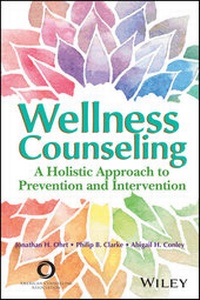
Wellness Counseling
Description

This innovative text presents a comprehensive review of the theoretical and empirical support for a wellness approach to counseling with current techniques for client assessment, case conceptualization, treatment planning, and intervention. The authors provide holistic strategies for wellness promotion with children, adolescents, and young, midlife, and older adults, as well as in counseling with groups, couples, and families. Each chapter includes reflection questions, learning activities, and resources to deepen readers' understanding of the content and application to practice. Wellness boosters offer quick methods for clients and counselors to increase their domain-specific and overall well-being. In addition, experienced counselors share their personal experiences implementing wellness interventions in "Practitioner Spotlight" vignettes. A chapter on counselor self-care completes the book.
- Requests for digital versions from ACA can be found on www.wiley.com.
- To purchase print copies, please visit the ACA website
- Reproduction requests for material from boks published by ACA should be directed to publications@counseling.org
More details
Other editions
Additional editions
Persons
Jonathan H. Ohrt, PhD, is an associate professor and counselor education program coordinator at the University of South Carolina.
Philip B. Clarke, PhD, is an associate professor in the Department of Counseling at Wake Forest University.
Abigail H. Conley, PhD, is an assistant professor in the Department of Counseling and Special Education, and an affiliate faculty member in the Institute for Women's Health, at Virginia Commonwealth University.
Content
Chapter 1
Introduction to Wellness Counseling
When one tugs at a single thing in nature, he finds it attached to the rest of the world.
-John Muir
Discovering theories and frameworks for counseling that fit for you and your clients is, in a weird way, like reconnecting with a long-lost love that you had never met. You are beside yourself with excitement that your paths have crossed. You share similar values and enhance each other's ways of navigating life's challenges. You enjoy spending time with this new love. As a college student trying to figure out what type of post-college helping professional education I (Phil) wanted, I searched desperately for a metaphorical connection. A friend of mine mentioned that she was applying to counseling programs. I read about many different counseling programs and their definition of counseling. I discovered the word "wellness" in many of the descriptions. "Counselors do that?" I thought to myself. "I thought they just focused on symptoms and what was going wrong with people." This idea of wellness resonated with my beliefs and values, even without a day of counselor training under my belt. Like new love, there were sparks, and I was definitely interested. The romance blossomed as I got to study with and serve as a graduate assistant for Jane Myers, one of the great scholars who has advanced our understanding and practice of wellness counseling. Wellness "completed me" as a professional. It was and is a significant part of my counselor identity- and just like a healthy romantic relationship, it made me want to be my best self as a counselor.
However, it was not until I obtained my master's degree and went into the real world of counseling that I truly appreciated how important wellness counseling was to me. Much of my work at the time was at an addictions treatment center working with clients diagnosed with co-occurring disorders. The most common struggle I saw across clients was not necessarily relapse into addiction or mental health symptomology but deficits in, and barriers to, wellness. Issues of lifestyle imbalance (e.g., poor nutrition and sleep habits, lack of meaning and purpose, spiritual bypass, conflict with family or friends or outright lack of social support, inability to identify and make sense of emotions, insufficient intellectual stimulation) not only severely detracted from my clients' lives but also seemed to perpetuate an ongoing cycle of addictive behaviors and mental health concerns.
The above is an excerpt from my story with wellness. There is a lot more to this subject matter than what I just described and that we (Jonathan, Abigail, and myself) capture in this book. The purpose of the book is to (a) provide a comprehensive overview of the theoretical background and empirical support for wellness counseling, (b) discuss current trends in wellness, (c) provide practical strategies for clinical application of wellness concepts, and (d) describe wellness counseling interventions for specific populations and settings. This book is applicable for counselors and counseling students who seek to better understand clients' holistic wellness and integrate wellness-based interventions in their practice; it also applies to educators who are teaching a course on wellness counseling or incorporating it into existing courses. In the upcoming sections, we explore the relevance of wellness and wellness counseling for all counselors. We then outline the contents and structure of this book. Along the way, we encourage you to reflect on what led you to read these pages at this time as well as your own perceived and lived benefits of wellness and wellness counseling.
The Value of Wellness
Wellness Is Who We Are
What does wellness mean to you? How do you define wellness? What are the key pieces that motivate you to work toward being well or your best self? These are a few of the essential questions that wellness counselors ask our clients. It is equally valuable for counselors to be able to define wellness and wellness counseling. First, any counselor who adopts wellness counseling as one of their counseling approaches needs to describe what it is during the informed consent process, meriting some definition of terms. Second, counselors may need to justify use of this approach to insurance providers. Additionally, clients may desire a starting point for operationalizing wellness to empower them to discover how they would define it. Myers, Sweeney, and Witmer's (2000) definition of wellness is a helpful point of departure in understanding this concept: "a way of life oriented toward optimal health and well-being, in which body, mind, and spirit are integrated by the individual to live life more fully within the human and natural community" (p. 252). We explore different definitions and offer our own definition of wellness as you proceed through the book. Moreover, we hope that you begin to formulate your own definition along the way.
As health care trends continue to move toward holistic and integrated care models, it is important for counselors to communicate their counseling philosophy and approaches to other professional helpers involved in their clients' care. The term "wellness" is in the definition of counseling: "Counseling is a professional relationship that empowers diverse individuals, families, and groups to accomplish mental health, wellness, education, and career goals" (Kaplan, Tarvydas, & Gladding, 2014, p. 368). It is an inextricable part of our professional identity. Hence, all counselors should be able to articulate what wellness is to consumers, government officials, and other helping professionals (Myers, 1992). Maintaining wellness at the forefront of counseling may aid in reducing the stigma of receiving counseling, potentially resulting in more people seeking and receiving services.
The World Needs Wellness Counselors
The world needs counselors skilled in wellness approaches now more than ever. According to an American Psychological Association (APA) survey, nearly one in four people rated their stress as an "8" or higher on a 1-10 scale in 2015 (APA, 2016). The high stress appears to be having a trickle-down effect, manifesting in symptoms including anxiety and melancholy (APA, 2016). Youths are unfortunately not free from the effects of stress, as evidenced by 31% of caregivers of K-12 students reporting high stress associated with school in their child or adolescent (National Public Radio, Robert Wood Johnson Foundation, & Harvard School of Public Health, 2013). Older students were placed in the high-stress category by their caregivers with more frequency than younger students. These findings were corroborated in a study of 11th graders (n = 128), 49% of whom endorsed feeling "a great deal of stress" every day-26% with depressive symptomology (Leonard et al., 2015). Further, more than one third of the sample had been intoxicated on alcohol or drugs in the previous month.
In 2015, the National Survey on Drug Use and Health produced findings that 43.4 million American adults have a mental disorder (Center for Behavioral Health Statistics and Quality, 2016). Several studies have demonstrated that there is a strong relationship between mental and physical health (Baughman et al., 2016; Razzano et al., 2015; Scott et al., 2016). For instance, in a sample of 457 people with mental disorders, 44% had hypertension (Razzano et al., 2015). In another study, almost two thirds of individuals with mental illness noted having chronic pain (Baughman et al., 2016). Participants also reported "not feeling very healthy" for an average of 15.7 days in the previous month (Baughman et al., 2016, p. 428).
There are several encouraging factors that accompany this concern; the primary one is that wellness issues are drawing the public's attention. According to Mattke et al. (2013), more than half of all employers with 50 or more employees offer a wellness program. Workplace wellness programs often include an initial wellness evaluation, dissemination of health information, and individual or group sessions led by a helping professional (Baicker, Cutler, & Song, 2010). Although most wellness programs center on physical health (Baicker et al., 2010), 41% of employment places have an Employee Assistance Program, enabling counselors to address mental health and other aspects of well-being (Mattke et al., 2013).
The well-being of young people is being addressed on several levels. Given Lai, Guo, Ijadi-Maghsoodi, Puffer, and Kataoka's (2016) statement that "schools are the most common entry point into mental health services in the United States" (p. 1328), efforts to enhance child and adolescent wellness are occurring through school-based mental health programs as well as through the infusion of mindfulness (Semple, Droutman, & Reed, 2017) and spirituality (Gibson, Dixon, & Myers, 2012) into the classroom. Many universities provide wellness programs for their students. Program staff can support the well-being of college students in several ways, such as distributing information as well as hosting campus events and screenings.
Medical and mental health professionals are working together in providing client services. These integrated care approaches include counselors as part of a team that conceptualizes and treats clients holistically, thereby improving care results in individuals with both mental and physical health concerns (Gerrity, 2016). Counselors are supporting...
