

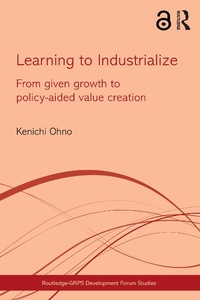
Learning to Industrialize
From Given Growth to Policy-aided Value Creation
Published on 3. April 2014
256 pages
978-1-136-19884-7 (ISBN)
Description

This book proposes a new, pragmatic way of approaching economic development which features policy learning based on a comparison of international best policy practices. While the important role of government in promoting private sector development is being recognized, policy discussion often remains general without details as to what exactly to do and how to avoid common pitfalls. This book fills the gap by showing concrete policy contents, procedures, and organizations adopted in high-performing East Asian economies.
Natural resources and foreign aid and investment can take a country to a certain income level, but growth stalls when given advantages are exhausted. Economies will be caught in middle income traps if growth impetus is not internally generated. Meanwhile, countries that have soared to high income introduced mindset, policies, and institutions that encouraged, or even forced, accumulation of human capital - skills, technology, and knowledge. How this can be done systematically is the main topic of policy learning. However, government should not randomly adopt what Singapore or Taiwan did in the past. A continued march to prosperity is possible only when policy makers acquire capability to formulate policy suitable for local context after studying a number of international experiences.
Developing countries wanting to adopt effective industrial strategies but not knowing where to start will benefit greatly by the ideas and hands-on examples presented by the author. Students of development economics will find a new methodological perspective which can supplement the ongoing industrial policy debate. The book also gives an excellent account of national pride and pragmatism exhibited by officials in East Asia who produced remarkable economic growth, as well as serious effort by an African country to emulate this miracle.
The Open Access version of this book, available at http://www.taylorfrancis.com/doi/view/10.4324/9780203085530 has been made available under a Creative Commons Attribution-Non Commercial-No Derivatives 4.0 license.
Natural resources and foreign aid and investment can take a country to a certain income level, but growth stalls when given advantages are exhausted. Economies will be caught in middle income traps if growth impetus is not internally generated. Meanwhile, countries that have soared to high income introduced mindset, policies, and institutions that encouraged, or even forced, accumulation of human capital - skills, technology, and knowledge. How this can be done systematically is the main topic of policy learning. However, government should not randomly adopt what Singapore or Taiwan did in the past. A continued march to prosperity is possible only when policy makers acquire capability to formulate policy suitable for local context after studying a number of international experiences.
Developing countries wanting to adopt effective industrial strategies but not knowing where to start will benefit greatly by the ideas and hands-on examples presented by the author. Students of development economics will find a new methodological perspective which can supplement the ongoing industrial policy debate. The book also gives an excellent account of national pride and pragmatism exhibited by officials in East Asia who produced remarkable economic growth, as well as serious effort by an African country to emulate this miracle.
The Open Access version of this book, available at http://www.taylorfrancis.com/doi/view/10.4324/9780203085530 has been made available under a Creative Commons Attribution-Non Commercial-No Derivatives 4.0 license.
Reviews / Votes
'Professor Ohno has written a pragmatic, clear-eyed argument in favor of 21st century industrial policy and provides examples and ways that developing countries can both comply with WTO rules and hasten the development of industrial sectors in which they can develop profitably. This is a valuable addition to the literature on industrial policy, as it moves beyond the old "state vs. market" arguments and focuses attention on the steps and capacities that need to be developed. Practitioners as well academics interested in industrial policy will find this book worth reading.' - David O. Dapice, Associate Professor of Economics, Tufts University, U.S.A.More details
Series
Language
English
Place of publication
London
United Kingdom
Publishing group
Taylor & Francis Ltd
Target group
College/higher education
Illustrations
24 Tables, black and white; 41 Illustrations, black and white
File size
2,89 MB
ISBN-13
978-1-136-19884-7 (9781136198847)
Copyright in bibliographic data and cover images is held by Nielsen Book Services Limited or by the publishers or by their respective licensors: all rights reserved.
Schweitzer Classification
Other editions
Additional editions
Book
09/2014
1st Edition
Routledge
€49.00
Shipment within 15-20 days
Book
10/2012
1st Edition
Routledge
€147.40
Shipment within 15-20 days
Person
Kenichi Ohno is Professor at the National Graduate Institute for Policy Studies, Tokyo. He was born in Kobe, Japan and holds a PhD in Economics from Stanford University, California. He worked at the International Monetary Fund and taught at the University of Tsukuba and Saitama University before assuming the current position.
Content
Introduction Part 1: Ideas and Methods 1. The Developmental Trap 2. Industrial Policy in the Age of Globalization 3. Ingredients of Proactive Industrialization 4. Policy Procedure and Organization Part 2: Country Studies 5. Meiji Japan: From Feudalism to Industrialization 6. Singapore: National Productivity Movement 7. Taiwan: Policy Drive for Innovation 8. Malaysia: Trapped in Upper Middle Income 9. Vietnam: Growth without Quality 10. Ethiopia: The Growth and Transformation Plan
