

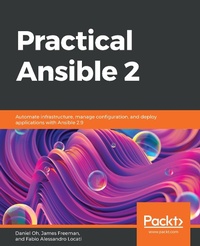
Practical Ansible 2
Automate infrastructure, manage configuration, and deploy applications with Ansible 2.9
1st Edition
Published on 3. June 2024
410 pages
978-1-78961-541-8 (ISBN)
Description

Leverage the power of Ansible to gain complete control over your systems and automate application deploymentKey Features - Use Ansible 2.9 to automate and control your infrastructure
- Delve into advanced functionality such as plugins and custom modules in Ansible
- Automate and orchestrate major cloud platforms such as OpenStack, AWS, and Azure using Ansible
Book DescriptionAnsible enables you to automate software provisioning, configuration management, and application roll-outs, and can be used as a deployment and orchestration tool. While Ansible provides simple yet powerful features to automate multi-layer environments using agentless communication, it can also solve other critical IT challenges, such as ensuring continuous integration and continuous deployment (CI/CD) with zero downtime. In this book, you'll work with Ansible 2.9 and learn to solve complex issues quickly with the help of task-oriented scenarios. You'll start by installing and configuring Ansible on Linux and macOS to automate monotonous and repetitive IT tasks and get to grips with concepts such as playbooks, inventories, and network modules. As you progress, you'll gain insight into the YAML syntax and learn how to port between Ansible versions. In addition to this, you'll also understand how Ansible enables you to orchestrate multi-layer environments such as networks, containers, and the cloud. By the end of this Ansible book, you'll be well - versed in writing playbooks and other related Ansible code to overcome just about all of your IT challenges, from infrastructure-as-code provisioning to application deployments, and even handling the mundane day-to-day maintenance tasks that take up so much valuable time.What you will learn - Become familiar with the fundamentals of the Ansible framework
- Set up role-based variables and dependencies
- Avoid common mistakes and pitfalls when writing automation code in Ansible
- Extend Ansible by developing your own modules and plugins
- Contribute to the Ansible project by submitting your own code
- Follow best practices for working with cloud environment inventories
- Troubleshoot issues triggered during Ansible playbook runs
Who this book is forIf you are a DevOps engineer, administrator, or any IT professional looking to automate IT tasks using Ansible, this book is for you. Prior knowledge of Ansible is not necessary.
- Delve into advanced functionality such as plugins and custom modules in Ansible
- Automate and orchestrate major cloud platforms such as OpenStack, AWS, and Azure using Ansible
Book DescriptionAnsible enables you to automate software provisioning, configuration management, and application roll-outs, and can be used as a deployment and orchestration tool. While Ansible provides simple yet powerful features to automate multi-layer environments using agentless communication, it can also solve other critical IT challenges, such as ensuring continuous integration and continuous deployment (CI/CD) with zero downtime. In this book, you'll work with Ansible 2.9 and learn to solve complex issues quickly with the help of task-oriented scenarios. You'll start by installing and configuring Ansible on Linux and macOS to automate monotonous and repetitive IT tasks and get to grips with concepts such as playbooks, inventories, and network modules. As you progress, you'll gain insight into the YAML syntax and learn how to port between Ansible versions. In addition to this, you'll also understand how Ansible enables you to orchestrate multi-layer environments such as networks, containers, and the cloud. By the end of this Ansible book, you'll be well - versed in writing playbooks and other related Ansible code to overcome just about all of your IT challenges, from infrastructure-as-code provisioning to application deployments, and even handling the mundane day-to-day maintenance tasks that take up so much valuable time.What you will learn - Become familiar with the fundamentals of the Ansible framework
- Set up role-based variables and dependencies
- Avoid common mistakes and pitfalls when writing automation code in Ansible
- Extend Ansible by developing your own modules and plugins
- Contribute to the Ansible project by submitting your own code
- Follow best practices for working with cloud environment inventories
- Troubleshoot issues triggered during Ansible playbook runs
Who this book is forIf you are a DevOps engineer, administrator, or any IT professional looking to automate IT tasks using Ansible, this book is for you. Prior knowledge of Ansible is not necessary.
More details
Other editions
Additional editions
Daniel Oh | James Freeman | Fabio Alessandro Locati
Practical Ansible 2
Automate infrastructure, manage configuration, and deploy applications with Ansible 2.9
Book
06/2020
Packt Publishing
€51.90
Shipment within 3-4 weeks
Persons
Oh Daniel :
Daniel Oh is a principal technical marketing manager at Red Hat. He provides runtimes, frameworks, fast data access, and high-performance messaging in flexible, easy-to-use, cost-effective, open, and collaborative ways. He's also a CNCF ambassador and DevOps Institute ambassador who evangelizes how to design and develop cloud-native serverless microservices and deploy them to multi/hybrid cloud-native platforms based on CNCF projects. Daniel loves to share his developer experiences with DevOps folks in terms of how to evolve traditional microservices to cloud-native, event-driven, and serverless applications via technical workshops, brown bag sessions, hackathons, and hands-on labs across regions at many international conferences.Freeman James :
James Freeman is an accomplished IT professional with over 25 years' experience in the technology industry. He has more than a decade of first-hand experience in solving real-world enterprise problems in production environments using Ansible, open source, and AWS. As part of this work, he frequently introduces Ansible as a new technology to businesses and CTOs for the first time. In addition, he has co-authored five books and one video training course on Ansible, facilitated bespoke Ansible workshops and training sessions, and presented at both international conferences and meetups on Ansible.Locati Fabio Alessandro :
Fabio Alessandro Locati - commonly known as Fale - is an EMEA associate principal solutions architect at Red Hat, a public speaker, an author, and an open source contributor. His primary areas of expertise are Linux, automation, security, and cloud technologies. Fale has more than 15 years of working experience in IT, with many of them spent consulting for various organizations, including dozens of Fortune 500 companies. Fale has written Learning Ansible 2.7, Learning Ansible 2, and OpenStack Cloud Security, and has been part of the review process of multiple books.
Daniel Oh is a principal technical marketing manager at Red Hat. He provides runtimes, frameworks, fast data access, and high-performance messaging in flexible, easy-to-use, cost-effective, open, and collaborative ways. He's also a CNCF ambassador and DevOps Institute ambassador who evangelizes how to design and develop cloud-native serverless microservices and deploy them to multi/hybrid cloud-native platforms based on CNCF projects. Daniel loves to share his developer experiences with DevOps folks in terms of how to evolve traditional microservices to cloud-native, event-driven, and serverless applications via technical workshops, brown bag sessions, hackathons, and hands-on labs across regions at many international conferences.Freeman James :
James Freeman is an accomplished IT professional with over 25 years' experience in the technology industry. He has more than a decade of first-hand experience in solving real-world enterprise problems in production environments using Ansible, open source, and AWS. As part of this work, he frequently introduces Ansible as a new technology to businesses and CTOs for the first time. In addition, he has co-authored five books and one video training course on Ansible, facilitated bespoke Ansible workshops and training sessions, and presented at both international conferences and meetups on Ansible.Locati Fabio Alessandro :
Fabio Alessandro Locati - commonly known as Fale - is an EMEA associate principal solutions architect at Red Hat, a public speaker, an author, and an open source contributor. His primary areas of expertise are Linux, automation, security, and cloud technologies. Fale has more than 15 years of working experience in IT, with many of them spent consulting for various organizations, including dozens of Fortune 500 companies. Fale has written Learning Ansible 2.7, Learning Ansible 2, and OpenStack Cloud Security, and has been part of the review process of multiple books.
Content
Table of Contents - Getting Started with Ansible
- Understanding the Fundamentals of Ansible
- Defining Your Inventory
- Playbooks and Roles
- Consuming and Creating Modules
- Consuming and Creating Plugins
- Coding Best Practices
- Advanced Ansible Topics
- Network Automation with Ansible
- Container and Cloud Management
- Troubleshooting and Testing Strategies
- Getting Started with Ansible Tower
- Understanding the Fundamentals of Ansible
- Defining Your Inventory
- Playbooks and Roles
- Consuming and Creating Modules
- Consuming and Creating Plugins
- Coding Best Practices
- Advanced Ansible Topics
- Network Automation with Ansible
- Container and Cloud Management
- Troubleshooting and Testing Strategies
- Getting Started with Ansible Tower
