

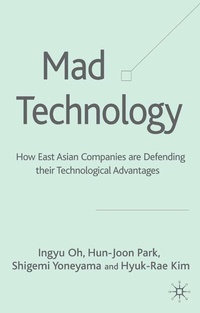
Mad Technology
Description

Reviews / Votes
'In the intellectual lineage of Charles Perrow's Normal Accidents and Susan Strange's Mad Money, Mad Technology is a serious and searching analysis of the past, present, and future of information and biochemical technology. Authors make a compelling case against the neoliberal consensus, and this book should provoke debate.' - John Lie, Professor and Dean of International and Area Studies, University of California, Berkeley, USA.
'Mad Technology is a long-awaited volume on the management of innovation and technology in the Asian context. Authors forewarn us about the danger of unregulated technologies that are freely sold in the global market. This book is a must for students, professionals, policy makers, and CEOs who want to know how to defend our normal science for a sustainable economic growth.' - Gordon Redding, Senior Affiliate Professor of AsianBusiness, INSEAD.
'In the intellectual lineage of Charles Perrow's Normal Accidents and Susan Strange's Mad Money, Mad Technology is a serious and searching analysis of the past, present, and future of information and biochemical technology. Authors make a compelling case against the neoliberal consensus, and this book should provoke debate.' - John Lie, Class of 1959 Professor and Dean of International and Area Studies, University of California, Berkeley
'Mad Technology is a long awaited volume on the management of innovation and technology in the Asian context. Authors forewarn us about the danger of unregulated technologies that are freely sold in the global market. This book is a must for students, professionals, policy makers, and CEOs who want to know how to defend our normal science for a sustainable economic growth.' - Gordon Redding, Senior Affiliate Professor of Asian Business, INSEAD
More details
Other editions
Additional editions
Persons
HUN-JOON PARK is Professor and Associate Dean of Graduate School of Management at Yonsei University, Korea. He has published several books on East Asian management and business ethics and has written numerous articles on technology management, corporate governance, managerial performance, and business ethics.
SHIGEMI YONEYAMA is Professor of Management at Musashi University, Japan. He has been publishing research results on technology development, transfers, and commercialization for the past ten years, and has written several books and articles on organizational behaviour, innovation, and comparative study of technology management. He is currently on sabbatical at INSEAD in France.
HYUK-RAE KIM is Professor Korean Studies at the Graduate School of International Studies at Yonsei University, Korea. He has written several journal articles on the Korean and East Asian political economy, technological management, and globalization, and is the editor of Politics and Markets in the Wake of the Asian Crisis.
