

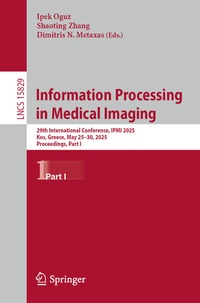
Information Processing in Medical Imaging
Description

This two-volume set LNCS 15829-15830 constitutes the proceedings of the 29th International Conference on Information Processing in Medical Imaging, IPMI 2025, held on Kos, Greece, during May 25-30, 2025.
The 51 full papers presented in this volume were carefully reviewed and selected from 143 submissions. They were organized in topical sections as follows:
Part I: Classification/Detection; Registration; Reconstruction; Image synthesis; Image enhancement; and Segmentation.
Part II: Computer-aided diagnosis/surgery; Brain; Diffusion models; Self-supervised learning; Vision-language models; Shape analysis; and Time-series image analysis.
More details
Other editions
Additional editions
Content
Classification/Detection: SpectMamba: Integrating Frequency and State Space Models for Enhanced Medical Image Detection.- Hierarchical Neural Cellular Automata for Lightweight Microscopy Image Classification.- PathTTT: Test-Time Training with Meta-Auxiliary Learning for Pathology Image Classification. Registration: Bi-invariant Geodesic Regression with Data from the Osteoarthritis Initiative.- GSSD: A Self-Distillation Paradigm with Gradient Surgery for End-to-End Deformable Image Registration.- Medical Image Registration Meets Vision Foundation Model: Prototype Learning and Contour Awareness.- Vascular-topology-aware Deep Structure Matching for 2D DSA and 3D CTA Rigid Registration.- Unsupervised Deformable Image Registration with Structural Nonparametric Smoothing. Reconstruction: Unsupervised Accelerated MRI Reconstruction via Ground-Truth-Free Flow Matching.- Optimization of acquisition schemes towards a better estimation of microstructure parameters in multidimensional diffusion MRI.- Bilinear Projector: Mitigating Discretization Artifacts in Model Based Iterative Reconstruction for X-ray CT.- Subspace Implicit Neural Representations for Real-Time Cardiac Cine MR Imaging. Image synthesis: 3D Shape-to-Image Brownian Bridge Diffusion for Brain MRI Synthesis from Cortical Surfaces.- Cascaded Diffusion Model and Segment Anything Model for Medical Image Synthesis via Uncertainty-Guided Prompt Generation.- DIReCT: Domain-Informed Rectified Flow for Controllable Brain MRI to PET Translation.- IGG: Image Generation Informed by Geodesic Dynamics in Deformation Spaces. Image enhancement: Cycle-consistent zero-shot through-plane super-resolution for anisotropic head MRI.- Bayesian Learning with Stochastic Perturbations and Langevin Expectation Maximization for Unsupervised DNN Image Quality Enhancement. Segmentation: MC-NuSeg: Multi-Contour Aware Nuclei Instance Segmentation with Segment Anything Model.- Pitfalls of topology-aware image segmentation.- GeoT: Geometry-guided Instance-dependent Transition Matrix for Semi-supervised Tooth Point Cloud Segmentation.- RemInD: Remembering Anatomical Variations for Interpretable Domain Adaptive Medical Image Segmentation.- Dynamic Allocation Hypernetwork with Adaptive Model Recalibration for Federated Continual Learning.- SkeIite: Compact Neural Networks for Efficient Iterative Skeletonization.- VerSe: Integrating Multiple Queries as Prompts for Versatile Cardiac MRI Segmentation.
