

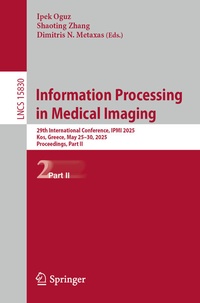
Information Processing in Medical Imaging
Description

This two-volume set LNCS 15829-15830 constitutes the proceedings of the 29th International Conference on Information Processing in Medical Imaging, IPMI 2025, held on Kos, Greece, during May 25-30, 2025.
The 51 full papers presented in this volume were carefully reviewed and selected from 143 submissions. They were organized in topical sections as follows:
Part I: Classification/Detection; Registration; Reconstruction; Image synthesis; Image enhancement; and Segmentation.
Part II: Computer-aided diagnosis/surgery; Brain; Diffusion models; Self-supervised learning; Vision-language models; Shape analysis; and Time-series image analysis.
More details
Other editions
Additional editions
Content
Computer-aided diagnosis/surgery: Concepts from Neurons: Building Interpretable Medical Image Diagnostic Models by Dissecting Opaque Neural Networks.- BioSonix: Can Physics-based Sonification Perceptualize Tissue Deformations from Tool Interactions? Brain: Explainable Deep Model for Understanding Neuropathological Events Through Neural Symbolic Regression.- A Multi-Layer Neural Transport Model for Characterizing Pathology Propagation in Neurodegenerative Diseases.- Enhancing Alzheimer's Diagnosis: Leveraging Anatomical Landmarks in Graph Convolutional Neural Networks on Tetrahedral Meshes.- Hierarchical Variable Importance with Statistical Control for Medical Data-Based Prediction.- Disentangle disease-relevant patterns from irrelevant patterns in fMRI analysis using equivariant and contrastive learning. Diffusion models: Continuous Diffusion Model for Self-supervised Denoising and Super-resolution on Fluorescence Microscopy Images.- Self-Supervised Denoising of Diffusion MRI Data with Efficient Collaborative Diffusion Model.- MAD-AD: Masked Diffusion for Unsupervised Brain Anomaly Detection. Self-supervised learning: Taming Masked Image Modeling for Chest X-ray Diagnosis by Incorporating Clinical Visual Priors.- Diffusion MAE: Paving the Way for Representation Learning of Diffusion MRI.- Resolving quantitative MRI model degeneracy in self-supervised machine learning. Vision-language models: Knowledge-enhanced Hyperbolic Language-Image Pretraining for Zero-shot Learning.- Structure Observation Driven Image-Text Contrastive Learning for Computed Tomography Report Generation.- Hierarchical CLIPs for Fine-grained Anatomical Lesion Localization from Whole-body PET/CT Images.- Multi-View and Multi-Scale Alignment for Contrastive Language-Image Pre-training in Mammography.- Interpretable Few-Shot Retinal Disease Diagnosis with Concept-Guided Prompting of Vision-Language Models.- Full Conformal Adaptation of Medical Vision-Language Models.- A Reality Check of Vision-Language Pre-training in Radiology: Have We Progressed Using Text? Shape analysis: ToothForge: Automatic Dental Shape Generation using Synchronized Spectral Embeddings.- LEDA: Log-Euclidean Diffeomorphism Autoencoder for Efficient Statistical Analysis of Diffeomorphisms.- CoRLD: Contrastive Representation Learning of Deformable Shapes in Images. Time-series image analysis: 4DRGS: 4D Radiative Gaussian Splatting for Efficient 3D Vessel Reconstruction from Sparse-View Dynamic DSA Images.- Brightness-Invariant Tracking Estimation in Tagged MRI.- SafeTriage: Facial Video De-identification for Privacy-Preserving Stroke Triage.
