

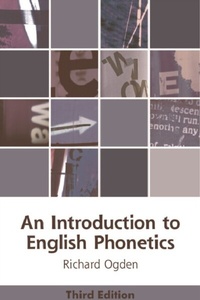
Introduction to English Phonetics
1st Edition
Published on 8. January 2023
256 pages
978-1-3995-0776-9 (ISBN)
Description

New for the third edition:
- Expands the range of speech examples across regional varieties of English and a diversity of different speaker demographics
- Additional exercises to help you explore the material, and updated resources and references to further reading
Maintains the useful features of the previous edition:
- Draws on material from real conversation
- Continues to combine articulatory, auditory and acoustic representations and descriptions of speech
- Continues to include a range of sounds not typically included in textbooks, such as clicks and ejectives
- Focuses on phonetics as a skill and encourages the reader to reflect on own speech
- Each chapter contains a summary, exercises and further reading
In the third edition of this bestselling introductory textbook, Richard Ogden presents the concepts, terminology and representations needed for understanding how English is pronounced globally. He guides you through the vocal tract, explains clearly how the sounds of speech are made, and introduces phonetic transcription and acoustic analysis.
This textbook uses naturally-occurring conversational speech throughout so you can get to know the details of everyday talk (and not just the careful pronunciations presented in dictionaries.) Written in a user-friendly style with plenty of examples, this textbook is a great starting point for your first university course on English phonetics.
More details
Other editions
Additional editions
Richard Ogden
An Introduction to English Phonetics
Book
01/2024
3rd Edition
Edinburgh University Press
€25.00
Shipment within 15-20 days
Previous edition
Richard Ogden
Introduction to English Phonetics
E-Book
02/2017
2nd Edition
Edinburgh University Press
€24.49
Available for download
Content
- Cover
- Half Title
- Series Page
- Title Page
- Copyright
- Contents
- List of figures and tables
- To readers
- Acknowledgements
- 1 Introduction to phonetics
- 1.1 What is phonetics?
- 1.2 What this book covers
- 1.3 Ways to talk about sounds
- 1.4 An overview of the book
- Further reading
- 2 Overview of the human speech mechanism
- 2.1 The complexity of speech sounds
- 2.2 Breathing
- 2.3 The larynx and voicing
- 2.4 Airflow
- 2.5 Place of articulation
- 2.6 Manner of articulation
- Summary
- Exercises
- Further reading
- 3 Representing the sounds of speech
- 3.1 Introduction
- 3.2 Phonetic transcription
- 3.3 Acoustic representations
- 3.4 Acoustic representations and segments
- 3.5 Representation and units in phonetics
- Summary
- Exercises
- Further reading
- 4 The larynx, voicing and phonation type
- 4.1 Introduction
- 4.2 How the larynx articulates
- 4.3 How the vocal folds vibrate
- 4.4 Fundamental frequency, pitch and intonation
- 4.5 Phrasing and intonation
- 4.6 Phonation type: an element of voice quality
- Summary
- Exercises
- Further reading
- 5 Vowels
- 5.1 Introduction
- 5.2 Reference points for vowels: cardinal vowels
- 5.3 The acoustics of vowels
- 5.4 Other vocalic features
- 5.5 Vowels in English 'keywords'
- 5.6 Reduced vowels
- 5.7 Voiceless vowels
- Summary
- Exercises
- Further reading
- 6 Approximants
- 6.1 Introduction
- 6.2 The palatal approximant [j]
- 6.3 A doubly articulated sound: the labiovelar approximant [w]
- 6.4 Laterals
- Summary
- Exercises
- Further reading
- 7 Plosives
- 7.1 Introduction
- 7.2 Overview of the production of plosives
- 7.3 Voicing and plosives in English
- 7.4 Glottalisation
- 7.5 Long closure
- 7.6 Place of articulation
- 7.7 Release features of plosives
- 7.8 Taps
- Summary
- Exercises
- Further reading
- 8 Fricatives
- 8.1 Introduction
- 8.2 The production of fricatives
- 8.3 Details of English fricatives
- 8.4 Non-lexical fricatives
- Summary
- Exercises
- Further reading
- 9 Nasals
- 9.1 The production of nasals
- 9.2 Details of English nasals
- 9.3 Nasalised vowels
- 9.4 Syllabic nasals
- Summary
- Exercises
- Further reading
- 10 Glottalic and velaric airstreams
- 10.1 Airstream mechanisms
- 10.2 The velaric airstream mechanism
- 10.3 The glottalic airstream mechanism
- Summary
- Exercises
- Further reading
- 11 Sounds and structures
- 11.1 Introduction
- 11.2 Data
- 11.3 Assimilation: place of articulation across word boundaries
- 11.4 Glottal stops
- 11.5 Silent pauses within an utterance
- 11.6 Silent pauses after syntactic completion
- 11.7 Examples of places with syntactic completion + pause
- 11.8 Syntactically complete phrases followed immediately by more talk
- Summary
- Note on the data Exercises
- Further reading
- 12 Conclusion
- Glossary
- Discussion of the exercises
- Charts
- Further reading
- Index
