

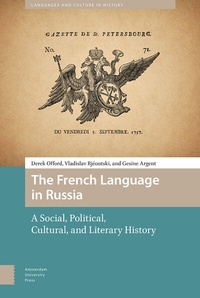
The French Language in Russia
A Social, Political, Cultural, and Literary History
Published on 10. September 2018
702 pages
978-90-485-3276-6 (ISBN)
Description

This book provides a wide-ranging account of the social, political, cultural, and literary functions of the French language in Russia from c. 1700 to 1917.
Reviews / Votes
Winner of the 2019 R. Gapper Book Prize awarded by The Society for French Studies for the best book in French Studies published in 2018! The work has been commended as "Not only a model of co-authorship, but a ground-breaking study of immense scholarly distinction which makes a real contribution to the wider debate about what Francophonie is and was."Winner of the 2019 Marc Raeff Book Prize awarded by the Eighteenth Century Russian Studies Association (ECRSA)! The prize is awarded annually '"For a publication that is of exceptional merit and lasting significance for understanding Imperial Russia during the long eighteenth century."
"[This book] will become an essential resource and springboard for scholars across a range of disciplines (history, literature, sociolinguistics) who are interested in the multifarious implications of Russia's endlessly intriguing French connection." - Thomas Newlin, The Russian Review, October 2020 (Vol. 79, No. 4)
"This very complete, monumental, detailed, extremely well documented work initiates us into a rich and still valid history." - Valentina Chepiga, Slavica Occitania, Toulouse, 50, 2020. Originally published in French.
"Offord, Rjeoutski and Argent have produced an important, original and scholarly work which will be of interest to specialists in political, social and cultural studies, as well as linguists. This work could almost be considered a blueprint for any future studies in historical sociolinguistics." - Alison Long, Keele University, BASEES Book Review, December 2019
"This long-awaited publication of the collaborative work on Russian Francophonie in the eighteenth-nineteenth centuries presents a collection of knowledge on the subject on an encyclopedic scale. It is undoubtedly the most comprehensive, systematic and methodologically accomplished study of Russian Francophone culture of its kind and sets a new conceptual matrix for the study of diachronic multilingualism and diglossia using a variety of sources and methodologies." - Ekaterina Chown, Durham University, Slavic Review, November 2019
"This study exemplifies the rarely used possibilities of teamwork in the social sciences and shows the path for more team-written monographs, which as yet are rarae aves. The skills and expertise of the book's three authors complement one another, resulting in a multifaceted and in-depth survey and analysis of the subject matter at hand." - Tomasz Kamusella, University of St Andrews, Journal of Historical Sociolinguistics, November 2019
"Intellectually rigorous, and based on an impressive wealth of multilingual published sources as well as unpublished or not readily available material, this book offers a new and refreshingly positive take on a subject that has traditionally been viewed negatively or at least through the prism of politically inflected stereotypes." - Helena Duffy, Royal Holloway London, French Studies, October 2019
"It is an exemplary addition, rich in detail, confident in its critical arguments and exceptionally well articulated." - W. Gareth Jones, Journal of European Studies 49(2)
"This is an exemplary study of the history of language, it deserves to be a model for future studies of other languages. The scholarship is impeccable, the range of reading is wide, the judgements inspire confidence." - Peter Burke, Emmanuel College Cambridge
"It is really original. Not only this subject, but many others of comparable significance, have hitherto been addressed only by historians with vague and general assumptions about language, or by (socio)linguists with little affinity for the historical context. It is also beautifully written and compellingly argued throughout. So far as I'm aware, this is simply the best thing of its kind available." - Robert Evans, Regius professor of History emeritus, University of Oxford
More details
Series
Edition
Digital original
Language
English
Place of publication
Amsterdam
Netherlands
Target group
Professional and scholarly
US School Grade: College Graduate Student
Edition type
Digital original
Illustrations
15 s/w Abbildungen
15 halftones; 15 Illustrations, black and white
File size
3,94 MB
ISBN-13
978-90-485-3276-6 (9789048532766)
Copyright in bibliographic data and cover images is held by Nielsen Book Services Limited or by the publishers or by their respective licensors: all rights reserved.
Schweitzer Classification
Other editions
Additional editions
Derek Offord | Vladislav Rjeoutski | Gesine Argent
The French Language in Russia
A Social, Political, Cultural, and Literary History
Book
09/2018
Amsterdam University Press
€86.00
Shipment within 15-20 days
Persons
Offord Derek :
Emeritus Professor Derek Offord, Senior Research Fellow, University of Bristol. Specialist in Russian cultural and intellectual history and the author or editor of books on early Russian liberalism, Russian travel-writing, the history of Russian thought, and the modern Russian language.Rjeoutski Vladislav :
Dr. Vladislav Rjeoutski, research fellow at the German Historical Institute in Moscow. Co-director of the DFG-funded research project on the languages of diplomacy in the eighteenth-century Russia, co-author (with Derek Offord and Gesine Argent) of: The French Language in Russia. A Social, Political, Cultural, and Literary History (Amsterdam: AUP, 2018).Argent Gesine :
Dr Gesine Argent is Centre Manager and Research Associate at the Princess Dashkova Russian Centre at the University of Edinburgh. Her research focuses on Russian language culture, language ideology, and language purism.
Emeritus Professor Derek Offord, Senior Research Fellow, University of Bristol. Specialist in Russian cultural and intellectual history and the author or editor of books on early Russian liberalism, Russian travel-writing, the history of Russian thought, and the modern Russian language.Rjeoutski Vladislav :
Dr. Vladislav Rjeoutski, research fellow at the German Historical Institute in Moscow. Co-director of the DFG-funded research project on the languages of diplomacy in the eighteenth-century Russia, co-author (with Derek Offord and Gesine Argent) of: The French Language in Russia. A Social, Political, Cultural, and Literary History (Amsterdam: AUP, 2018).Argent Gesine :
Dr Gesine Argent is Centre Manager and Research Associate at the Princess Dashkova Russian Centre at the University of Edinburgh. Her research focuses on Russian language culture, language ideology, and language purism.
Content
List of illustrations Preface Acknowledgements Presentation of dates, transliteration, and other editorial practices Abbreviations used in the notes The Romanovs Introduction Conventional assumptions about Franco-Russian bilingualism Russia and 'the West', and the two Russias Empire, nation, and language Sociolinguistic perspectives Methodological considerations Literature as a primary source Chapter 1: The historical contexts of Russian francophonie The spread of French in seventeenth- and eighteenth-century Europe The westernization of Russia in the eighteenth century The introduction of foreign languages into eighteenth-century Russia The golden age of the nobility The Napoleonic Wars and the Decembrist Revolt The literary community and the intelligentsia in the age of Nicholas I Chapter 2: Teaching and learning French An overview of French teaching in Russia French versus German French versus Latin French (and English) versus Russian Acquiring social and cultural codes by learning French Chapter 3: French at court The discovery of sociability French as a sign of the status of the Russian court French as a court language under Catherine II French at the nineteenth-century court French as a royal language Chapter 4: French in high society The place of French in the noble's linguistic repertoire French in the sites of noble sociability The spirit of the grand monde and social relations in it Francophonie and social identity French beyond the metropolitan aristocracy Chapter 5: French in diplomacy and other official domains The Chancery of Foreign Affairs and language training for Russian diplomats The gradual rise of French in European and Russian treaties Turning to French for the conduct of Russian diplomatic business The influx of French loanwords into Russian diplomatic parlance Language use in internal communications about foreign affairs The triumph of French in the diplomatic community and the limits to its use French and Russian in other official domains French at the Academy of Sciences Chapter 6: Writing French Types of text and language choice in them Language choice in nobles' personal correspondence Language use in diaries, travel notes, memoirs, and albums Writing French to join Europe Count Rostopchin's 'memoirs' Women's place in the literary landscape Early nineteenth-century women's prose fiction Chapter 7: French for cultural propaganda and political polemics Transforming Russia's image Cultural propaganda in French in the age of Catherine Russian use of the Francophone press in the age of Catherine and beyond The promotion and translation of Russian literature Chaadaev's first 'Philosophical Letter' Geopolitical polemics around 1848 Polemical writings in French after the Crimean War Chapter 8: Language attitudes Language debate and its place in discourse about national identity The development of Russian language consciousness Linguistic Gallophobia in eighteenth-century comic drama The linguistic debate between Karamzin and Shishkov Rostopchin's Gallophobia Literary reflection on francophonie in the 1820s and 1830s A Slavophile view of Russian francophonie: Konstantin Aksakov Chapter 9: Perceptions of bilingualism in the classical Russian novel The rise of the novel and the expression of nationhood in it Ivan Turgenev Lev Tolstoi: War and Peace Tolstoi: Anna Karenina Fedor Dostoevskii Conclusion The functions of French in Imperial Russia The changing climate in which French was used Cultural borrowing and language use in grand narratives about Russian culture Bibliography Archival sources Published primary sources Secondary sources Index
