

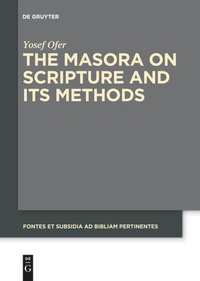
The Masora on Scripture and Its Methods
Masora on Scripture and Its Methods
1st Edition
Published on 20. December 2018
XII, 286 pages
978-3-11-059456-0 (ISBN)
Description

The starting point for any study of the Bible is the text of the Masora, as designed by the Masoretes. The ancient manuscripts of the Hebrew Bible contain thousands of Masora comments of two types: Masora Magna and Masora Prava. How does this complex defense mechanism, which contains counting of words and combinations from the Bible, work?
Yosef Ofer, of Bar-Ilan University and the Academy of the Hebrew Language, presents the way in which the Masoretic comments preserve the Masoretic Text of the Bible throughout generations and all over the world, providing comprehensive information in a short and efficient manner.
The book describes the important manuscripts of the Hebrew Bible, and the methods of the Masora in determining the biblical spelling and designing the forms of the parshiot and the biblical Songs. The effectiveness of Masoretic mechanisms and their degree of success in preserving the text is examined. A special explanation is offered for the phenomenon of qere and ketiv.
The book discusses the place of the Masoretic text in the history of the Bible, the differences between the Babylonian Masora and that of Tiberias, the special status of the Aleppo Codex and the mystery surrounding it. Special attention is given to the comparison between the Aleppo Codex and the Leningrad Codex (B 19a). In addition, the book discusses the relationship between the Masora and other tangential domains: the grammar of the Hebrew language, the interpretation of the Bible, and the Halakha.
The book is a necessary tool for anyone interested in the text of the Bible and its crystallization.
Yosef Ofer, of Bar-Ilan University and the Academy of the Hebrew Language, presents the way in which the Masoretic comments preserve the Masoretic Text of the Bible throughout generations and all over the world, providing comprehensive information in a short and efficient manner.
The book describes the important manuscripts of the Hebrew Bible, and the methods of the Masora in determining the biblical spelling and designing the forms of the parshiot and the biblical Songs. The effectiveness of Masoretic mechanisms and their degree of success in preserving the text is examined. A special explanation is offered for the phenomenon of qere and ketiv.
The book discusses the place of the Masoretic text in the history of the Bible, the differences between the Babylonian Masora and that of Tiberias, the special status of the Aleppo Codex and the mystery surrounding it. Special attention is given to the comparison between the Aleppo Codex and the Leningrad Codex (B 19a). In addition, the book discusses the relationship between the Masora and other tangential domains: the grammar of the Hebrew language, the interpretation of the Bible, and the Halakha.
The book is a necessary tool for anyone interested in the text of the Bible and its crystallization.
More details
Other editions
Additional editions
Yosef Ofer
The Masora on Scripture and Its Methods
Book
12/2020
1st Edition
De Gruyter
€29.95
Shipment within 7-9 days
Yosef Ofer
The Masora on Scripture and Its Methods
Book
12/2018
1st Edition
De Gruyter
€189.95
Shipment within 7-9 days
E-Book
12/2018
1st Edition
De Gruyter
€189.95
Available for download
Person
Yosef Ofer, Bar Ilan University, Ramat Gan, Israel.
Content
- Intro
- Contents
- Preface
- Part I: The Biblical Masora and its Methods
- 1. What is the Masora?
- 2. Methods of Description and Classification
- 3. Determining Orthography on the Basis of Masoretic Notes
- 4. The Accumulative Masora
- 5. Open and Closed Passages and the Writing of Songs
- 6. Ketiv and Qere
- 7. The Masora on Scripture as an "Error Correcting Code"
- Part II: The Masoretic Text in Time and Space
- 8. The Aleppo Codex and its Discovery
- 9. The Babylonian Masora and Its Influence
- 10. The Masoretic Text and its Role in the History of the Text of Scripture
- 11. Secondary Stress Marks (Ge'ayot) - in Manuscripts and in Printed Editions
- 12. Published Editions of the Hebrew Bible - and Their Relation to the Masora and the Aleppo Codex
- Part III: The Masora in Interaction with Other Disciplines
- 13. The Masora and Hebrew Grammar
- 14. The Masora and Biblical Exegesis
- 15. The Masora and Halakha
- Index of Manuscripts
- Index of People
- Index of Terms
