

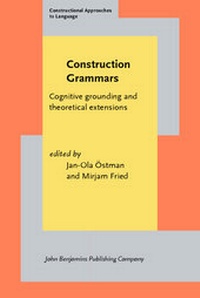
Construction Grammars
Cognitive grounding and theoretical extensions
1st Edition
Published on 28. February 2005
VIII, 325 pages
978-90-272-9470-8 (ISBN)
Description

The notion 'construction' has become indispensable in present-day linguistics and in language studies in general. This volume extends the traditional domain of Construction Grammar (CxG) in several directions, all with a cognitive basis. Addressing a number of issues (such as coercion, discourse patterning, language change), the contributions show how CxG must be part and parcel of cognitively oriented studies of language, including language universals. The volume also gives informative accounts of how the notion 'construction' is developed in approaches that are conceptually close to, and relatively compatible with, CxG: Conceptual Semantics, Word Grammar, Cognitive Grammar, Embodied Construction Grammar, and Radical Construction Grammar.
More details
Other editions
Additional editions
Book
02/2005
John Benjamins Publishing Co
€190.98
Shipment within 3-4 weeks
Book
02/2005
John Benjamins Publishing Co
€121.90
Shipment within 10-15 days
Persons
Content
- Construction Grammars
- Editorial page
- Title page
- LCC data
- Table of contents
- 1. The cognitive grounding of Construction Grammar
- 1. Introduction
- 2. The cognitive dimension
- 3. Present advances
- 4. Further issues
- Notes
- References
- I. Theoretical extensions
- 2. Argument realization
- 1. Introduction
- 2. Previous claims
- 3. Implicit theme
- 3.1. Implicit theme construction
- 3.2. Motivating the implicit theme construction
- 4. Omission under low discourse prominence
- 5. Obligatorily transitive single-event verbs
- 6. Ditransitives
- 7. Explaining the tendencies
- Notes
- References
- 3. Entity and event coercion in a symbolic theory of syntax
- 1. Introduction
- 2. Coercion by construction: Nominal syntax
- 3. Argument-Structure constructions
- 4. Aspectual constructions
- 4.1. Aspectual meaning
- 4.2. Aspectual concord constructions: The Frame Adverbial construction
- 4.3. Aspectual Shift constructions: The Progressive
- 4.4. Tense constructions: The Present in French and English
- 5. Conclusion
- Notes
- References
- 4. Frames, profiles and constructions
- 1. Introduction
- 1.1. About the problem: The Finnish permissive construction
- 1.2. About the framework: Why two theories?
- 2. Overview: Two CGs
- 3. Complementary problems, complementary strong points
- 4. A solution: Combining two CGs
- 5. A test case: A brief history of the Finnish permissive construction
- 6. A corollary: Syntactic structure and conceptual structure
- 7. Conclusion
- Notes
- References
- 5. Construction Discourse
- 1. The issue: The need for discourse study
- 2. Setting the scene: Headlines and determiners
- 3. The setting: On discourse and Construction Grammar
- 4. Complicating action: Four claims
- 4.1. Conventionalized discourse
- 4.2. Syntax and discourse
- 4.3. Context dependency
- 4.4. Frames as genres
- 5. Frames of understanding
- 6. Discourse patterns as conventional constructions
- 7. Resolution: dp representation
- 8. Evaluation: Mother drowned baby
- 8.1. Headline
- 8.2. Family conversation
- 8.3. Interlanguage
- 8.4. On the feasibility of alternative solutions
- 9. Coda
- Notes
- References
- II. Construction Grammars
- 6. Embodied Construction Grammar in simulation-based language understanding
- 1. Overview
- 1.1. Embodied schemas
- 1.2. A first look at constructions
- 2. A detailed analysis
- 2.1. Referring expressions
- 2.2. Predicating expressions
- 3. ECG in language understanding
- 3.1. Constructional analysis
- 3.2. Simulative inference
- 3.3. Scaling up
- 4. Concluding remarks
- Acknowledgments
- Notes
- References
- 7. Constructions in Conceptual Semantics
- Introduction
- 1. Conceptual semantics
- 2. Is there a difference between conceptual semantics and Goldberg's Construction Grammar?
- 3. Conceptual structure
- 4. Lexical linking
- 4.1. General tendencies
- 4.2. Send
- 4.3. Give
- 4.4. Paint
- 4.5. Conclusion
- 5. The instrumental elative constructions in Finnish
- 5.1. The NP-construction [isku NP-ELA]
- 5.2. The VP-constructions [saa/otta-NP-ELA GOAL], [saa/otta-NP-ELA], and [anta-NP-ALL NP-ELA]
- 5.3. The clause-level construction [TIME tule-NP-ELA]
- 6. Ablative case adjuncts in Finnish
- 6.1. General
- 6.2. A simple example of the formal analysis: The o'clock ABL Adjunct
- 6.3. An example of an ambiguous sentence
- 6.4. Malefactive owner ABL adjunct
- 6.5. The Loser ABL Adjunct construction
- 6.6. The Losing Control ABL Adjunct
- 7. Explaining the relationships between the ABL-constructions
- 7.1. The possessive construction and secondary predicate sentences
- 7.2. Holding is controlling
- 8. Conclusion
- Appendix: The case system in Finnish
- Notes
- References
- 8. Constructions in Word Grammar
- 1. Word Grammar and Construction Grammar
- 2. WG notation: Graphs not boxes
- 3. Inheritance in WG
- 4. Syntax without phrase structure
- 5. A WG analysis of the What's X doing Y? construction
- 6. A WG analysis of double objects
- 7. Conclusion: What is a construction?
- Notes
- References
- 9. Logical and typological arguments for Radical Construction Grammar*
- 1. Introduction: Vanilla construction grammar and Radical Construction Grammar
- 2. From syntactic categories to semantic maps
- 2.1. The typological argument
- 2.2. The logical argument
- 3. From syntactic relations to symbolic relations
- 3.1. The logical argument
- 3.2. The typological argument
- 3.3. Comprehending constructions without relations
- 4. From universal constructions to syntactic space
- 5. Conclusion
- Notes
- References
- Subject index
- Index of constructions
- The series Constructional Approaches to Language
