

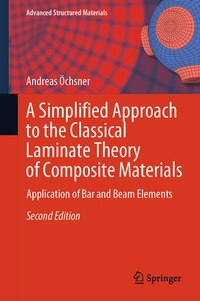
A Simplified Approach to the Classical Laminate Theory of Composite Materials
Description

This book provides a systematic introduction to composite materials, which are obtained by a layer-wise stacking of one-dimensional bar/beam elements. Each layer may have different mechanical properties, but each single layer is considered as isotropic. The major idea is to provide a simplified theory to easily understand the classical two-dimensional laminate theory for composites based on laminae with unidirectional fibers. In addition to the elastic behavior, failure is investigated based on the maximum stress, maximum strain, Tsai-Hill, and the Tsai-Wu criteria.
Partial differential equations lay the foundation to mathematically describe the mechanical behavior of any classical structural member known in engineering mechanics, including composite materials. The so-called classical laminate theory provides a simplified stress analysis, and a subsequent failure analysis, without the solution of the system of coupled differential equations for the unknown displacements. The procedure provides the solution of a statically indeterminate system based on a generalized stress-strain relationship under consideration of the constitutive relationship and the definition of the so-called stress resultants. This laminate theory is typically provided for two-dimensional plane problems, where the basic structural element is a simple superposition of a classical plane elasticity element with a thin plate element under the consideration of an orthotropic constitutive law.
This two-dimensional approach and the underlying advanced continuum mechanical modeling might be very challenging for some students, particularly at universities of applied sciences. Thus, a reduced approach, the so-called simplified classical laminate theory, has been developed. The idea is to use solely isotropic one-dimensional elements, i.e., a superposition of bar and beam elements, to introduce the major calculation steps of the classical laminate theory. Understanding this simplified theory is much easier and the final step it to highlight the differences when moving to the general two-dimensional case.
More details
Other editions
Additional editions
Previous edition
Person
Andreas Öchsner is a full professor of Lightweight Design and Structural Simulation at Esslingen University of Applied Sciences, Germany. After completing his Dipl.-Ing. degree in Aeronautical Engineering at the University of Stuttgart (1997), he served as a research and teaching assistant at the University of Erlangen-Nuremberg from 1997 to 2003 while pursuing his Doctor of Engineering Sciences (Dr.-Ing.) degree. From 2003 to 2006, he was an assistant professor at the Department of Mechanical Engineering and the head of the Cellular Metals Group affiliated with the University of Aveiro, Portugal. He spent seven years (2007-2013) as a full professor at the Department of Applied Mechanics, Technical University of Malaysia, where he was also the head of the Advanced Materials and Structure Lab. From 2014 to 2017, he was a full professor at the School of Engineering, Griffith University, Australia.
Content
Introduction.- Bar Elements.- Euler-Bernoulli Beam Elements.- Combination of Bar and Beam Elements.- Classical Laminate Theory for One-Dimensional Elements.- Example Problems.- Outlook to the Two-Dimensional Case.
