

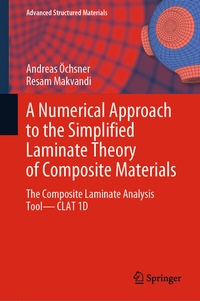
A Numerical Approach to the Simplified Laminate Theory of Composite Materials
Description

A typical approach to treat composite materials, which are composed of layered unidirectional lamina, is the so-called classical laminate theory (CLT). This theory is based on the theory for plane elasticity elements and classical (shear-rigid) plate elements under the assumption of orthotropic constitutive equations. The solution of the fundamental equations of the classical laminate theory is connected with extensive matrix operations and many problems require in addition iteration loops.
This two-dimensional approach and the underlying advanced continuum mechanical modeling might be very challenging for some students, particularly at universities of applied sciences. Thus, a reduced approach, the so-called simplified classical laminate theory (SCLT), has been recently proposed. The idea was to use solely isotropic one-dimensional elements, i.e., a superposition of bar and beam elements, to introduce the major calculation steps of the classical laminate theory. Understandingthis simplified theory is much easier and the final step it to highlight the differences when moving to the general two-dimensional case.
This monograph first provides a systematic and thorough introduction to the simplified laminate theory based on the theory for bars and classical beam plate elements. The focus is on stacking of isotropic layers to simplified laminates. In addition to the elastic behavior, failure is investigated based on the maximum stress, maximum strain, Tsai-Hill, and the Tsai-Wu criteria. We provide a Python-based computational tool, the so-called Composite Laminate Analysis Tool (CLAT 1D) to easily solve some standard questions from the context of fiber reinforced composites. The tool runs in any standard web browser and offers a user-friendly interface with many post-processing options. The functionality comprises stress and strain analysis of simplified lamina and laminates and the failure analysis based on different criteria.
More details
Other editions
Additional editions
Persons
Andreas Öchsner is a Full Professor for lightweight design and structural simulation at the Esslingen University of Applied Sciences, Germany. Having obtained a Dipl.-Ing. degree in Aeronautical Engineering at the University of Stuttgart (1997), Germany, he served as a Research and Teaching Assistant at the University of Erlangen-Nuremberg from 1997 to 2003 while working to complete his Doctor of Engineering Sciences (Dr.-Ing.) degree. From 2003 to 2006, he was an Assistant Professor at the Department of Mechanical Engineering and Head of the Cellular Metals Group affiliated with the University of Aveiro, Portugal. He spent seven years (2007-2013) as a Full Professor at the Department of Applied Mechanics, Technical University of Malaysia, where he was also Head of the Advanced Materials and Structure Lab. From 2014-2017, he was a Full Professor at the School of Engineering, Griffith University, Australia, and Leader of the Mechanical Engineering Program (Head of Discipline and Program Director).
Resam Makvandi
received his Ph.D. at the Institute of Mechanics, Otto von Guericke University of Magdeburg, Germany. He completed his B.Sc. degree at the Islamic Azad University, Ahvaz Branch, Iran (2010) and his M.Eng. degree at the University of Technology, Malaysia (2013), both in Mechanical Engineering.
Content
Introduction.- Simplified Laminate Theory.- Composite Laminate Analysis Tool - CLAT 1D.- Application Examples.- Source Codes.- Index.
