

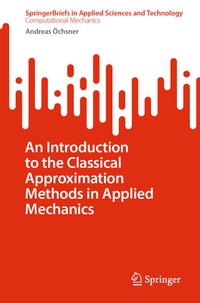
An Introduction to the Classical Approximation Methods in Applied Mechanics
Description

This book presents a unified approach to classical approximation methods in engineering by applying the weighted residual method to transform differential equations into solvable algebraic systems. It demonstrates how this procedure underlies the finite difference, finite element, finite volume, and boundary element methods. The mechanical focus is on the one-dimensional tensile bar, allowing the mathematical framework and resulting matrix equations to be fully displayed and understood without symbolic abstraction. This approach supports a clear understanding of the derivation processes and is designed to help readers implement and extend features such as constitutive models in commercial simulation tools.
More details
Other editions
Additional editions
Person
Andreas Öchsner is Full Professor for lightweight design and structural simulation at the Esslingen University of Applied Sciences, Germany. His research interests are related to experimental and computational mechanics, cellular metals and thin structures and interphases. His editorial work comprises posts as Editor-in-chief of the international journal Continuum Mechanics and Thermodynamics (Springer), Editor-in-chief of the Springer book series on Advanced Structured Materials and Editor of SpringerBriefs in Applied Sciences and Technology: Computational Mechanics.
