

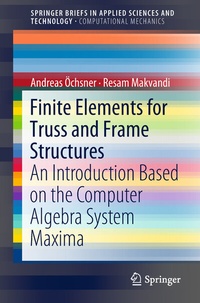
Finite Elements for Truss and Frame Structures
Description

This book is intended as an essential study aid for the finite element method. Based on the free computer algebra system Maxima, the authors offer routines for symbolically or numerically solving problems in the context of plane truss and frame structures, allowing readers to check classical 'hand calculations' on the one hand and to understand the computer implementation of the method on the other. The mechanical theories focus on the classical one-dimensional structural elements, i.e. bars, Euler-Bernoulli and Timoshenko beams, and their combination to generalized beam elements. Focusing on one-dimensional elements reduces the complexity of the mathematical framework, and the resulting matrix equations can be displayed with all components and not merely in the form of a symbolic representation. In addition, the use of a computer algebra system and the incorporated functions, e.g. for equation solving, allows readers to focus more on the methodology of the finite element method andnot on standard procedures.
More details
Other editions
Additional editions
Persons
Andreas Öchsner is a Full Professor of Lightweight Design and Structural Simulation at Esslingen University of Applied Sciences, Germany. Having obtained his Dipl.-Ing. degree in Aeronautical Engineering at the University of Stuttgart (1997), Germany, he subsequently served as a research and teaching assistant at the University of Erlangen-Nuremberg from 1997 to 2003 while working to complete his Doctor of Engineering Sciences (Dr.-Ing.) degree. From 2003 to 2006, he was an Assistant Professor at the Department of Mechanical Engineering and Head of the Cellular Metals Group affiliated with the University of Aveiro, Portugal. He spent seven years (2007-2013) as a Full Professor at the Department of Applied Mechanics, Technical University of Malaysia, where he was also Head of the Advanced Materials and Structure Lab. From 2014 to 2017 he was a Full Professor at the School of Engineering, Griffith University, Australia and Leader of the Mechanical Engineering Program (Head of Discipline and Program Director).
Resam Makvandi is a PhD candidate and research fellow at the Institute of Mechanics, Otto von Guericke University of Magdeburg, Germany. He obtained his B.Sc. degree from Islamic Azad University, Ahvaz Branch, Iran (2010) and his M.Eng. degree from the University of Technology, Malaysia (2013), both in Mechanical Engineering.
