

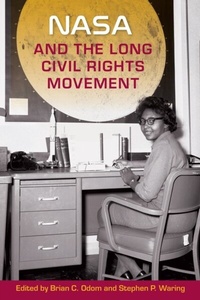
NASA and the Long Civil Rights Movement
Description

As NASA prepared for the launch of Apollo 11 in July 1969, many African American leaders protested the billions of dollars used to fund ?space joyrides? rather than help tackle poverty, inequality, and discrimination at home. This volume examines such tensions as well as the ways in which NASA's goal of space exploration aligned with the cause of racial equality. It provides new insights into the complex relationship between the space program and the civil rights movement in the Jim Crow South and abroad.
Essays explore how thousands of jobs created during the space race offered new opportunities for minorities in places like Huntsville, Alabama, while at the same time segregation at NASA's satellite tracking station in South Africa led to that facility's closure. Other topics include black skepticism toward NASA's framing of space exploration as ?for the benefit of all mankind,? NASA's track record in hiring women and minorities, and the efforts of black activists to increase minority access to education that would lead to greater participation in the space program. The volume also addresses how to best find and preserve archival evidence of African American contributions that are missing from narratives of space exploration.
NASA and the Long Civil Rights Movement offers important lessons from history as today's activists grapple with the distance between social movements like Black Lives Matter and scientific ambitions such as NASA's mission to Mars.
Contributors: P.J. Blount | Jonathan Coopersmith | Matthew L. Downs | Eric Fenrich | Cathleen Lewis | Cyrus Mody | David S. Molina | Brian C. Odom | Brenda Plummer | Christina K. Roberts | Keith Snedegar | Stephen P. Waring | Margaret A. Weitekamp
Publication of the paperback edition made possible by a Sustaining the Humanities through the American Rescue Plan grant from the National Endowment for the Humanities.
All prices
More details
Other editions
Additional editions

Persons
Content
- Intro
- Title Page
- Copyright Page
- Contents
- List of Figures
- Foreword: How We Tell about the Civil Rights Movement and Why It Matters
- Introduction: Exploring NASA in the Long Civil Rights Movement
- Part I. New Frameworks
- 1. Space History Matures-and Reaches a Crossroads
- 2. Bringing Mankind to the Moon: The Human Rights Narrative in the Space Age
- 3. Bringing the Moon to Mankind: The Civil Rights Narrative and the Space Age
- Part II. Southern Context
- 4. The Newest South: Race and Space on the Dixie Frontier
- 5. Accommodating the Forces of Change: Civil Rights and Economic Development in Space Age Huntsville, Alabama
- 6. NASA, the Association of Huntsville Area Contractors, and Equal Employment Opportunity in the Rocket City, 1963-1965
- Part III. International Context
- 7. Arnaldo Tamayo Méndez and Guion Bluford: The Last Cold War Race Battle
- 8. The Congressional Black Caucus and the Closure of NASA's Satellite Tracking Station at Hartebeesthoek, South Africa
- Part IV. Broader Context
- 9. "A Competence Which Should Be Used": NASA, Social Movements, and Social Problems in the 1970s
- 10. The Gates of Opportunity: NASA, Black Activism, and Educational Access
- 11. "Petite Engineer Likes Math, Music"
- Conclusion: Where Do We Go from Here? Ensuring the Past and Future History of Space
- List of Contributors
- Index
