

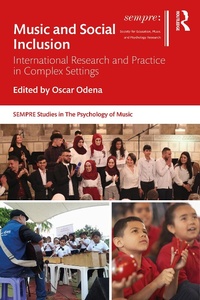
Music and Social Inclusion
International Research and Practice in Complex Settings
1st Edition
Published on 30. December 2022
290 pages
978-1-000-81622-8 (ISBN)
Description

How do we develop social inclusion through musical activities? What is the power of music in enhancing individual inclusion, group cohesion, and cross-community work in post-conflict environments? How can we investigate social music programmes and interventions? This comprehensive volume offers new research on these questions by an international team of experts from the fields of music education, music psychology, ethnomusicology, and community music. The book celebrates the rich diversity of ways in which learners of all ages participate in social music projects in complex settings. Contributions focus broadly on musical and social processes, considering its conceptualisation and practices in a number of contexts. The authors examine how social music projects can be fostered in complex settings, drawing examples from schools and community settings. These critical chapters will inspire readers to think deeply about social music interventions and their development. The book will be of crucial interest to educators, policymakers, researchers, and students, as it draws on applied research from across 14 countries, of which ten are in the Global South.
Reviews / Votes
'A scholarly collection by talented academic researchers intended to stimulate discussion within the field...for socially minded music educators, the volume is not only informative but inspirational. [With an] incredible diversity of programs studied, serving a wide range of ages, ethnicities, socio-economic classes and political contexts, Music and Social Inclusion stands as a good manual for anyone interested in conscientiously building or developing a social music program of their own.'American Music Teacher
'Authored by experts in the fields of music, sociology, psychology and education, delving into the multifaceted dimensions of how music can bridge gaps, break barriers and create spaces for cohesion within diverse and intricate societal frameworks...Odena sets the agenda by interrogating the power of music in enhancing social inclusion...Coyne and MacDonald explore homelessness and choral signing as a place of sanctuary. Mateos-Moreno provides a very interesting and scholarly interrogation of landmarks of a community music project...There is much to ponder in this edited volume [which] illustrates the symbiosis between practice and research...Educators, policy-makers, researchers and of course students will be encouraged to think critically about their own study and practice.'
International Journal of Community Music
More details
Series
Edition
1. Auflage
Language
English
Place of publication
London
United Kingdom
Publishing group
Taylor & Francis Ltd
Target group
College/higher education
Professional and scholarly
Product notice
Reflowable
Illustrations
11 Tables, black and white; 12 Line drawings, black and white; 6 Halftones, black and white; 18 Illustrations, black and white
ISBN-13
978-1-000-81622-8 (9781000816228)
Copyright in bibliographic data and cover images is held by Nielsen Book Services Limited or by the publishers or by their respective licensors: all rights reserved.
Schweitzer Classification
Other editions
Additional editions
Book
08/2024
1st Edition
Routledge
€63.60
Shipment within 10-20 days
Book
12/2022
1st Edition
Routledge
€193.13
Shipment within 10-20 days
Person
Oscar Odena is Professor of Education at the School of Education and the School of Interdisciplinary Studies, University of Glasgow, UK. His areas of expertise comprise qualitative research approaches, inclusion, creativity, and music education. He has authored over 80 papers, and his monograph Musical Creativity Revisited was published by Routledge in 2018. He has been Principal Investigator in four projects on the role of the arts for inclusion and social cohesion. He serves on the boards of leading journals and the review colleges of the UK Arts and Humanities Research Council and Irish Research Council.
Content
Introduction
Part I - Foundations
Chapter 1 - Exploring the order and disjuncture of music projects in places affected by war, Gillian Howell
Chapter 2 - A model for developing music and music education activities for social cohesion in complex settings, Oscar Odena
Part II - Cross-community environments
Chapter 3 - 'I just feel I belong here': homeless choirs and singing groups in the UK and Brazil, Shelly Coyne and Raymond MacDonald
Chapter 4 - 'Participatory songwriting' as process/narrative: insights from a community music project with diverse communities in the north east of England, Sam Slatcher
Chapter 5 - Playlists, connection and covid: making sense of lockdown and loss with songs in Mexico City and Glasgow, Valeria Gascon
Chapter 6 - What are the landmarks in a community music project? The case of the Kithara project, Daniel Mateos-Moreno
Chapter 7 - The impact of music education in social projects: two cases in south Brazil, Sergio Figueiredo and Oscar Odena
Chapter 8 - Crescendo: using a music education programme to improve social outcomes in disadvantaged communities, Conneth Poland, Liam O'Hare and Leeanne O'Hara
Chapter 9 - Does the 21st century music curriculum enable Northern Ireland's children sing each other's songs?, Jenny Scharf and Oscar Odena
Chapter 10 - There is no global justice without global cognitive justice: envisioning music education through the ecology of knowledges in the context of Mexico, Hector Vazquez-Cordoba
Part III - Conflict and post-conflict environments
Chapter 11 - The art of positive fatalism, Lukas Pairon
Chapter 12 - Arts for peace education in Chihuahua, Mexico: efforts, outcomes and challenges of two community music programs, Patricia A. Gonzalez-Moreno and Ruben Carrillo
Chapter 13 - Conflict transformation, scalability and the non-governmental ear in a hip-hop social project in Iztapalapa, Mexico City, Andrew Green
Chapter 14 - Expedicion sensorial programme: transformations in the role of cultural policies in peacebuilding in Colombia, Andrea Rodriguez-Sanchez and Gloria Zapata-Restrepo
Chapter 15 - Using sound ethnography to study a social music programme in Colombia, Andrea Rodriguez-Sanchez, Oscar Odena and Alberto Cabedo-Mas
Chapter 16 - Every voice counts: the Listening Guide Method as a methodology to analyse musical and political identities of FARC ex-combatant musicians, Santiago Nino Morales and Raymond Macdonald
Afterword. Beyond inclusion, Geoff Baker
Part I - Foundations
Chapter 1 - Exploring the order and disjuncture of music projects in places affected by war, Gillian Howell
Chapter 2 - A model for developing music and music education activities for social cohesion in complex settings, Oscar Odena
Part II - Cross-community environments
Chapter 3 - 'I just feel I belong here': homeless choirs and singing groups in the UK and Brazil, Shelly Coyne and Raymond MacDonald
Chapter 4 - 'Participatory songwriting' as process/narrative: insights from a community music project with diverse communities in the north east of England, Sam Slatcher
Chapter 5 - Playlists, connection and covid: making sense of lockdown and loss with songs in Mexico City and Glasgow, Valeria Gascon
Chapter 6 - What are the landmarks in a community music project? The case of the Kithara project, Daniel Mateos-Moreno
Chapter 7 - The impact of music education in social projects: two cases in south Brazil, Sergio Figueiredo and Oscar Odena
Chapter 8 - Crescendo: using a music education programme to improve social outcomes in disadvantaged communities, Conneth Poland, Liam O'Hare and Leeanne O'Hara
Chapter 9 - Does the 21st century music curriculum enable Northern Ireland's children sing each other's songs?, Jenny Scharf and Oscar Odena
Chapter 10 - There is no global justice without global cognitive justice: envisioning music education through the ecology of knowledges in the context of Mexico, Hector Vazquez-Cordoba
Part III - Conflict and post-conflict environments
Chapter 11 - The art of positive fatalism, Lukas Pairon
Chapter 12 - Arts for peace education in Chihuahua, Mexico: efforts, outcomes and challenges of two community music programs, Patricia A. Gonzalez-Moreno and Ruben Carrillo
Chapter 13 - Conflict transformation, scalability and the non-governmental ear in a hip-hop social project in Iztapalapa, Mexico City, Andrew Green
Chapter 14 - Expedicion sensorial programme: transformations in the role of cultural policies in peacebuilding in Colombia, Andrea Rodriguez-Sanchez and Gloria Zapata-Restrepo
Chapter 15 - Using sound ethnography to study a social music programme in Colombia, Andrea Rodriguez-Sanchez, Oscar Odena and Alberto Cabedo-Mas
Chapter 16 - Every voice counts: the Listening Guide Method as a methodology to analyse musical and political identities of FARC ex-combatant musicians, Santiago Nino Morales and Raymond Macdonald
Afterword. Beyond inclusion, Geoff Baker
