

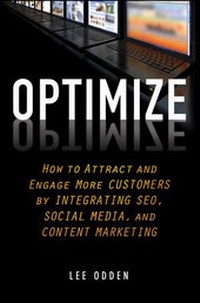
Optimize
Description

Optimize is designed to give readers a practical approachto integrating search and social media optimization with contentmarketing to boost relevance, visibility, and customer engagement.Companies, large and small, will benefit from the practicalplanning and creative content marketing tactics in this book thathave been proven to increase online performance across marketing,public relations, and customer service. Learn to incorporateessential content optimization and social media engagementprinciples thereby increasing their ability to acquire and engagerelevant customers online.
Optimize provides insights from Lee Odden, one of theleading authorities on Content and Online Marketing. This bookexplains how to:
* Create a blueprint for integrated search, social media andcontent marketing strategy
* Determine which creative tactics will provide the best resultsfor your company
* Implement search and social optimization holistically in theorganization
* Measure the business value of optimized and socialized contentmarketing
* Develop guidelines, processes and training to scale onlinemarketing success
Optimize offers a tested approach for a customer-centricand adaptive online marketing strategy that incorporates the bestof content, social media marketing, and search engine optimizationtactics.
All prices
More details
Other editions
Additional editions
Person
Content
Preface vii
Acknowledgments xi
PHASE 1: PLANNING
Chapter 1 Setting the Stage for an Optimized State of Mind 3
Chapter 2 Journey: Where Does Optimize and Socialize Fit in YourCompany? 15
Chapter 3 Smart Marketing Requires Intelligence: Research,Audit, and Listen 25
Chapter 4 In It to Win It: Setting Objectives 39
Chapter 5 Roadmap to Success: Content Marketing Strategy 51
PHASE 2: IMPLEMENTATION
Chapter 6 Know Thy Customer: Personas 65
Chapter 7 Words Are Key to Customers: Keyword Research 75
Chapter 8 Attract, Engage, and Inspire: Building Your ContentPlan 99
Chapter 9 Content Isn't King, It's the Kingdom:Creation and Curation 115
Chapter 10 If It Can Be Searched, It Can Be Optimized: ContentOptimization 127
Chapter 11 Community Rules: Social NetworkDevelopment--Don't Be Late to the Social Networking Party157
Chapter 12 Electrify Your Content: Promotion and Link Building175
Chapter 13 Progress, Refi nement, and Success: Measurement195
PHASE 3: SCALE
Chapter 14 Optimize and Socialize: Processes and Training211
Chapter 15 Are You Optimized? 225
About the Author 231
Notes 233
Index 239
CHAPTER 2
Journey: Where Does Optimize and Socialize Fit in Your Company?
Companies large and small, in industries from retail to manufacturing, publish content online with an expectation that a certain audience of people will find, read, and act on that content. While most search engine optimization and social media marketing efforts are rightly focused on marketing goals like acquiring more customers and increasing revenue, making purchases is not the only reason consumers use search or ask for referrals through social networks.
There’s a lot of tactical advice online about search, social media, and content marketing for companies that want to better connect with customers, but that advice doesn’t always consider the differences between types of companies or even content within companies. For the best return on marketing investment, it’s important to understand that there are notable differences in tactics for effective optimization depending on the audience and how they prefer to discover, consume, and act on information. The very nature of B2C versus B2B or small company versus large company content, audience, and outcomes can be different, so the approach to optimizing content for search and social media must be tailored accordingly.
As an online marketer, you’re charged with assessing internal resources, overall business goals, customer buying cycle, and time frame in order to make the best decisions possible with your resources. As you read on, watch for some of the things that best represent your business and online marketing situation. This chapter gives you optimization examples to understand the differences between B2B, B2C, small companies, and large companies. We will also talk about several rarely explored opportunities for holistic search and social media optimization of content: internal departments such as public relations, customer service, and human resources and recruiting.
OPTIMIZED B2C SEARCH MARKETING
J&O Fabrics is a small business in New Jersey that was historically focused on selling fabric through its brick-and-mortar store as well as through online channels like eBay. Dissatisfaction with third-party marketing costs in combination with a frustration over limited website traffic led to an investment in SEO. As a result of optimizing the website with relevant keywords and a program designed to attract links, traffic to the J&O Fabrics website increased 214 percent. The company’s online marketing became more efficient and effective, allowing it to eliminate certain types of advertising and increase organic “free” search traffic significantly.
Stop there and you have a typical SEO success story. But Ryan Safady of J&O Fabrics understood from the start that content was the key to making the pages of his online store stand out for more than just search engines. With a keen understanding of customer needs as well as data from web analytics and keyword research, content creation and optimization were made part of the process of maintaining product content on the website www.jandofabrics.com. As a small business, J&O needed to use their resources efficiently, so when a blog was started, an existing customer e-mail newsletter was leveraged for content along with a free blog-hosting platform. Knowing what types of products customers were prone to buy online and in which season helped flavor content and optimization efforts on a mix of broad topics and more specific long-tail keyword phrases. The combination of making keyword optimization a process for updating and adding new content to the online store as well as offering customer-centric tips on the blog helped facilitate a website that became highly relevant for ready-to-buy customers, search engines, and other websites that link to useful resources. Increased content relevancy and usefulness inspired the kind of inbound links and social sharing that search engines like Google reward with top three positions on hundreds of important keyword phrases. Extensive top search visibility has enabled J&O’s small business to effectively compete directly with national chains, all based from a single retail store.
J&O Fabrics has continued to work on being the most relevant source of fabric online by expanding content and optimization efforts to Twitter, Facebook, and YouTube. Social channels share unique content with the J&O Fabrics community and involve members in content creation through contests and promotions that result in even more awareness, sharing, and links. A strong search and social media presence reinforces a cycle of discovery, consumption, and sharing that involves current customer networks as well as attracting new customers actively looking to purchase specific products.
B2B CONTENT MARKETING OPTIMIZATION
Companies focused on business-to-business sales often experience a much longer sales cycle involving the creation of more content that serves to educate and nurture prospects into qualified leads and customers. In other words, there’s usually a lot more content romance involved with B2B prospects before they become customers.
The approach to optimization for J&O Fabrics as a small, B2C company was notably different than that employed by Marketo, a B2B marketing software company. Before Marketo’s initial product was officially launched, the company made the decision to invest in content and optimization, particularly through the practice of blogging. Whereas J&O Fabrics had a longstanding website and content to begin with, Marketo started its SEO efforts with a very new website and blog. B2B markets are often less competitive in search, but that was not the case with Marketo, which faced several longstanding competitors that had anywhere from 3 to 10 years’ head start with their search engine optimization programs.
Audits are a key part of search engine optimization, allowing marketers to assess the current state of the website in ways that identify any conflicts or inefficiencies for search engines as they crawl, index, and rank web pages. An audit with Marketo’s website early on helped chart a productive course toward technical optimization of the content management system as well as a content creation plan. Blogs can be highly effective players in an integrated search and social media strategy, and Marketo took full advantage of the platform by creating an intelligent and ambitious mix of keyword-rich content that was just as relevant to buyers as it was to search engines.
Keyword research into broad industry- and category-focused keyword phrases that would associate Marketo as an industry player, in combination with more specific phrases relevant to buyers as they make their way through the sales process, played well for Marketo in its SEO and content creation efforts. Beginning as a small business and a start-up, Marketo has been able to accelerate the growth of its business through the marketing efficiency and effectiveness that come from content and search engine optimization focused both on customers and search engines.
The result? Although Marketo is only a four-year-old company in the B2B marketing space, you can easily find the company on Google using phrases like “B2B Marketing” in a category where competitors have operated full-scale SEO programs for nearly 10 years. One keyword doesn’t make a business, though, and Marketo understands that an abundance of information online means prospects have pulled themselves through much of the traditional sales funnel by discovering and consuming brand content. Marketo’s dedication to creating and promoting relevant content on its array of blogs and resource center in accordance to the information needs of its prospects throughout the buying cycle facilitated a substantial online presence on hundreds of competitive topics where the company’s prospective customers were actively looking. In fact, Marketo added more than 1,100 customers1 in its first three years, and revenue increased 700 percent over a two-year period, with vice president of marketing Jon Miller citing search and blogging as being the most effective lead-generation tactics2 during an Online Marketing Summit conference in San Diego.
OPTIMIZATION AND THE ENTERPRISE
Large and complex organizations have many more considerations with coordinated optimization, social media, and content marketing efforts. Many effective SEO and social media marketing consultants have had difficulty making an impact because of their inability to win internal client support among interdepartmental teams needed for implementation. Competent SEO and social media marketing expertise is moot if a consultant doesn’t understand how to navigate large and complex organizational structures. Success is as dependent on political and organizational savvy as it is on content marketing mastery.
A very large company in the health care technology field, which generates tens of billions of dollars in annual revenue among more than 20 different companies, decided to roll all of the disparate company brands and websites under a common corporate content management system. Customers visiting the old website addresses were redirected to the new home of the company under the main company website. The new CMS allowed centralized management of website resources and a common brand identity.
The company soon realized that, although the combined website presented a unified brand and redirected requests for old pages to new destinations, the methods of redirection were not as easy for search engines to understand as they were for people. Website traffic was affected and an SEO audit was completed...
