

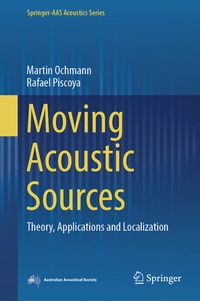
Moving Acoustic Sources
Description

This book highlights the mathematical, physical, and technical properties of moving acoustic sources. Authors consider point sources and infinite or finite line sources moving along various curves in three-dimensional space. After studying the general theory of such sources, the frequency spectrum and the associated Doppler shift are derived explicitly for different trajectories. The sound radiation in half-spaces with a locally reacting and homogeneous ground is investigated in detail based on the knowledge of closed-form solutions for the stationary impulse response. An important field of application is the localization of moving sources. Among other approaches, an equivalent source method in the time domain is used to develop an effective source localisation method. Important practical applications are explored with these techniques, e.g. the detection of noise sources from trains and airplanes.
The research results published in this book are mainly obtained within the three-year project "Localization and identification of moving noise sources" funded by the German Research Foundation.
More details
Other editions
Additional editions
Persons
Prof. Dr.-Ing. Martin Ochmann has, after university education in Technical Environmental Engineering (Dipl.-Ing.) and Mathematics (Diploma), received a doctor degree (1985) and habilitation in Technical Acoustics (1990) at the Technical University of Berlin at the Institute of Technical Acoustics. He was directing the researcher group Computational Acoustics (PG-CA) at Berliner Hochschule für Technik and several corresponding acoustical research projects. His research activities cover sound radiation from vibrating surfaces, fluid-structure interaction, acoustical scattering, numerical acoustics, boundary element methods, acoustics of moving sources, and acoustical half-space problems.
Dr.-Ing. Rafael Piscoya has studied Physics at the Catholic University in Peru. In 1994, he obtained his Magister degree with the work "Acoustic design of rooms using ray tracing". From 1999 to 2003, he did his Ph.D. studies at the Technical University in Berlin which he concluded with the thesis "Influencing the radiation pattern of horns through collocation of impedances on their side walls". Since 2003 he has been working in different research projects collecting knowledge and experience in the solution of numerous acoustic problems using numerical methods.
Content
Introduction.- The frequency spectrum of moving sources.- Sound field of a source moving in half space in time domain.- The equivalent source method in time domain.- The equivalent source method for localization of moving source.- Final remarks and outlook.- References.- Index.
