

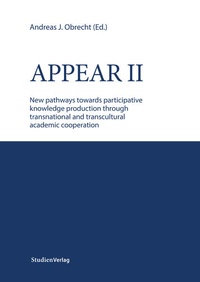
APPEAR II
New pathways towards participative knowledge production through transnational and transcultural academic cooperation
1st Edition
Published on 15. February 2022
374 pages
978-3-7065-6208-9 (ISBN)
Description

This book is an ambitious undertaking - a research documentation that describes a wide variety of approaches to knowledge production relevant to development policy, and illustrates the diverse possibilities of transdisciplinary development research within 25 projects in 15 countries. The editor encouraged the 105 authors - 46 female, 59 male - to investigate questions, problems and dimensions of knowledge production that are usually not addressed in research and project reports. Project planning, no matter how successful, can only partially anticipate the social reality of implementing a project. Flexibility, creativity and improvisation are indispensable prerequisites for successful project implementation in often difficult research conditions. Thus, this book is not only a documentation of the second phase of the Austrian Partnership Programme in Higher Education and Research for Development - APPEAR - but also a discursive contribution on practical approaches to transdisciplinary and transcultural knowledge production.
More details
Other editions
Additional editions
Andreas J. Obrecht
APPEAR II
New pathways towards participative knowledge production through transnational and transcultural academic cooperation
Book
02/2022
1st Edition
Studien Verlag
€39.90
Shipment within 5-7 days
Person
Andreas Obrecht, ao. Univ.-Prof. Mag. Dr.: Soziologe, Ethnologe, Schriftsteller, Radiomoderator und Leiter der Geschäftsstelle der Kommission für Entwicklungsfragen (KEF) sowie Leiter des "Austrian Partnership Programme in Higher Education und Research for Development" (APPEAR) an der OeAD-GmbH im Auftrag der Austrian Development Agency (ADA)
Content
- Intro
- Title
- Content
- 1 Preface - Sustainable Development through Higher Education
- 2 Introduction - Austrian Partnership Programme in Higher Education and Research for Development. Eleven years of development policy-relevant teaching and research - and this is just the beginning!
- 3 Palestine
- 3.1 Rooting Development in the Palestinian Context
- 3.1.1 The advanced academic partnership - ROOTDEVPAL
- 3.1.2 Reflections
- 3.1.3 Transcending the academic realm in conflict and war zones
- 3.1.4 Enumeration of results
- 3.2 Strengthening Higher Education Capacities in Palestine for Gender Equality
- 3.2.1 The project - SHE-GE
- 3.2.2 Why was it important to start the project in Gaza?
- 3.2.3 Project results: planned, collateral and contingent
- 3.2.4 Enumeration of results
- 3.3 Promotion of Energy-Efficient Buildings towards Developing a Sustainable Built Environment in Gaza Strip
- 3.3.1 About PEEB
- 3.3.2 Why this project?
- 3.3.3 Gender perspectives
- 3.3.4 Enumeration of PEEB results
- 3.3.5 Energy-efficient buildings as a sustainable and innovative approach of construction in Gaza - the advanced academic partnership CBEEB
- 3.3.6 Capacity building for increased energy awareness and the potential of sustainable buildings concepts in the Gaza region
- 3.3.7 Advanced activities and enumeration of CBEEB results
- 3.4 Developing Maker Movement-Inspired Training Courses on Renewable Energy Sources in Gaza Strip, Palestine
- 3.4.1 MakingFutureEnergy4Palestine
- 3.4.2 BOKU Vienna contribution
- 3.4.3 ISLAMIC UNIVERSITY Gaza - gender perspectives
- 3.4.4 Enumeration of results
- 4 Nicaragua
- 4.1 Strengthening Local Research Capacities at the Bluefields Indian and Caribbean University, Nicaragua, to Confront the Effects of Climate Change
- 4.1.1 Description
- 4.1.2 The Nicaraguan perspective
- 4.1.3 Why international cooperation in higher education matters
- 4.1.4 Enumeration of results
- 5 Ethiopia
- 5.1 Strengthening Regional Capacity in Research and Training in Fisheries and Aquaculture for Improved Food Security and Livelihoods in Eastern Africa
- 5.1.1 The project - STRECAFISH
- 5.1.2 The project and its people that supplemented a hands-on practical-oriented graduate training programme in fisheries and aquaculture
- 5.1.3 Why fish farming in Ethiopia?
- 5.1.4 Enumeration of results
- 5.2 Sustainable Highland Rivers Management in Ethiopia
- 5.2.1 The project - LARIMA
- 5.2.2 Awareness raising and capacity building as a key role for further development
- 5.2.3 A contribution to re-establish freshwater health and biodiversity?
- 5.2.4 Enumeration of results
- 5.3 Implementation of Academic Land Administration Education in Ethiopia for Supporting Sustainable Development
- 5.3.1 The project - EduLAND2
- 5.3.2 Equal partnership
- 5.3.3 Gender aspects
- 5.3.4 Enumeration of results
- 5.4 Advanced Academic Partnership for Legal and Human Rights Education in Ethiopia
- 5.4.1 The project - AAPLHRE
- 5.4.2 Human rights education during states of emergency, political reforms and a pandemic
- 5.4.3 Working together to fulfill our objective
- 5.4.4 Enumeration of results
- 5.5 Technology Enabled Maternal and Child Healthcare in Ethiopia
- 5.5.1 The project - TEMACC
- 5.5.2 Why the project was necessary
- 5.5.3 TEMACC successfully completed - and now?
- 5.5.4 Enumeration of results
- 5.6 Partnership for Strengthening Institutional Capacity in Peacebuilding and Conflict Transformation in Ethiopia
- 5.6.1 Description
- 5.6.2 Ownership and belonging in international academic curriculum development
- 5.6.3 Curricular innovation in peace and development studies beyond linear thinking
- 5.6.4 Enumeration of results
- 5.7 Inclusion in Education for Persons with Disabilities
- 5.7.1 The project - INEDIS
- 5.7.2 Gender equality and empowerment across four universities in Ethiopia and Austria
- 5.7.3 Institutional change and impact in higher education institutions in Ethiopia and Austria
- 5.7.4 Enumeration of results
- 6 Kenya - Uganda
- 6.1 Strengthening Capacities for Agricultural Education, Research and Adoption in Kenia
- 6.1.1 The project - SCARA, the Kenyan experience
- 6.1.2 ICT (Information and Communication Technology) and agriculture in Kenya: experiences from the APPEAR project SCARA
- 6.1.3 Enumeration of results
- 6.2 Strengthening Higher Education, Research and Community Outreach in Agroecology in the Rwenzori Region in Western Uganda
- 6.2.1 The project - AER
- 6.2.2 Participatory curriculum development of a Master of Science in Agroecology - a case study from Western Uganda
- 6.2.3 From teaching towards learning - lessons learnt from AER
- 6.2.4 Enumeration of results
- 6.3 Capacity Building on the Water-Energy-Food Security Nexus through Research and Training in Kenya and Uganda
- 6.3.1 The project - CapNex
- 6.3.2 A personal reflection
- 6.3.3 Gender perspectives
- 6.3.4 Enumeration of results
- 6.4 Professional Social Work in East Africa - Towards Sustainable Impact
- 6.4.1 The project - PROSOWO II
- 6.4.2 Social work in East Africa: reclaiming the profession's glory, unlocking the future
- 6.4.3 Celebrating World Social Work Day amidst difficult circumstances: impressions from East Africa
- 6.4.4 Enumeration of results
- 7 Mozambique
- 7.1 Strengthening Remote Sensing Data Processing and Interpretation Capacities for Operational Use in Agricultural System Monitoring
- 7.1.1 The project - EO4Africa
- 7.1.2 Reaching the youngest - investing in educational tools
- 7.1.3 Remote sensing, a new and reliable data source for agricultural monitoring in low-income countries - applications and potential use cases and users in Mozambique
- 7.1.4 Enumeration of results
- 7.2 Innovating Sustainable Agriculture in Mozambique - Learning and Teaching Tools
- 7.2.1 The project - ISAM
- 7.2.2 Developing a collaborative Master's curriculum and innovative learning and teaching tools for sustainable agricultural development
- 7.2.3 Perspectives, experiences and actions within the scope of the ISAM Project
- 7.2.4 Enumeration of results
- 7.3 Capacity Building for Renewable Energy Technologies in Mozambique
- 7.3.1 The project - RETEM
- 7.3.2 The project and its people
- 7.3.3 Between high expectations and daily routine
- 7.3.4 Enumeration of results
- 8 Senegal - Burkina Faso
- 8.1 Sustainable Energy Access for Sustainable Cities
- 8.1.1 Description of SEA4cities
- 8.1.2 Bringing together players in access and transition to energy sustainability
- 8.1.3 Learning by doing: when design makes sustainability accessible to all
- 8.1.4 Enumeration of results
- 8.2 Sustainable Management of Water and Fish Resources
- 8.2.1 The project - SUSFISH-plus
- 8.2.2 Learning innovations for sustainable fisheries in Burkina Faso: a social simulation demonstration in the frame of the Agenda 2030
- 8.2.3 Higher education for a sustainable water management
- 8.2.4 Enumeration of results
- 8.3 Local Cattle Breeds of Burkina Faso - Characterisation and Sustainable Utilisation
- 8.3.1 The project - LoCaBreed
- 8.3.2 From cattle keepers to cattle breeders. Steps of a transition - development countries' realities and their implications
- 8.3.3 The best bulls for Burkina Faso
- 8.3.4 Enumeration of results
- 9 Georgia - Armenia
- 9.1 Academic Collaboration for Building Capacity in Environmental Studies
- 9.1.1 The project - ACCES
- 9.1.2 Quality assurance of e-learning - mechanisms and approaches
- 9.1.3 Strengthening the resilience of university education through innovative teaching
- 9.1.4 Enumeration of results
- 9.2 Building Organic Agriculture in Armenia. Improving the Knowledge and Skills of Organic Stakeholders through Participatory Curriculum Development and Outreach
- 9.2.1 The project - BOAA
- 9.2.2 The importance of how you teach - modern teaching methods in post-Soviet pedagogy
- 9.2.3 Participatory curriculum development - lessons learnt
- 9.2.4 Enumeration of results
- 9.3 Transdisciplinarity for Sustainable Tourism Development in the Caucasus Region
- 9.3.1 The project - CaucaSusT
- 9.3.2 At the end of it all, what have we learnt?
- 9.3.3 The impact of the CaucaSusT project on ASPU and TSU academic programs - a stakeholder perspective
- 9.3.4 Enumeration of results
- 10 Student Mobility - A Historical Perspective on the APPEAR Scholarship Programme
- 10.1 Capacity Building and the North-South Dialogue Programme
- 10.2 Focus shift from the individual to the institution
- 10.3 The APPEAR Programme
- 11 Authors
