

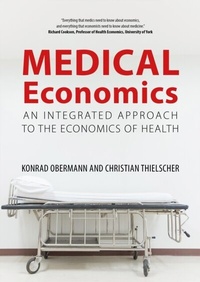
Medical Economics
Description

Health economics has become an established field of enquiry over recent years and is now an important contributor to normative health policy, and decisions concerning the allocation of resources and the quality of healthcare provision across the world.
Medical Economics, written by two physicians who are also qualified economists, introduces readers to the core economic considerations in healthcare provision and management. Addressing concerns that are relevant to both the individual and to public health, the authors draw on a wider range of economic tools and analytical frameworks than typically offered by standard textbooks. Combining thought experiments with real-world examples they illustrate the healthcare challenges facing today's policy-makers.
The book is aimed specifically at courses in medicine, public health, and healthcare management and administration, but also at economists looking for a broader perspective on healthcare systems, including healthcare financing, markets, the role of the state and other macroeconomic considerations, evaluation methods, healthcare technology, paying for medical care, health insurance and ethical issues.
All prices
More details
Other editions
Additional editions
Persons
Konrad Obermann is Senior Staff Scientist at the Mannheim Institute of Public Health, Heidelberg University. He is a medical doctor and economist with over 25 years experience in clinical care, research and strategic planning. His particular research interests are in international health economics, health system development and healthcare financing.
Christian Thielscher is Director of the Competence Center for Medical Economics at FOM University, Essen, Germany. He is editor of the successful 2-volume textbook on health economics, Medizinokonomie (Springer, 2015).
Content
Introduction: approaching health economics
Part I Health, healthcare, and healthcare systems1. Understanding "health" in health economics2. From disease to care3. Ethics, values and the idea of a good life4. Medicine as a business: caring for patients and managing a business5. Financing healthcare6. The relation between macroeconomics and health7. Comparing health systems
Part II Health economic theory8. Approaching healthcare from an economic point of view9. The standard in current economics: neoclassical economics10. Markets, market failure, state intervention and state failure11. Options to finance medical care12. Evaluation methods in health economics13. Health technology and health technology assessment14. Paying for medical care: balancing appropriateness, quality, and cost
Part III From theory to practice: using medical economics to improve global health15.Medical economics: an applied interdisciplinary science that looks at evidence, considers complexity and implements what works16. Global health and social health protection17. Towards rational financing for healthcare18. Priority setting and essential health service packages19. The Covid-19 outbreak and the role of medical economics in responding to global health threatsEpilogue: moving beyond the commoditization of health and making better use of the "dismal science"
