

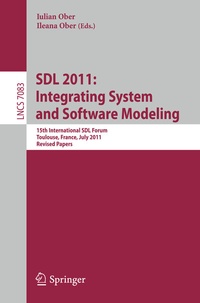
SDL 2011: Integrating System and Software Modeling
15th International SDL Forum Toulouse, France, July 5-7, 2011. Revised Papers
Published on 3. December 2011
VIII, 277 pages
978-3-642-25264-8 (ISBN)
Description

This book constitutes the thoroughly refereed post-conference proceedings of the 15th International SDL Forum, SDL 2011, held in Toulouse, France, in July 2011. The 16 revised full papers presented together were carefully reviewed and selected for inclusion in the book. The papers cover a wide range of topics such as SDL and related languages; testing; and services and components to a wide range presentations of domain specific languages and applications, going from use maps to train station models or user interfaces for scientific dataset editors for high performance computing.
More details
Other editions
Additional editions
Iulian Ober | Ileana Ober
SDL 2011: Integrating System and Software Modeling
15th International SDL Forum Toulouse, France, July 5-7, 2011. Revised Papers
Book
11/2011
Springer
€53.49
Shipment within 7-9 days
Content
- Title
- Preface
- Organization
- Table of Contents
- Invited Contributions and Tutorials
- Model-Based Performance Analysis of Service-Oriented Systems (Invited Talk)
- SCADE: A Comprehensive Framework for Critical System and Software Engineering
- SDL-2010: Background, Rationale, and Survey
- Background for the Development of SDL-2010
- Status of SDL-2000
- The Data Issue
- Diagram Structure
- Features without Formal Semantics
- Feature Deletion, Retention and Extension
- Organization of the SDL-2010 Language Standard
- Shorthand Transformation Models
- Reorganization of the Documents for the Language Standard
- Basic SDL-2010 - Z.101
- Comprehensive SDL-2010 - Z.102
- Shorthand Notation and Annotation in SDL-2010 - Z.103
- Data and Action Language in SDL-2010 - Z.104
- SDL-2010 Combined with ASN.1 Modules - Z.105
- Common Interchange Format for SDL-2010 - Z.106
- Formal Definition (Annex F to Z.100)
- Changed, New and Deleted Features
- Synonym as a ``Read Only Variable
- Lower Bound of Agent Instance Sets
- Input and Save via Gate
- Multiple Priority Levels of Input
- Timer Supervised States
- Deleted Features
- Conclusion
- References
- TASTE: A Real-Time Software Engineering Tool-Chain Overview, Status, and Future
- Introduction
- Scope
- Case Study
- Specification of the System
- The Challenge
- The TASTE Approach: AADL and ASN.1
- The Graphical TASTE Model
- Model Transformation and Code Generation
- Runtime Features
- Conclusion and Future
- References
- Domain Specific Languages (Part 1)
- Synthesizing Software Models: Generating Train Station Models Automatically
- Introduction
- Background
- Domain-Specific Language
- Train Control Language
- Alloy
- Model Synthesis
- Synthesizing TCL Models
- Generating TCL Models
- Adding Dynamic Properties
- Optimizing Alloy Models
- Discussion
- Related Work
- Conclusion
- Future Work
- References
- Exploring Early Availability Requirements Using Use Case Maps
- Introduction
- Availability Requirements
- Availability Modeling in Use Case Maps
- Use Case Maps Architectural Features
- UCM Fault Detection Modeling
- UCM Modeling of Fault Recovery and Repair
- UCM Modeling of Fault Recovery-Reintroduction
- UCM Fault Prevention Modeling
- UCM Availability Metamodels
- Illustrative Example: In Service Software Upgrade (ISSU)
- Conclusion
- References
- Paprika: Rapid UI Development of Scientific Dataset Editors for High Performance Computing
- Introduction
- The Paprika Process
- Modeling of the Scientific Dataset
- Automatic Generation of the Editor
- Paprika Generic Editor
- Implementation and Use
- Paprika Studio
- Paprika Generic Editor
- Demonstration
- An Empirical Study
- Evaluation Method and Criteria
- Results Analysis
- Conclusion and Perspectives
- References
- Test
- Verifiable Coverage Criteria for Automated Testing
- Introduction
- Functional Criterion
- Structural Criterion
- Tolerance Range Criterion
- Conclusions
- References
- A New Approach in Model-Based Testing: Designing Test Models in TTCN-3
- Introduction
- Model-Based Testing
- Designing Abstract Models in TTCN-3
- Modelling System and Its Interfaces
- Functional Approach for Modelling Behaviour in TTCN-3
- Modelling Behaviour with State Transition Tables
- Analysis of Mapping Alternatives
- Propositions
- Conclusions
- References
- Towards a Model Based Approach for Integration Testing
- Introduction
- UML Testing Profile (UTP)
- UTP Based Integration Testing Approach
- Overall Approach
- Test Model Generation
- Related Work
- Conclusion
- References
- Components and Services
- Session Initiation as a Service
- Introduction
- The Case for Dynamic Session Initiation
- Example Service (SimplePhoneCall)
- The Session Initiation Functionality
- System Design (with Controller Role)
- Composition of Session Initiation and Service Sessions
- Discussion and Related Work
- References
- PMG-Pro: A Model-Driven Development Method of Service-Based Applications
- Introduction
- Service-Based Applications: A Scenario
- The PMG-Pro Method
- The Presenting Step
- The Modeling Step
- The Automated Code Generation Step
- Related Work
- Conclusion
- References
- A Model-Driven Framework for Component-Based Development
- Introduction
- The Model-Driven Framework for Component-Based Development
- Service Models
- Component Models
- Component Composition
- System Composition
- Related Work
- Concluding Remarks
- References
- Separation of Concerns with Transactional Regions
- Introduction
- Regions as Modular Units
- Orthogonal Regions
- Regions as Units of Modularity
- Transactional Regions
- Motivation
- Transactional Composition
- Untitled
- Size Metrics
- Modularity Metrics
- Case Study Results
- Monolithic Implementation
- Transactional Implementation
- Metrics Comparison
- Discussion
- Summary
- Related Work
- Conclusions
- References
- Specification and Description Language (SDL)
- Real-Time Signaling in SDL
- Introduction
- Conceptual Considerations
- Realization of Time-Triggered Schedulers in SDL
- Drawbacks of SDL Solutions
- Real-Time Signaling in SDL: Concept, Syntax, and Semantics
- Specified Signal Arrival Time
- Signal Expiry Time
- Timestamping of Signals
- Example of Real-Time Signaling
- SDL Environment Framework (SEnF)
- Evaluation
- Related Work
- Conclusions and Future Work
- References
- Priority Scheduling in SDL
- Introduction
- Related Work
- Scheduling Strategies in SDL
- Problem Statement
- Supported Scheduling Strategies
- Suspension of Agents
- Dealing with the SDL Environment
- Implementation Aspects
- Experimental Evaluation
- Accuracy of SDL Timers
- Prioritized Signal Exchange
- Conclusions
- References
- A Model-Based Formalization of the Textual Notation for SDL-UML
- Introduction
- Related Work
- The Textual Notation of the SDL-UML Profile
- A Model-Based Formalization of the Textual Notation
- General Approach
- A Metamodel for the Textual Notation of SDL-UML
- OCL Constraints on the Textual Notation
- Transformation of Shorthand Notations
- Framework for Processing the Textual Notation
- Components of the Framework
- Requirements for the Parser
- The SGLR Parser
- The Syntax Definition Formalism and Its Relation to Metaclasses
- Conclusion and Future Work
- References
- Domain Specific Languages (Part 2)
- Standardizing Variability - Challenges and Solutions
- Introduction
- Challenges
- Achieving Generality
- Automated Generation
- Powerful Abstraction Mechanisms While Still Simple
- Concrete Syntax
- Generic Tooling
- Solutions
- Achieving Generality: The Fragment
- Automating Generation: Semantics by Transformation
- Abstraction Mechanisms: The MAGIC of CVL
- Concrete Syntax: Different Solutions to Different Problems
- Generic Tooling: The CVL Tool
- Related Work
- Summary and Future Work
- References
- MDE4HPC: An Approach for Using Model-Driven Engineering in High-Performance Computing
- Introduction
- Problem Statement
- Current Development Process
- State of the Art
- The HPC World
- Model Driven Engineering
- Overview of the Proposed Approach MDE4HPC
- General MDA Principles Applied
- Openings Offered by the Models Use
- Archi-MDE
- Conclusion and Future Work
- References
- AUTOSAR vs. MARTE for Enabling Timing Analysis of Automotive Applications
- Introduction
- Modeling Needs for Automotive Applications to Enable Scheduling Analysis
- System-Oriented Features
- Design-Oriented Features
- Modeling Languages Capabilities
- Conclusions
- References
- Author Index
