

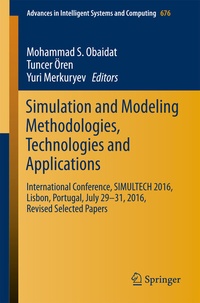
Simulation and Modeling Methodologies, Technologies and Applications
Description

This Proceedings book reports on new and innovative solutions regarding methodologies and applications of modeling and simulation. It includes a set of selected, extended papers from the 6th International Conference on Simulation and Modeling Methodologies, Technologies and Applications (SIMULTECH 2016), held in Lisbon, Portugal, from 29 to 31 July, 2016. The conference brought together researchers, engineers and practitioners interested in methodologies and applications of modeling and simulation.
SIMULTECH 2016 received 76 submissions from 35 countries and all continents. After a double-blind paper review performed by the Program Committee, 18% were accepted as full papers and thus selected for oral presentations. Additional papers were accepted as short papers and posters.
A further selection was made after the Conference, based also on the assessment of presentation quality and audience interest, so that this book includes the extended and revised versionsof the very best papers from SIMULTECH 2016.
More details
Other editions
Additional editions
Persons
Content
- Intro
- Preface
- Organization
- Conference Chair
- Program Chair
- Program Committee
- Additional Reviewer
- Invited Speakers
- Contents
- Invited Paper
- Credibility, Validity and Testing of Dynamic Simulation Models
- Abstract
- 1 Introduction
- 2 Structure Credibility Testing
- 2.1 Direct Structure Tests
- 2.2 Indirect Structure Tests
- 2.3 Building High-Quality Models Versus Testing Model Validity
- 3 Output Behavior Credibility Testing
- 4 Concluding Observations
- References
- Papers
- Model-Based Development of a Multi-algorithm Harvest Planning System
- 1 Introduction
- 2 Model Architecture
- 2.1 Model Overview
- 3 Model Implementation
- 4 Model Execution
- 4.1 Simulation Visualisation
- 5 Results
- 6 Discussion
- 7 Live Planning
- 8 Conclusions and Future Work
- References
- Cluster Performance Simulation for Spark Deployment Planning, Evaluation and Optimization
- Abstract
- 1 Introduction
- 2 Spark Simulation Framework Architecture
- 2.1 Spark Behaviour Model
- 2.2 Memory Model
- 2.3 Simulator User Input
- 2.4 Simulator Output
- 3 Experimental Setup
- 3.1 Experiment Cluster
- 3.2 Workload Description
- 4 Evaluation and Analysis
- 4.1 Baseline Validation
- 4.2 Memory Model Accuracy Analysis
- 4.3 Software and Hardware Parameters Scalability Analysis
- 4.4 Simulation Speed
- 5 Case Study 1: Spark Cluster Deployment Planning
- 6 Case Study 2: Memory Optimization for Spark Performance
- 7 Related Work
- 8 Conclusion and Future Work
- References
- Generator Platform of Benchmark Time-Lapsed Images Development of Cell Tracking Algorithms: Implementation of New Features Towards a Realistic Simulation of the Cell Spatial and Temporal Organization
- Abstract
- 1 Introduction
- 2 State of the Art
- 2.1 Synthetic Image Generators
- 2.2 Cell Tracking
- 3 Methodologies
- 3.1 Implementation of the Image Generator - Tool Interface and Basic Functionalities
- 3.2 Object Modeling
- 3.3 Tested Tracking Algorithms
- 4 Results and Discussion
- 4.1 Simple Nearest-Neighbor Algorithm
- 4.2 Nearest-Neighbor with Morphology Algorithm
- 4.3 Cluster Tracking
- 5 Conclusions and Future Work
- Acknowledgments
- References
- Proteins Flexibility as a Criterion for Elucidation of Activating Mutants in Personalized Cancer Medicine
- Abstract
- 1 Introduction
- 2 MET Structure and Function
- 2.1 Sema Domain and MET p.Tyr501Cys Point Mutation
- 3 Flexibility Defines Protein-Protein Binding
- 4 Mutation Y501C Increases Flexibility of the Sema Domain in Its Binding Sites
- 5 Patient Treatment Based on the MD Simulations
- 6 Conclusion
- 7 Methods
- References
- Distributed PowerShell Load Generator (D-PLG): A Tool for Generating Dynamic Network Traffic
- 1 Introduction
- 2 Related Work
- 2.1 Online Failure Prediction
- 2.2 Network Load and Traffic Generation
- 3 Distributed PowerShell Load Generator (D-PLG)
- 3.1 Web Browsing
- 3.2 Remote Desktop Protocol
- 3.3 Server Message Block (SMB) and File Sharing
- 3.4 Possible Future Modules
- 4 Experimental Methodology
- 4.1 Virtual Environment
- 4.2 Experiment Design
- 5 Experimental Results
- 6 Future Work
- 7 Conclusion
- References
- HLogo: A Haskell STM-Based Parallel Variant of NetLogo
- 1 Introduction
- 2 Agent Based Modelling and Simulation in NetLogo
- 3 Related Work
- 4 Haskell
- 4.1 Static Typing
- 4.2 Monads
- 4.3 Software Transactional Memory (STM)
- 5 HLogo
- 5.1 HLogo Agents
- 5.2 Commands
- 5.3 Procedures
- 5.4 A HLogo Model Example
- 6 Parallelizing HLogo
- 6.1 Commands and Transactions
- 7 Experiment
- 8 Conclusions and Future Work
- References
- Requirements Gathering and Validation for Risk-Oriented Tool Support in Supply Chains
- 1 Introduction
- 2 Background on Risk
- 2.1 Notion of Risk
- 2.2 Risk Management
- 3 Survey on Risk Management in Supply Chain SMEs
- 3.1 Survey Process
- 3.2 Characterisation of Participating Companies
- 3.3 Risk Management
- 3.4 Need for Better Risk Management Tools
- 3.5 Fine-Grained Requirements Identification Using Correlation Analysis
- 4 Agile Requirements Validation Process
- 4.1 Overview of the Agile Process Followed
- 4.2 Summary of Functional and Non-functional Tool Requirements
- 4.3 Lessons Learned
- 5 Conclusions
- References
- Making Network Solvers Globally Convergent
- 1 Introduction
- 2 Generalized Resistive Systems
- 3 Globally Convergent Algorithms
- 4 Application to Gas Transport Networks
- 5 Conclusions
- References
- Predictive-Delay Control for Overloading in Real-Time Scheduling
- 1 Introduction
- 2 Task Model and Experimental Settings
- 2.1 Task Division into Calculate-Output and Update-State
- 2.2 Physical Processes
- 2.3 Feedback Scheduling and the EDF Protocol
- 2.4 PID Controller
- 3 Subtask Scheduling
- 3.1 Schedulability
- 4 Predictive-Delay Control
- 5 Overloaded System-Based Comparison Without FBS
- 6 Comparison and Hybridization Under FBS and Scheduling Artefacts
- 6.1 Tasks Systems
- 6.2 Impact of the Input-Output Latency on QC
- 6.3 Case of Subtask Scheduling
- 6.4 Case of P-DC Solution
- 6.5 Hybridization
- 7 Conclusions
- References
- Agent-Based Modelling and Simulation Framework for Health Care
- Abstract
- 1 Introduction
- 2 Literature Review
- 2.1 Agent-Based Simulation
- 2.2 Agent-Based Simulation in the Health Care Domain
- 3 Patient Agent Models
- 3.1 Conceptual Model
- 3.2 Cancer Evolution Model
- 3.3 Conceptual Agent Model
- 4 Simulation Methodology (SiCaPP)
- 5 SiCaPP Architecture
- 6 SiCaPP Kernel
- 6.1 Generate Population
- 6.2 Treatment Selection
- 6.3 Treatment Trajectory
- 6.4 Treatment Modifications During Chemotherapy
- 7 Validation
- 7.1 Experiment and Generate the Virtual Population
- 7.2 Calibration and Simulation Results
- 8 Discussion
- 9 Conclusion and Future Work
- References
- Parameter Identification of Canalyzing and Nested Canalyzing Boolean Functions with Ternary Vectors for Gene Networks
- 1 Introduction
- 2 Fundamentals
- 2.1 Boolean Functions and Zhegalkin Polynomials
- 2.2 Ternary Vector Lists
- 2.3 OTVLs and Zhegalkin Polynomials
- 3 Zhegalkin Identification by Branch-and-Cut Algorithm
- 3.1 Minimization Problem
- 3.2 Branch-and-Cut Algorithm
- 4 Canalyzing Functions
- 4.1 Definition of Canalyzing Functions
- 4.2 OTVLs of Canalyzing Functions
- 4.3 Zhegalkin Identification with Canalyzing Constraints
- 5 Nested Canalyzing Functions
- 6 Application of the Constrained Identification Algorithm
- 7 Conclusions
- References
- The Power of Surrogate-Assisted Evolutionary Computing in Searching Vaccination Strategy
- 1 Introduction
- 2 Material and Method
- 3 Results
- 4 Conclusion and Discussion
- References
- Modelling Population Dynamics Using a Hybrid Simulation Approach: Application to Healthcare
- Abstract
- 1 Introduction
- 2 Healthcare Simulation
- 3 Input Data
- 4 Model Description
- 4.1 Computer Model
- 4.2 Cohorts 0-4
- 4.3 Cohorts 5-19, 20-39, and 40-59
- 4.4 Cohort 60+
- 4.5 SD-DES Time Mechanism
- 5 Blending Problem
- 5.1 Optimization Algorithm
- 5.2 Simulation: Optimization Results
- 6 Model Testing and Calibration
- 7 Simulation Experiments
- 7.1 Simulation Scenario
- 7.2 Simulation Results and Discussion
- 7.3 Future Work
- 8 Conclusions
- Acknowledgements
- References
- A Simulation-Based Dynamic Scheduling Method in Project Cost Estimation Process
- Abstract
- 1 Introduction
- 2 Related Work
- 3 A Generic Scheduling Problem in State-Dependent Work
- 3.1 A Generic Model of Dynamic Scheduling for State-Dependent Work
- 3.2 Scheduling Method
- 4 A Model of Project Cost Estimation Process
- 5 Simulation-Based Method
- 5.1 Order Selection Mechanism
- 5.2 Allocation of MH for Cost Estimation
- 6 Numerical Examples
- 6.1 Design of Simulation Experiments
- 6.2 Results of Simulation Experiments
- 7 Conclusion
- Acknowledgements
- References
- Future Prediction of Regional City Using Causal Inference Based on Time Series Data
- Abstract
- 1 Introduction
- 2 Causal Inference Using Time Series Data
- 2.1 Hypothesis of Causal Inference Using Time Series Data
- 2.2 Verification of Causal Inference Using Samples of Time Series Data
- 3 Simulation Model for Future Prediction
- 3.1 Selecting Simulation Model Through Verification
- 3.1.1 Simulation Models
- 3.1.2 Verification Method
- 3.1.3 Time Series Data
- 3.2 Verification of Future Prediction Using Simulation Models
- 4 Future Prediction of Regional City Using Causal Indicators
- 4.1 Future Prediction for Regional City in the Future
- 4.2 Future Prediction of Total Population by Introducing Measure
- 5 Conclusions
- References
- Cooperative Radio Resources Allocation and Congestion Prevention Scheme for LTE-A
- Abstract
- 1 Introduction
- 2 The Proposed Cooperative Radio Resources Allocation
- 2.1 System Model
- 2.2 Inter-mobile Users' Cooperation
- 2.3 Optimization of PRB Allocation
- 2.4 Congestion Prevention
- 2.5 Radio Resources Allocation Track
- 3 Performance Evaluation
- 3.1 Simulation Parameters and Scenario
- 3.2 Simulation Results and Discussion
- 4 Conclusion
- References
- Author Index
